blue sweet calabash
Passiflora morifolia · Accepted scientific name
Scientific literature: Very Sparse (3 studies) · ★☆☆☆☆
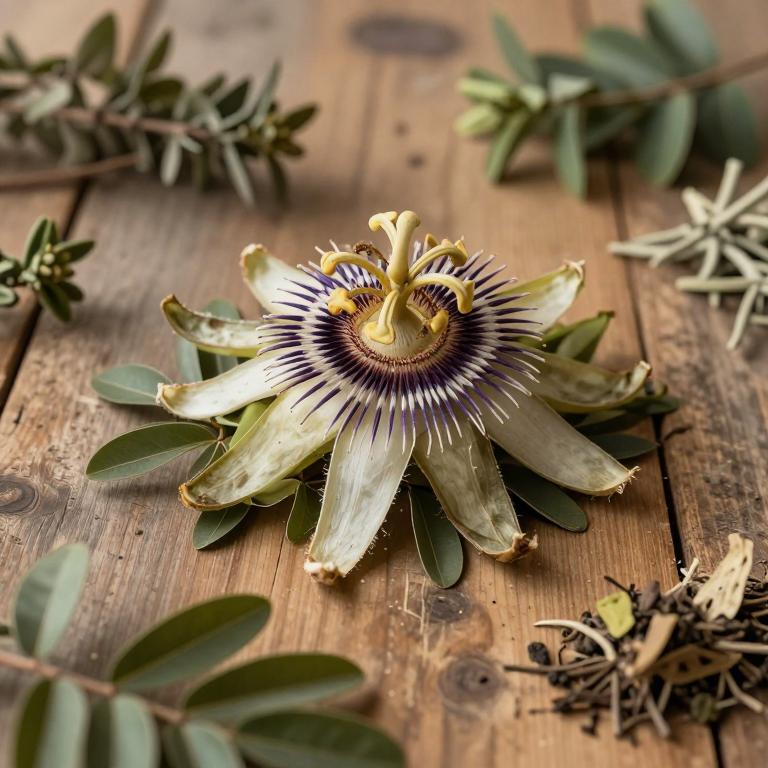
Blue sweet calabash, scientifically known as Passiflora morifolia, is a captivating climbing vine native to tropical regions. Renowned for its striking, intricate flowers and nutritious fruit, this plant holds significant ethnobotanical value. It is widely utilized in traditional medicine for its soothing properties and diverse therapeutic potential.
- Family
- Passifloraceae
- Native range
- Africa
- Parts used
- Not available
- Common names
- Blue Sweet Calabash
- Scientific synonyms
- Passiflora Weberiana · Passiflora Warmingii · 4 more
Names and Synonyms
Common Names
- Blue sweet calabash
Scientific Names
Accepted name
Passiflora morifoliaSynonyms
- Passiflora weberiana
- Passiflora warmingii
- Passiflora erosa
- Passiflora dumetosa
- Passiflora heydei
- Passiflora warmingii subsp. chacoensis
Regional and Traditional Names
Spanish:
- Pasionaria morada
German:
- Maulbeerblättrige Passionsblume
- Maulbeerbaumblättrige Passionsblume
- Maulbeerbaumblättrige Passionsblume
- Maulbeerblättrige Passionsblume
Sources: Wikidata, Catalogue of Life
Taxonomical Classification
This plant belongs to the kingdom Plantae and is classified under the phylum Streptophyta and class Equisetopsida. Within the subclass Magnoliidae and order Malpighiales, it is a member of the family Passifloraceae. Specifically, its taxonomic identity is defined by its placement within the genus Passiflora.
| Rank | Classification |
|---|---|
| Kingdom | Plantae |
| Phylum | Streptophyta |
| Class | Equisetopsida |
| Subclass | Magnoliidae |
| Order | Malpighiales |
| Family | Passifloraceae |
| Genus | Passiflora |
Sources: The World Checklist of Vascular Plants (WCVP)
Distribution
This plant exhibits a wide and diverse geographical distribution across several continents. In the Macaronesian region, it can be found specifically within the Canary Islands. Its presence extends to South Tropical Africa, where it inhabits areas such as Zimbabwe. In Western Asia, the species is documented in Palestine, while in China, it is located in the South-Central region. Finally, the plant is also distributed throughout the Southwest of Mexico.
| Region | Area |
|---|---|
| Macaronesia | Canary Is. |
| South Tropical Africa | Zimbabwe |
| Western Asia | Palestine |
| China | China South-Central |
| Mexico | Mexico Southwest |
| Mexico | Mexico Southeast |
| Central America | Guatemala |
| Northern South America | Venezuela |
| Western South America | Bolivia |
| Western South America | Colombia |
Sources: The World Checklist of Vascular Plants (WCVP)
Botanical Identification
Ecology
The ecology of Passiflora morifolia is characterized by its broad adaptability across diverse landscapes, ranging from sea level up to an elevation of 3000 m AMSL. This species demonstrates significant ecological plasticity, occupying a variety of distinct biomes and environmental settings, including the Cerrado (latu sensu), Atlantic Forest (Floresta Ciliar), and Seasonal Semi-deciduous Forest (Floresta Estacional Semi-decidual). Furthermore, it is capable of thriving in anthropic areas (Área Antrópica), indicating a resilience to human-modified environments and a capacity to colonize disturbed habitats alongside more stable natural ecosystems.
- Elevational range max:
- 3000 m AMSL
- Elevational range min:
- 0 m AMSL
- Habitat :
- Área Antrópica, Cerrado (lato sensu), Floresta Ciliar ou Galeria, Floresta Estacional Semidecidual
Life history
The life history of Passiflora morifolia is characterized by its status as a perennial plant, allowing it to persist through multiple growing seasons rather than completing its cycle within a single year. As a perennial species, it establishes a robust root system that supports continuous growth and seasonal regeneration, enabling the plant to survive varying environmental conditions over a long lifespan. Throughout its life cycle, it undergoes phases of vegetative expansion where climbing vines extend through foliage, followed by reproductive stages where it produces its distinctive flowers and subsequent fruit. This perennial nature ensures that the plant can re-emerge and continue its biological processes annually, provided it maintains access to necessary nutrients and favorable climatic stability.
- Lifecycle :
- perennial
Morphology
The morphology of Passiflora morifolia is characterized by its growth form as a non-woody herb and a climbing forb. It functions as an obligatory climber, utilizing a vine growth habit to ascend structures for support. As a terrestrial plant, it is neither aquatic nor an epiphyte, maintaining an independent life cycle without parasitic dependencies. The plant's structure is primarily defined by its herbaceous, non-woody stems that allow it to navigate its environment as a sprawling or climbing liana-like vine.
- Aquatic :
- terrestrial
- Climber :
- vine
- Climber :
- obligatory
- Epiphyte :
- terrestrial
- Growth form :
- herb
- Growth form :
- forb
- Parasite :
- independent
- Woodiness :
- non-woody
Physiology
The physiological development of Passiflora morifolia is characterized by distinct morphological parameters, particularly regarding its foliar structure which plays a critical role in its photosynthetic efficiency and transpiration processes. The leaves exhibit significant variability in size, a factor that influences the plant's metabolic rate and surface area for gas exchange. Specifically, the leaf length within this species ranges from a minimum of 4 cm to a maximum of 12 cm. This variation in leaf dimensions suggests a physiological adaptability to varying light intensities and moisture availability in its environment, allowing the plant to optimize its carbon assimilation and resource management across different stages of growth or microclimatic conditions.
- Leaf length max:
- 12 cm
- Leaf length min:
- 4 cm
Reproduction
The reproduction of Passiflora morifolia is characterized by the development of a fruit type classified as a berry, which contains the seeds necessary for the continuation of the species. This fruit is indehiscent, meaning it does not spontaneously split open at maturity to release its contents, instead requiring external agents or decomposition to expose the seeds.
- Dehiscence :
- indehiscent
- Fruit type :
- berry
Sources: Global Inventory of Floras and Traits (GIFT)
Chemicals
Passiflora morifolia has 3 reported phytochemicals identified across 0 scientific publications and several other databases. The most consistently reported chemicals include Epilotaustralin, LINAMARIN, Lotaustralin.
| Chemical | Supporting sources | Consensus |
|---|---|---|
| Epilotaustralin | 1 supporting sources | ★☆☆☆☆ |
| LINAMARIN | 1 supporting sources | ★☆☆☆☆ |
| Lotaustralin | 1 supporting sources | ★☆☆☆☆ |
Epilotaustralin
- Phytochemistry
LINAMARIN
- Phytochemistry
Lotaustralin
- Phytochemistry