Passiflora apetala
Passiflora apetala · Accepted scientific name
Scientific literature: Very Sparse (7 studies) · ★☆☆☆☆
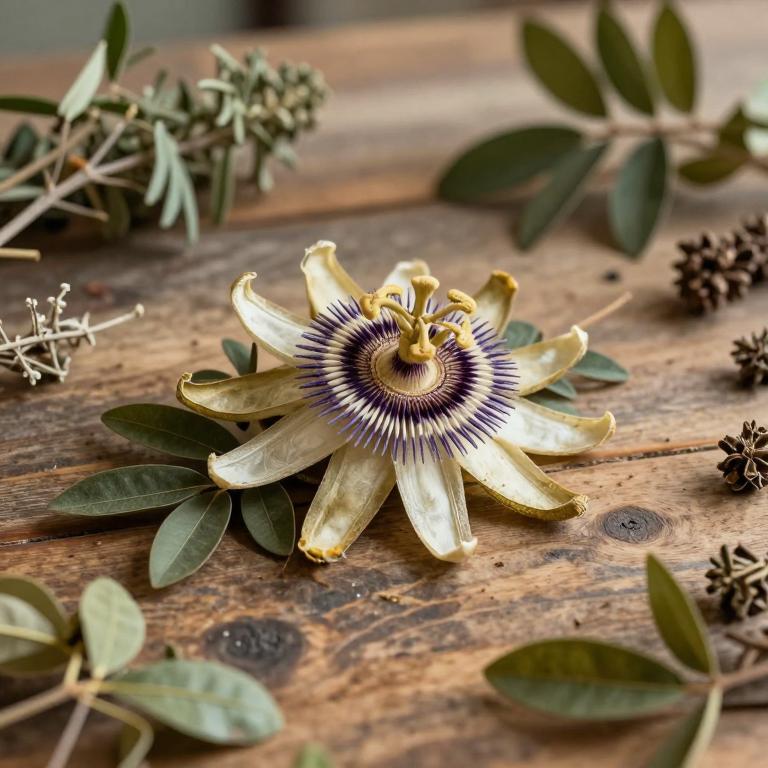
Passiflora apetala, scientifically known as Passiflora apetala, is a climbing vine native to tropical regions, celebrated for its striking, intricate blooms. Renowned in traditional medicine, this species offers diverse therapeutic potential, often utilized for its calming properties and antioxidant benefits, making it a fascinating subject in ethnobotanical studies.
- Family
- Passifloraceae
- Native range
- Northern America
- Parts used
- Not available
- Common names
- Not available
- Scientific synonyms
- Not available
Names and Synonyms
Scientific Names
Accepted name
Passiflora apetalaSources: Wikidata
Taxonomical Classification
This plant belongs to the kingdom Plantae and the phylum Streptophyta, falling under the class Equisetopsida and subclass Magnoliidae. Within the order Malpighiales, it is classified under the family Passifloraceae and the genus Passiflora. As a member of the Passiflora genus, Passiflora apetala represents a specific lineage of medicinal flora.
| Rank | Classification |
|---|---|
| Kingdom | Plantae |
| Phylum | Streptophyta |
| Class | Equisetopsida |
| Subclass | Magnoliidae |
| Order | Malpighiales |
| Family | Passifloraceae |
| Genus | Passiflora |
Sources: The World Checklist of Vascular Plants (WCVP)
Distribution
This plant exhibits a specific geographical distribution concentrated within the tropical regions of North and Central America. In the north, its presence is documented throughout Southeast Mexico. Moving southward into Central America, the species can be found inhabiting the landscapes of Honduras. It also extends its range into the lush environments of Costa Rica. Finally, its distribution reaches as far south as Panamá.
| Region | Area |
|---|---|
| Mexico | Mexico Southeast |
| Central America | Costa Rica |
| Central America | Honduras |
| Central America | Panamá |
Sources: The World Checklist of Vascular Plants (WCVP)
Botanical Identification
Ecology
The ecology of Passiflora apetala is characterized by its specific distribution within montane environments, where it thrives within a defined altitudinal corridor. This species is primarily found in mid-to-high elevation habitats, occupying a niche that ranges from a minimum of 1000 m AMSL to a maximum of 2000 m AMSL. Within this vertical gradient, the plant adapts to the varying temperature regimes and moisture availability typical of these elevations, playing a role in the complex structural dynamics of its local ecosystem.
- Elevational range max:
- 2000 m AMSL
- Elevational range min:
- 1000 m AMSL
Morphology
The morphology of Passiflora apetala is characterized by its growth habit as a non-woody, liana-type climber that functions as an obligatory climber to ascend towards light sources. Rather than being an epiphyte or a parasite, this species is an independent, terrestrial plant that establishes itself firmly in soil environments, avoiding aquatic or semiaquatic habitats. As a liana, it utilizes specialized structures to navigate its surroundings, relying on external support to extend its reach while maintaining a non-woody stem architecture.
- Aquatic :
- terrestrial
- Climber :
- liana
- Climber :
- obligatory
- Epiphyte :
- terrestrial
- Parasite :
- independent
- Woodiness :
- non-woody
Sources: Global Inventory of Floras and Traits (GIFT)
Chemicals
Passiflora apetala has 7 reported phytochemicals identified across 0 scientific publications and several other databases. The most consistently reported chemicals include Deidaclin, Epivolkenin, Passibiflorin, Taraktophyllin, Tetraphyllin A.
| Chemical | Supporting sources | Consensus |
|---|---|---|
| Deidaclin | 1 supporting sources | ★☆☆☆☆ |
| Epivolkenin | 1 supporting sources | ★☆☆☆☆ |
| Passibiflorin | 1 supporting sources | ★☆☆☆☆ |
| Taraktophyllin | 1 supporting sources | ★☆☆☆☆ |
| Tetraphyllin A | 1 supporting sources | ★☆☆☆☆ |
| Tetraphyllin B | 1 supporting sources | ★☆☆☆☆ |
| Volkenin | 1 supporting sources | ★☆☆☆☆ |
Deidaclin
- Phytochemistry
Epivolkenin
- Phytochemistry
Passibiflorin
- Phytochemistry
Taraktophyllin
- Phytochemistry
Tetraphyllin A
- Phytochemistry
Tetraphyllin B
- Phytochemistry
Volkenin
- Phytochemistry