fragrant granadilla
Passiflora alata · Accepted scientific name
Scientific literature: Very Sparse (24 studies) · ★☆☆☆☆
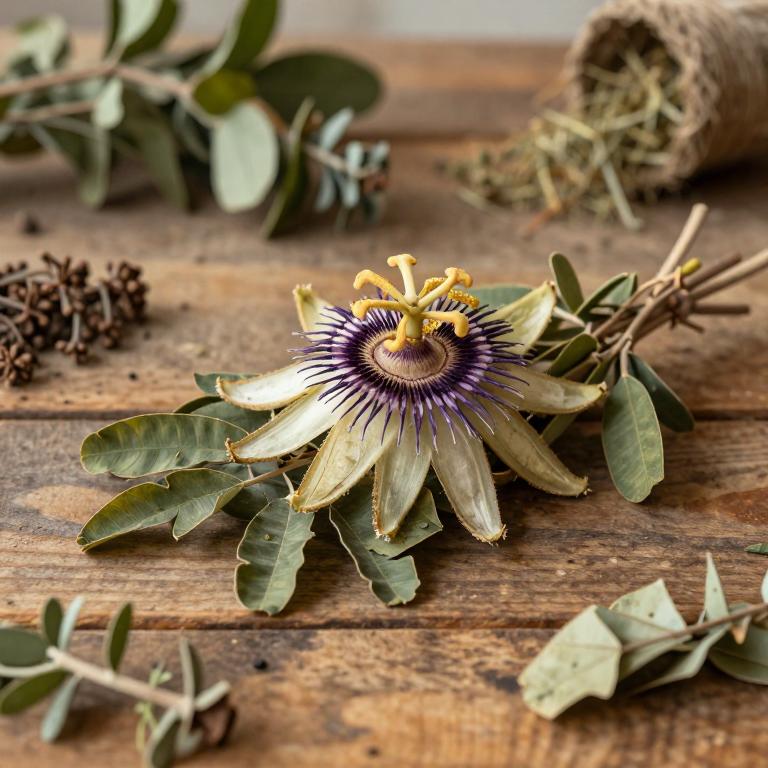
Fragrant granadilla, scientifically known as Passiflora alata, is a stunning climbing vine celebrated for its aromatic, edible fruit and vibrant blooms. Native to tropical regions, this medicinal plant offers therapeutic benefits, including calming properties, making it a valuable botanical treasure in traditional healing and contemporary holistic wellness practices.
- Family
- Passifloraceae
- Native range
- Africa
- Parts used
- Leaf
- Common names
- Fragrant Granadilla · Wingstem Passionflower
- Scientific synonyms
- Passiflora Brasiliana · Passiflora Bicolorata · 16 more
Names and Synonyms
Common Names
- fragrant granadilla
- wingstem passionflower
Scientific Names
Accepted name
Passiflora alataSynonyms
- Passiflora brasiliana
- Passiflora bicolorata
- Passiflora mascarensis
- Passiflora mauritiana
- Passiflora latifolia
- Passiflora alata var. insignis
- Passiflora alata var. mauritiana
- Passiflora alata var. pedunculata
- Passiflora alata var. latifolia
- Passiflora angulata
- Granadilla mauritiana
- Granadilla alata
- Passiflora sarcosepala
- Passiflora alata var. brasiliana
- Passiflora alata var. acuminata
- Passiflora tetradena
- Passiflora pyriformis
- Passiflora oviformis
Regional and Traditional Names
Spanish:
- pasionaria
Sources: Wikidata, Catalogue of Life
Taxonomical Classification
This plant, Passiflora alata, belongs to the kingdom Plantae within the phylum Streptophyta and the class Equisetopsida. It is further classified under the subclass Magnoliidae and the order Malpighiales. Finally, it is a member of the family Passifloraceae and is situated within the genus Passiflora.
| Rank | Classification |
|---|---|
| Kingdom | Plantae |
| Phylum | Streptophyta |
| Class | Equisetopsida |
| Subclass | Magnoliidae |
| Order | Malpighiales |
| Family | Passifloraceae |
| Genus | Passiflora |
Sources: The World Checklist of Vascular Plants (WCVP)
Distribution
This plant exhibits a broad geographical distribution spanning across several distinct regions. In the Western Indian Ocean, it can be found growing in Mauritius and Réunion. Its presence extends significantly into Mexico, specifically within the Southwest and Southeast areas of the country. Additionally, the species is located within Central America, specifically in Costa Rica. Together, these locations highlight the diverse environmental range inhabited by Passiflora alatata.
| Region | Area |
|---|---|
| Western Indian Ocean | Mauritius |
| Western Indian Ocean | Réunion |
| Mexico | Mexico Southwest |
| Mexico | Mexico Southeast |
| Central America | Costa Rica |
| Northern South America | French Guiana |
| Western South America | Ecuador |
| Western South America | Peru |
| Brazil | Brazil West-Central |
| Brazil | Brazil Northeast |
Sources: The World Checklist of Vascular Plants (WCVP)
Botanical Identification
Ecology
The ecology of Passiflora alata is characterized by its presence across a diverse array of environments, ranging from anthropogenic areas (Área Antrópica) to specialized ecosystems such as Campo Rupestre, Restinga, and Ombrophilous Forests (Floresta Ombrófila/Floresta Pluvial). This plant exhibits a broad altitudinal distribution, occupying a vast vertical gradient that begins at sea level (0 m AMSL) and extends up to a maximum elevation of 1600 m AMSL. This wide elevational range, coupled with its ability to thrive in both disturbed human-influenced habitats and more stable, high-moisture forest or coastal scrub settings, indicates a high degree of ecological plasticity.
- Elevational range max:
- 1600 m AMSL
- Elevational range min:
- 0 m AMSL
- Habitat :
- Área Antrópica, Campo Rupestre, Floresta Ombrófila (= Floresta Pluvial), Restinga
Life history
The life history of Passiflora alata is characterized by its nature as a perennial plant, allowing it to persist through multiple growing seasons rather than completing its cycle in a single year. Throughout its existence, the species maintains an evergreen habit, ensuring that its foliage remains functional and green year-round without undergoing a seasonal shedding period. This combination of longevity and continuous leaf retention enables the plant to establish a stable presence in its habitat, providing a consistent vegetative structure that supports its long-term reproductive cycles.
- Deciduousness :
- evergreen
- Lifecycle :
- perennial
Morphology
The morphology of Passiflora alatata is characterized by its growth habit as a non-woody liana, functioning as an obligatory climber that relies on external structures for support. It is a terrestrial species, rather than aquatic or epiphytic, maintaining an independent existence without parasitism. Its structural development is defined by its climbing nature, utilizing specialized tendrils to ascend through its environment, while remaining fundamentally a non-woody, terrestrial plant.
- Aquatic :
- terrestrial
- Climber :
- liana
- Climber :
- obligatory
- Epiphyte :
- terrestrial
- Parasite :
- independent
- Woodiness :
- non-woody
Physiology
The physiology of Passiflora alata is characterized by complex metabolic processes geared toward rapid vegetative growth and reproductive success in tropical and subtropical environments. As a climbing vine, its physiological development is heavily reliant on thigmotropism, where specialized tendrils respond to mechanical stimuli to facilitate upward movement toward light sources. Photosynthetic activity is driven by its broad, deeply lobed leaves, which optimize light interception and gas exchange through regulated stomatal conductance. Regarding its nutrient acquisition and symbiotic relationships, Passiflora alata is not a nitrogen fixer; it lacks the specialized root nodules and the symbiotic association with diazotrophic bacteria (such as Rhizobium) required to convert atmospheric nitrogen into bioavailable forms. Consequently, its nitrogen metabolism is entirely dependent on the uptake of nitrates and ammonium from the soil through its extensive root system. The plant also exhibits specialized secondary metabolism, synthesizing various alkaloids, cyanogenic glycosides, and flavonoids that serve as physiological defense mechanisms against herbivory and environmental stressors.
- Nitrogen fixer :
- no
Sources: Global Inventory of Floras and Traits (GIFT)
Plant Parts
Passiflora alata has 1 reported plant parts identified across 2 scientific publications and several other databases that are studied for medicinal purposes. The most consistently reported plant part include leaf.
| Plant part | Supporting sources | Consensus |
|---|---|---|
| Leaf | 2 supporting sources | ★☆☆☆☆ |
Leaf
- Phytotherapy research : PTR
- Phytochemical analysis : PCA
Chemicals
Passiflora alata has 8 reported phytochemicals identified across 2 scientific publications and several other databases. The most consistently reported chemicals include Flavonoids, Isovitexin, Vitexin, Isoorientin, Oleanolic acid 3-sophoroside.
| Chemical | Supporting sources | Consensus |
|---|---|---|
| Flavonoids | 3 supporting sources | ★★☆☆☆ |
| Isovitexin | 2 supporting sources | ★☆☆☆☆ |
| Vitexin | 2 supporting sources | ★☆☆☆☆ |
| Isoorientin | 1 supporting sources | ★☆☆☆☆ |
| Oleanolic acid 3-sophoroside | 1 supporting sources | ★☆☆☆☆ |
| Orientin | 1 supporting sources | ★☆☆☆☆ |
| Phenols | 1 supporting sources | ★☆☆☆☆ |
| Quadranguloside | 1 supporting sources | ★☆☆☆☆ |
Flavonoids
- Journal of pharmaceutical and biomedical analysis
- Journal of the science of food and agriculture
- Journal of ethnopharmacology
Isovitexin
- Journal of pharmaceutical and biomedical analysis
- Phytochemical analysis : PCA
Vitexin
- Journal of pharmaceutical and biomedical analysis
- Phytochemical analysis : PCA
Isoorientin
- Phytochemical analysis : PCA
Oleanolic acid 3-sophoroside
- Food research international (Ottawa, Ont.)
Orientin
- Phytochemical analysis : PCA
Phenols
- Journal of the science of food and agriculture
Quadranguloside
- Food research international (Ottawa, Ont.)
Activities
Passiflora alata has 2 reported activities identified across 2 scientific publications and several other databases. The most consistently reported activities include Anxiolytic, Sedative.
| Activity | Supporting sources | Consensus |
|---|---|---|
| Anxiolytic | 1 supporting sources | ★☆☆☆☆ |
| Sedative | 1 supporting sources | ★☆☆☆☆ |
Anxiolytic
- Journal of the science of food and agriculture
Sedative
- Journal of ethnopharmacology
Conditions
Passiflora alata has 5 reported investigations on conditions identified across 2 scientific publications and several other databases. The most consistently reported conditions include antispasmodics, anxiety, anxiolytic, sedative, sedatives.
| Condition | Supporting sources | Consensus |
|---|---|---|
| Antispasmodics | 1 supporting sources | ★☆☆☆☆ |
| Anxiety | 1 supporting sources | ★☆☆☆☆ |
| Anxiolytic | 1 supporting sources | ★☆☆☆☆ |
| Sedative | 1 supporting sources | ★☆☆☆☆ |
| Sedatives | 1 supporting sources | ★☆☆☆☆ |
Antispasmodics
- Journal of pharmaceutical and biomedical analysis
Anxiety
- Journal of pharmaceutical and biomedical analysis
Anxiolytic
- Journal of the science of food and agriculture
Sedative
- Journal of ethnopharmacology
Sedatives
- Journal of pharmaceutical and biomedical analysis
Preparations
Passiflora alata has 6 reported preparations identified across 2 scientific publications and several other databases. The most consistently reported preparations include extracts, Passiflora alata leaf extracts, aqueous extract, aqueous spray-dried extract, hydroethanol extracts.
| Preparation | Supporting sources | Consensus |
|---|---|---|
| Extracts | 3 supporting sources | ★★☆☆☆ |
| Passiflora alata leaf extracts | 1 supporting sources | ★☆☆☆☆ |
| Aqueous extract | 1 supporting sources | ★☆☆☆☆ |
| Aqueous spray-dried extract | 1 supporting sources | ★☆☆☆☆ |
| Hydroethanol extracts | 1 supporting sources | ★☆☆☆☆ |
| Raw material for anxiolytic phytotherapeutic agents | 1 supporting sources | ★☆☆☆☆ |
Extracts
- Journal of pharmaceutical and biomedical analysis
- Phytochemical analysis : PCA
- Talanta
Passiflora alata leaf extracts
- Phytochemical analysis : PCA
Aqueous extract
- Journal of ethnopharmacology
Aqueous spray-dried extract
- Journal of ethnopharmacology
Hydroethanol extracts
- Phytotherapy research : PTR
Raw material for anxiolytic phytotherapeutic agents
- Journal of the science of food and agriculture