Virginia creeper
Parthenocissus quinquefolia · Accepted scientific name
Scientific literature: Sparse (71 studies) · ★★☆☆☆
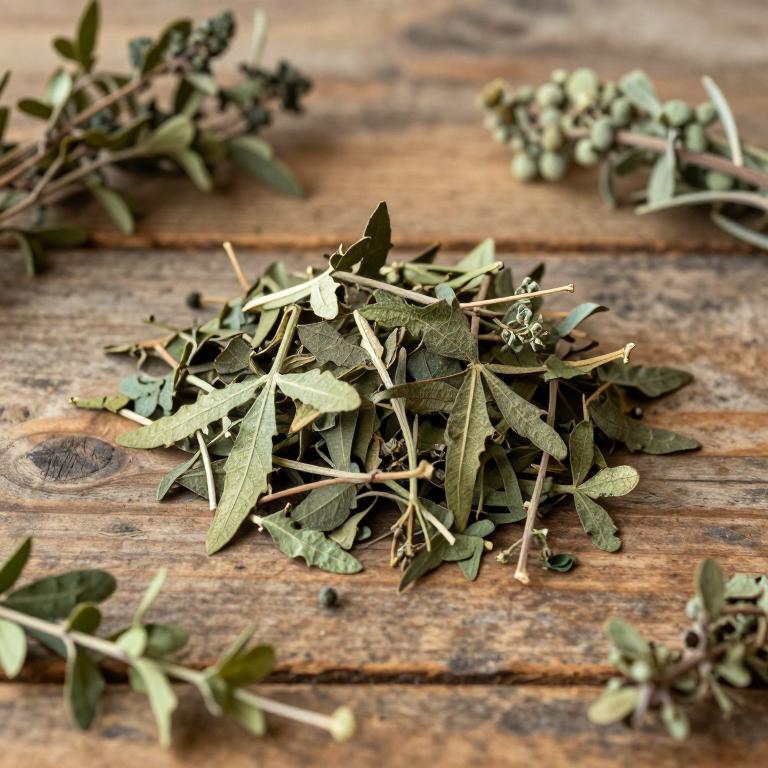
Virginia creeper, scientifically known as Parthenocissus quinquefolia, is a versatile deciduous vine renowned for its striking foliage. Beyond its ornamental beauty, this plant holds significant place in traditional medicine. Often used to treat skin conditions and inflammation, it offers fascinating ethnobotanical properties that continue to intrigue modern herbalists.
Names and Synonyms
Common Names
- American ivy
- Virginia creeper
- five-leaved Virginia creeper
- five-leaved ivy
- Virginia-Creeper
- American-ivy
- five-leaf-ivy
- woodbine
Scientific Names
Accepted name
Parthenocissus quinquefoliaSynonyms
- Parthenocissus quinquefolia f. minor
- Parthenocissus quinquefolia f. engelmannii
- Parthenocissus graebneri
- Parthenocissus quinquefolia var. minor
- Parthenocissus spaethii
- Parthenocissus radicantissima var. minor
- Parthenocissus quinquefolia var. hirsuta
- Parthenocissus radicantissima
- Parthenocissus quinquefolia f. hirsuta
- Vitis inserta var. hirsuta
- Parthenocissus saint-paulii
- Quinaria quinquefolia
- Quinaria radicantissima
- Parthenocissus dumetorum
- Psedera hirsuta
- Quinaria hirsuta
- Psedera quinquefolia
- Cissus pubescens
- Parthenocissus engelmannii
- Cissus quinquefolia
- Ampelopsis hirsuta
- Ampelopsis graebneri
- Ampelopsis hederacea
- Ampelopsis hederacea var. dumetorum
- Ampelopsis hederacea var. minor
- Ampelopsis hederacea var. murorum
- Ampelopsis latifolia
- Ampelopsis muralis
- Ampelopsis pubescens
- Ampelopsis quinquefolia
- Ampelopsis quinquefolia var. angustifolia
- Ampelopsis quinquefolia var. dumetorum
- Ampelopsis quinquefolia var. graebneri
- Ampelopsis quinquefolia var. heptaphylla
- Ampelopsis quinquefolia var. hirsuta
- Ampelopsis quinquefolia var. laciniata
- Ampelopsis quinquefolia var. latifolia
- Ampelopsis quinquefolia var. murorum
- Ampelopsis quinquefolia var. pubescens
- Ampelopsis quinquefolia var. radicantissima
- Ampelopsis quinquefolia var. spaethii
- Ampelopsis radicantissima
- Ampelopsis radicantissima var. graebneri
- Ampelopsis radicantissima var. saint-paulii
- Ampelopsis roylei
- Ampelocissus tricolor
- Ampelopsis engelmannii
- Ampelocissus cirrhata
- Ampelocissus major
- Ampelocissus serrata
- Ampelopsis saint-paulii
- Ampelopsis virginiana
- Parthenocissus pubescens
- Parthenocissus muralis
- Psedera quinquefolia var. murorum
- Psedera quinquefolia var. minor
- Psedera quinquefolia var. hirsuta
- Vitis quinquefolia
- Vitis pubescens
- Vitis quinquefolia var. hirsuta
- Parthenocissus hirsuta
- Parthenocissus quinquefolia var. saint-paulii
- Parthenocissus quinquefolia var. murorum
- Ampelopsis radicantissima var. engelmannii
- Ampelopsis radicantissima f. minor
- Parthenocissus hederacea
- Vitis hederacea
- Cissus hederacea var. hirsuta
- Parthenocissus dumetorum var. laciniata
- Parthenocissus muralis var. minor
- Hedera carnosa
- Hedera quinquefolia
Regional and Traditional Names
Spanish:
- Parthenocissus engelmannii
- Ampelopsis quinquefolia
- Hedera quinquefolia
- Quinaria hederacea
- Parthenocissus quinquefolia fo. engelmannii
- Vitis quinquefolia
- Psedera quinquefolia
- Parra virgen
- enredadera de Virginia
German:
- Selbstkletternde Jungfernrebe
- Fünfblättrige Jungfernrebe
- vigne vierge vraie
- gewöhnliche Jungfernrebe
- wilder Wein
- Haftender Wilder Wein
- Fuenffingerige Jungfernrebe
- Selbstkletternde Jungfernrebe
French:
- Vigne vierge vraie
- Vigne vierge de virginie
- Vigne-vierge à cinq folioles
- vigne vierge à cinq folioles
- ampélopside vigne-vierge
- parthénocisse à cinq folioles
- vigne grimpante
- vigne vierge
- vigne vierge à cinq folioles
- vigne-vierge grimpante
- vigne vierge vraie
- Vigne vierge a cinq folioles
- Vigne vierge de Virginie
- Vigne-vierge commune
Sources: Wikidata, Catalogue of Life
Taxonomical Classification
This plant belongs to the kingdom Plantae and is classified under the phylum Streptophyta within the class Equisetopsida. Following the subclass Magnoliidae, it falls under the order Vitales and the family Vitaceae. Finally, it is identified by its specific genus, Parthenocissus.
| Rank | Classification |
|---|---|
| Kingdom | Plantae |
| Phylum | Streptophyta |
| Class | Equisetopsida |
| Subclass | Magnoliidae |
| Order | Vitales |
| Family | Vitaceae |
| Genus | Parthenocissus |
Sources: The World Checklist of Vascular Plants (WCVP)
Distribution
This plant exhibits a broad presence across several regions within the European continent. In Northern Europe, its distribution includes the territories of Great Britain and Ireland. Moving toward Middle Europe, the species can be found growing in Austria. It also maintains a consistent presence throughout the Czechia-Slovakia region. Finally, the plant is widely distributed within the borders of Germany.
| Region | Area |
|---|---|
| Northern Europe | Great Britain |
| Northern Europe | Ireland |
| Middle Europe | Austria |
| Middle Europe | Czechia-Slovakia |
| Middle Europe | Germany |
| Middle Europe | Hungary |
| Middle Europe | Netherlands |
| Middle Europe | Switzerland |
| Southeastern Europe | Albania |
| Southeastern Europe | Bulgaria |
Sources: The World Checklist of Vascular Plants (WCVP)
Botanical Identification
Ecology
The ecology of Parthenocissus quinquefolia is characterized by its preference for forest environments, where it thrives as a climbing woody vine within the complex structure of the woodland canopy. This species occupies a broad altitudinal gradient, ranging from sea level up to a maximum elevation of 500 m AMSL. Within these forested habitats, it utilizes its climbing capabilities to access light and nutrients, contributing to the structural diversity of its ecosystem.
- Elevational range max:
- 500 m AMSL
- Elevational range min:
- 0 m AMSL
- Habitat :
- forest
Life history
The life history of Parthenocissus quinquefolia is characterized by its existence as a perennial organism, allowing it to persist through multiple growing seasons. It is classified as a phanerophyte, a life form that maintains its buds above the ground level, enabling it to thrive as a climbing woody vine. This species exhibits a deciduous nature, shedding its foliage annually in response to seasonal changes.
- Deciduousness :
- deciduous
- Life form :
- phanerophyte
- Lifecycle :
- perennial
Morphology
The morphology of Parthenocissus quinquefolia is characterized by its robust, woody growth form, typically manifesting as a shrub or a large liana. As an obligatory climber, this plant relies on its climbing structures to ascend, often reaching significant heights; while the mean height is approximately 6.77 m, individual specimens can range from a minimum of 6 m to a maximum of 30 m. It is a terrestrial species, functioning as an independent organism rather than a parasite or an epiphyte. Its structural development is defined by its woodiness, providing the necessary strength to support its extensive liana-like habit as it scales various environments.
- Aquatic :
- terrestrial
- Climber :
- liana
- Climber :
- obligatory
- Epiphyte :
- terrestrial
- Growth form :
- shrub
- Parasite :
- independent
- Plant height max:
- 30 m
- Plant height mean:
- 6.76666666666667 m
- Plant height min:
- 6 m
- Woodiness :
- woody
Physiology
The physiology of Parthenocissus quinquefolia is characterized by a C3 photosynthetic pathway, reflecting its metabolic strategy for carbon fixation. As a non-carnivorous species, it relies on traditional soil-based nutrient uptake rather than specialized insectivorous mechanisms. The leaf morphology exhibits significant variability, with leaf lengths ranging from a minimum of 2 cm to a maximum of 15 cm, yielding a mean leaf length of 10.25 cm. The width of the foliage is similarly diverse, spanning from 1 cm to a maximum of 9 cm, with a mean leaf width recorded at 4.75 cm. These dimensions contribute to a mean leaf size of 136.6225 cm², while the Specific Leaf Area (SLA) maintains a mean value of 198.35 cm²/g, indicating the structural density and resource allocation efficiency of its photosynthetic tissues.
- Carnivory :
- non-carnivorous
- Leaf length max:
- 15 cm
- Leaf length mean:
- 10.25 cm
- Leaf length min:
- 2 cm
- Leaf size mean:
- 136.6225 cm²
- Leaf width max:
- 9 cm
- Leaf width mean:
- 4.75 cm
- Leaf width min:
- 1 cm
- Photosynthetic pathway :
- C3
- Specific Leaf Area (SLA) mean:
- 198.35 cm²/g
Reproduction
The reproduction of Parthenocissus quinquefolia is characterized by a biotic pollination syndrome, specifically relying on insects to facilitate fertilization, as self-fertilization is noted to be absent. The flowering process typically begins in July and concludes in August, featuring inflorescences that range in length from a minimum of 0.08 m to a maximum of 0.2 m. Following successful pollination, the plant produces fleshy, indehiscent fruits classified as berries. These fruits generally measure between 1 cm and 1.2 cm in length and maintain a width ranging from approximately 0.88 cm to 1.2 cm. The seeds contained within these berries are relatively small, with a mean mass of approximately 0.02388541675 g (ranging from 0.017 g to 0.0333 g) and a consistent volume of 36 mm³. Dispersal is achieved through a zoochorous syndrome, where animals play a key role in spreading the seeds. Notably, asexual reproduction is absent in this species, making sexual reproduction via insect pollination and animal dispersal the primary drivers of its life cycle.
- Dehiscence :
- indehiscent
- Dispersal syndrome :
- zoochorous
- Flowering time :
- Jul
- Flowering time :
- Aug
- Fruit dryness :
- fleshy
- Fruit length max:
- 1.2 cm
- Fruit length mean:
- 1.1 cm
- Fruit length min:
- 1 cm
- Fruit type :
- berry
- Fruit width max:
- 1.2 cm
- Fruit width mean:
- 0.883333333333333 cm
- Fruit width min:
- 1 cm
- Inflorescence length max:
- 0.2 m
- Inflorescence length min:
- 0.08 m
- Pollination syndrome :
- insect
- Pollination syndrome :
- biotic
- Reproduction asexual :
- absent
- Seed mass max:
- 0.0333 g
- Seed mass mean:
- 0.02388541675 g
- Seed mass min:
- 0.017 g
- Seed volume max:
- 36 mm³
- Self fertilization :
- absent
Sources: Global Inventory of Floras and Traits (GIFT)
Chemicals
Parthenocissus quinquefolia has 13 reported phytochemicals identified across 0 scientific publications and several other databases. The most consistently reported chemicals include ANTHOCYANIN, Anthocyanidin, Calcium glycolate, Calcium tartrate, Leucoanthocyanidin.
| Chemical | Supporting sources | Consensus |
|---|---|---|
| ANTHOCYANIN | 1 supporting sources | ★☆☆☆☆ |
| Anthocyanidin | 1 supporting sources | ★☆☆☆☆ |
| Calcium glycolate | 1 supporting sources | ★☆☆☆☆ |
| Calcium tartrate | 1 supporting sources | ★☆☆☆☆ |
| Leucoanthocyanidin | 1 supporting sources | ★☆☆☆☆ |
| POTASSIUM TARTRATE | 1 supporting sources | ★☆☆☆☆ |
| Sodium tartrate | 1 supporting sources | ★☆☆☆☆ |
| TANNIC ACID | 1 supporting sources | ★☆☆☆☆ |
| glycolic acid | 1 supporting sources | ★☆☆☆☆ |
| oxalic acid | 1 supporting sources | ★☆☆☆☆ |
ANTHOCYANIN
- Dr. Duke
Anthocyanidin
- Dr. Duke
Calcium glycolate
- Dr. Duke
Calcium tartrate
- Dr. Duke
Leucoanthocyanidin
- Dr. Duke
POTASSIUM TARTRATE
- Dr. Duke
Sodium tartrate
- Dr. Duke
TANNIC ACID
- Dr. Duke
glycolic acid
- Dr. Duke
oxalic acid
- Dr. Duke
Activities
Parthenocissus quinquefolia has 58 reported activities identified across 0 scientific publications and several other databases. The most consistently reported activities include Acaricide, Acidifier, Additive, Aldose-Reductase-Inhibitor, Allergenic.
| Activity | Supporting sources | Consensus |
|---|---|---|
| Acaricide | 1 supporting sources | ★☆☆☆☆ |
| Acidifier | 1 supporting sources | ★☆☆☆☆ |
| Additive | 1 supporting sources | ★☆☆☆☆ |
| Aldose-Reductase-Inhibitor | 1 supporting sources | ★☆☆☆☆ |
| Allergenic | 1 supporting sources | ★☆☆☆☆ |
| AntiHIV | 1 supporting sources | ★☆☆☆☆ |
| Antianacarditic | 1 supporting sources | ★☆☆☆☆ |
| Antibacterial | 1 supporting sources | ★☆☆☆☆ |
| Anticariogenic | 1 supporting sources | ★☆☆☆☆ |
| Anticolitic | 1 supporting sources | ★☆☆☆☆ |
Acaricide
- Dr. Duke
Acidifier
- Dr. Duke
Additive
- Dr. Duke
Aldose-Reductase-Inhibitor
- Dr. Duke
Allergenic
- Dr. Duke
AntiHIV
- Dr. Duke
Antianacarditic
- Dr. Duke
Antibacterial
- Dr. Duke
Anticariogenic
- Dr. Duke
Anticolitic
- Dr. Duke