desert grass
Panicum turgidum · Accepted scientific name
Scientific literature: Very Sparse (6 studies) · ★☆☆☆☆
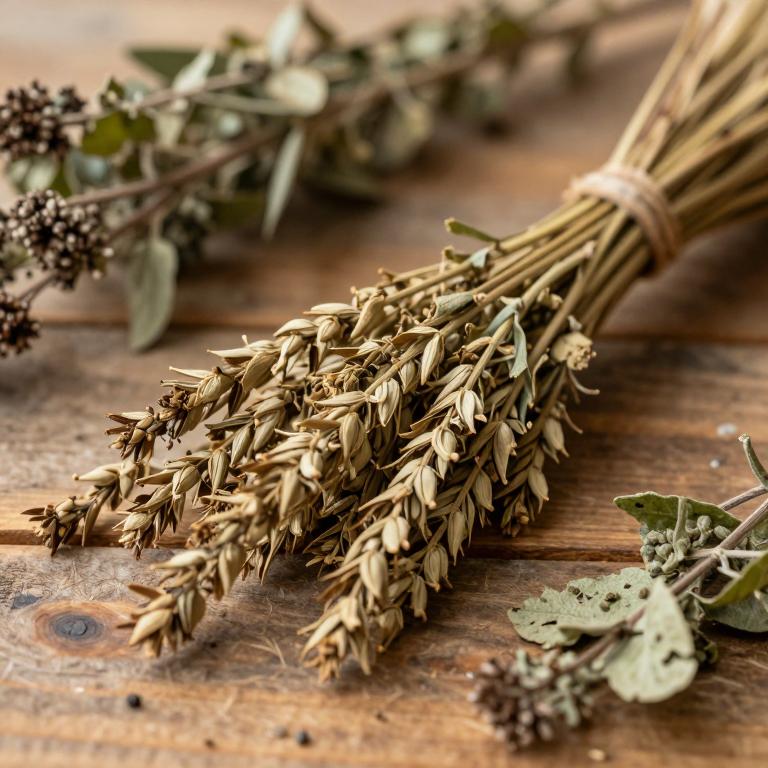
Desert grass, scientifically known as Panicum turgidum, is a resilient perennial herb native to arid regions. Renowned for its ability to thrive in harsh climates, this plant holds significant ethnobotanical value. It is frequently utilized in traditional medicine to treat various ailments, offering unique pharmacological potential for modern studies.
- Family
- Poaceae
- Native range
- Africa
- Parts used
- Not available
- Common names
- Desert Grass
- Scientific synonyms
- Panicum Neglectum · Panicum Nubicum · 2 more
Names and Synonyms
Common Names
- desert grass
Scientific Names
Accepted name
Panicum turgidumSynonyms
- Panicum neglectum
- Panicum nubicum
- Panicum notarisii
- Panicum frutescens
Sources: Wikidata, Catalogue of Life
Taxonomical Classification
This plant, known scientifically as Panicum turgidum, belongs to the kingdom Plantae and the phylum Streptophyta. Within the class Equisetopsida and subclass Magnoliidae, it is classified under the order Poales and the family Poaceae. Finally, its taxonomic hierarchy concludes within the genus Panicum.
| Rank | Classification |
|---|---|
| Kingdom | Plantae |
| Phylum | Streptophyta |
| Class | Equisetopsida |
| Subclass | Magnoliidae |
| Order | Poales |
| Family | Poaceae |
| Genus | Panicum |
Sources: The World Checklist of Vascular Plants (WCVP)
Distribution
This plant is widely distributed across several regions within Northern Africa. It can be found growing in the diverse landscapes of Algeria. Furthermore, its presence extends into the territories of Egypt and Libya. The species is also documented throughout the northern reaches of Morocco. Finally, it occupies significant geographical areas within Tunisia.
| Region | Area |
|---|---|
| Northern Africa | Algeria |
| Northern Africa | Egypt |
| Northern Africa | Libya |
| Northern Africa | Morocco |
| Northern Africa | Tunisia |
| Northern Africa | Western Sahara |
| West Tropical Africa | Benin |
| West Tropical Africa | Burkina |
| West Tropical Africa | Mali |
| West Tropical Africa | Mauritania |
Sources: The World Checklist of Vascular Plants (WCVP)
Botanical Identification
Ecology
The ecology of Panicum turgidum is fundamentally defined by its specialization within sand habitat environments, where it has adapted to survive in nutrient-poor and physically unstable substrates. This preference for sandy soils suggests a high tolerance for well-drained conditions and potentially periodic moisture fluctuations characteristic of coastal or arid sandy ecosystems. Within these specific niches, the plant plays a role in stabilizing shifting substrates and contributing to the organic matter cycle in otherwise sparse landscapes. Its physiological existence is closely tied to the unique chemical and structural properties of sand, which dictates its competitive interactions and survival strategies among other flora adapted to such xeric or littoral zones.
- Habitat :
- sand habitat
Life history
The life history of Panicum turgidum is characterized by a perennial lifecycle, allowing the plant to persist through multiple growing seasons. In terms of its biological structure and survival strategy, it functions as a cryptophyte, utilizing specialized underground or near-surface structures to endure unfavorable environmental conditions. More specifically, its growth habit is classified as a hemicryptophyte, meaning its perennating buds are located at the soil surface, protected by leaf litter or soil, which facilitates its long-term establishment and resilience within its ecological niche.
- Life form :
- hemicryptophyte
- Life form :
- cryptophyte
- Lifecycle :
- perennial
Morphology
The morphology of Panicum turgidum is characterized by a graminoid growth form, functioning as a non-woody herb. It is a self-supporting plant that does not exhibit climbing habits, such as lianas or vines, and it maintains an independent lifestyle rather than acting as a parasite. As a terrestrial species, it does not possess epiphytic or aquatic tendencies. In terms of stature, the plant typically reaches a mean height of 1.5 m, with a recorded maximum height of 1.2 m.
- Aquatic :
- terrestrial
- Climber :
- self-supporting
- Epiphyte :
- terrestrial
- Growth form :
- herb
- Growth form :
- graminoid
- Parasite :
- independent
- Plant height max:
- 1.2 m
- Plant height mean:
- 1.5 m
- Woodiness :
- non-woody
Physiology
The physiology of Panicum turgidum is characterized by a highly efficient metabolic framework, specifically utilizing the C4 photosynthetic pathway to optimize carbon fixation and water-use efficiency. This specialized pathway allows the plant to concentrate carbon dioxide around the enzyme Rubisco, minimizing photorespiration and enabling robust growth even under conditions of high light intensity and temperature. Furthermore, in terms of nutrient acquisition, Panicum turgidum does not function as a nitrogen fixer, meaning it lacks the symbiotic relationship with diazotrophic bacteria required to convert atmospheric nitrogen into bioavailable forms, and instead relies on the uptake of inorganic nitrogen from the soil.
- Nitrogen fixer :
- no
- Photosynthetic pathway :
- C4
Reproduction
The reproduction of Panicum turgidum is characterized by a specialized reproductive cycle and specific seed morphology. The flowering period typically occurs during the month of April, though the timing can be variable across different cycles. As an abiotic pollination strategy, the plant relies on wind as its primary pollination syndrome to facilitate the transfer of pollen. The resulting seeds are notably small, with a mean mass of 0.0017 g. These seeds exhibit a narrow range of weight variation, with a minimum mass of 0.0014 g and a maximum mass of 0.002 g.
- Flowering time :
- Apr
- Pollination syndrome :
- wind
- Pollination syndrome :
- abiotic
- Seed mass max:
- 0.002 g
- Seed mass mean:
- 0.0017 g
- Seed mass min:
- 0.0014 g
Sources: Global Inventory of Floras and Traits (GIFT)
Chemicals
Panicum turgidum has 1 reported phytochemicals identified across 0 scientific publications and several other databases. The most consistently reported chemicals include Flavonoids.
| Chemical | Supporting sources | Consensus |
|---|---|---|
| Flavonoids | 1 supporting sources | ★☆☆☆☆ |
Flavonoids
- Pharmacognosy magazine
Activities
Panicum turgidum has 1 reported activities identified across 0 scientific publications and several other databases. The most consistently reported activities include Antipyretic.
| Activity | Supporting sources | Consensus |
|---|---|---|
| Antipyretic | 1 supporting sources | ★☆☆☆☆ |
Antipyretic
- Pakistan journal of pharmaceutical sciences
Conditions
Panicum turgidum has 4 reported investigations on conditions identified across 0 scientific publications and several other databases. The most consistently reported conditions include dermatomycosis, mastitis, oxidative stress, respiratory infections.
| Condition | Supporting sources | Consensus |
|---|---|---|
| Dermatomycosis | 1 supporting sources | ★☆☆☆☆ |
| Mastitis | 1 supporting sources | ★☆☆☆☆ |
| Oxidative stress | 1 supporting sources | ★☆☆☆☆ |
| Respiratory infections | 1 supporting sources | ★☆☆☆☆ |
Dermatomycosis
- Journal of ethnobiology and ethnomedicine
Mastitis
- Journal of ethnobiology and ethnomedicine
Oxidative stress
- Pharmacognosy magazine
Respiratory infections
- Journal of ethnobiology and ethnomedicine
Preparations
Panicum turgidum has 3 reported preparations identified across 0 scientific publications and several other databases. The most consistently reported preparations include Ethanol extracts, P. turgidum crude extract, P. turgidum extract.
| Preparation | Supporting sources | Consensus |
|---|---|---|
| Ethanol extracts | 1 supporting sources | ★☆☆☆☆ |
| P. turgidum crude extract | 1 supporting sources | ★☆☆☆☆ |
| P. turgidum extract | 1 supporting sources | ★☆☆☆☆ |
Ethanol extracts
- Pakistan journal of pharmaceutical sciences
P. turgidum crude extract
- Pharmacognosy magazine
P. turgidum extract
- Pharmacognosy magazine