aerva
Ouret lanata · Accepted scientific name
Scientific literature: Very Sparse (36 studies) · ★☆☆☆☆
Aerva, scientifically known as Ouret lanaata, is a versatile medicinal herb renowned in traditional wellness practices. Often found in tropical regions, this resilient plant offers diverse therapeutic benefits, including anti-inflammatory and antioxidant properties. It serves as a vital natural remedy for various skin conditions and digestive health support.
- Family
- Amaranthaceae
- Native range
- Africa
- Parts used
- Leaf
- Common names
- Aerva
- Scientific synonyms
- Ouret Persica Var. Pubescens · Illecebrum Lanatum · 28 more
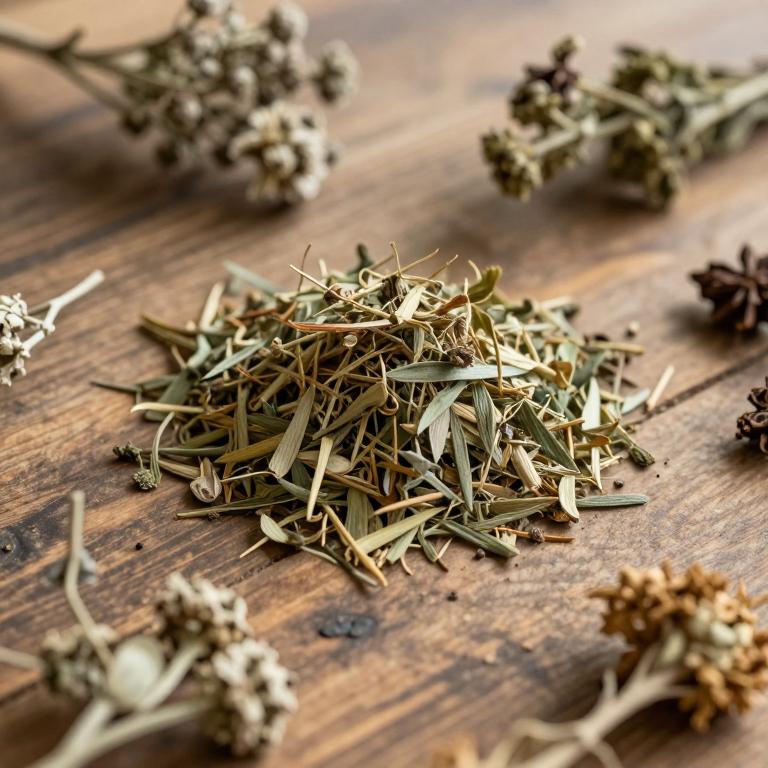
Names and Synonyms
Common Names
- aerva
Scientific Names
Accepted name
Ouret lanataSynonyms
- Ouret persica var. pubescens
- Illecebrum lanatum
- Aerva lanata var. robusta
- Aerva lanata var. viridis
- Aerva lanata var. steudneri
- Paronychia lanata
- Aerva lanata
- Aerva lanata var. orbicularis
- Amaranthus lanatus
- Aerva lanata var. elegans
- Alternanthera pubescens
- Amaranthus aeruoides
- Aerva lanata f. grandifolia
- Aerva lanata var. citrina
- Aerva elegans
- Aerva floribunda
- Aerva mozambicensis
- Aerva lanata f. microphylla
- Aerva lanata var. pseudojavanica
- Aerva lanata var. rhombea
- Aerva lanata f. squarrosa
- Aerva lanata var. suborbicularis
- Aerva tandalo
- Aerva sansibarica
- Aerva pubescens
- Aerva arachnoidea
- Achyranthes pubescens
- Aerva lanata var. rotundifolia
- Aerva lanata var. microstachys
- Aerva lanata var. floribunda
Sources: Wikidata, Catalogue of Life
Taxonomical Classification
This plant belongs to the kingdom Plantae and is classified within the phylum Streptophyta and the class Equisetopsida. Under the subclass Magnoliidae, it follows the order Caryophyllales and is a member of the family Amaranthaceae. Within this lineage, it is specifically categorized under the genus Ouret.
| Rank | Classification |
|---|---|
| Kingdom | Plantae |
| Phylum | Streptophyta |
| Class | Equisetopsida |
| Subclass | Magnoliidae |
| Order | Caryophyllales |
| Family | Amaranthaceae |
| Genus | Ouret |
Sources: The World Checklist of Vascular Plants (WCVP)
Distribution
This plant exhibits a diverse geographical distribution across the African continent. In Northern Africa, it can be specifically found within the borders of Egypt. Moving toward the West Tropical Africa region, the species is well-established in Benin and Burkina. Its presence continues through Ghana, where it remains a notable part of the local flora. Finally, the distribution extends further west to include the nation of Guinea.
| Region | Area |
|---|---|
| Northern Africa | Egypt |
| West Tropical Africa | Benin |
| West Tropical Africa | Burkina |
| West Tropical Africa | Ghana |
| West Tropical Africa | Guinea |
| West Tropical Africa | Ivory Coast |
| West Tropical Africa | Liberia |
| West Tropical Africa | Nigeria |
| West Tropical Africa | Sierra Leone |
| West Tropical Africa | Togo |
Sources: The World Checklist of Vascular Plants (WCVP)
Botanical Identification
Ecology
The ecology of Ouret lanaata is characterized by its broad adaptability across diverse environmental niches, ranging from cultivated and disturbed grounds to more stable natural environments such as woodland, bushland, and grassland. It frequently establishes itself at the transitional zones of ecosystems, specifically at swamp and forest edges where moisture levels and light availability vary. This plant displays a significant vertical distribution, occupying an elevational range that extends from as low as 60 m AMSL to a maximum altitude of 1097 m AMSL.
- Elevational range max:
- 1097 m AMSL
- Elevational range min:
- 60 m AMSL
- Habitat :
- from cultivated and disturbed ground to woodland, bushland and grassland, at swamp and forest edges
Life history
The life history of Ouret lanaata is characterized by its perennial lifecycle, allowing the plant to persist across multiple growing seasons rather than completing its cycle in a single year. In terms of its structural growth habit and survival strategy, the species is classified as a chamaephyte, a life form where the reproductive shoots are located close to the ground level, often protected by accumulated organic matter or leaf litter. This classification as a chamaephyte is consistent across both its morphological descriptions, defining its stature and positioning within its ecological niche.
- Life form :
- chamaephyte
- Lifecycle :
- perennial
Morphology
The morphology of Ouret lanaata is characterized by its growth form as a non-woody herb, exhibiting a self-supporting structure without the need for climbing. This terrestrial plant functions independently, neither acting as a parasite nor as an epiphyte. In terms of stature, it displays significant variability in height, ranging from a minimum of 0.1 m to a maximum of 2 m, with an average plant height of approximately 1.25 m.
- Aquatic :
- terrestrial
- Climber :
- self-supporting
- Epiphyte :
- terrestrial
- Growth form :
- herb
- Parasite :
- independent
- Plant height max:
- 2 m
- Plant height mean:
- 1.25 m
- Plant height min:
- 0.1 m
- Woodiness :
- non-woody
Physiology
The physiology of Ouret lanaata is characterized by a specialized carbon fixation strategy, utilizing the C4 photosynthetic pathway to enhance efficiency in environments where gas exchange and water conservation are critical. Unlike plants employing C3 or CAM pathways, this C4 mechanism allows for a more concentrated CO2 concentration around the enzyme Rubisco, thereby minimizing photorespiration and maximizing biomass production under high light intensities. Furthermore, regarding its nutrient acquisition capabilities, the plant does not function as a nitrogen fixer; it relies on the uptake of available nitrates and ammonium from the soil rather than engaging in symbiotic nitrogen fixation through specialized root nodules.
- Nitrogen fixer :
- no
- Photosynthetic pathway :
- C4
Reproduction
The reproduction of Ouret lanaata is characterized by the production of extremely minute seeds, reflecting a strategy focused on high dispersal potential through small particulate matter. Quantitative analysis of the seed characteristics reveals a highly specialized reproductive output, with a documented mean seed mass of 0.000146667 g. The variability within the seed population is relatively narrow, ranging from a minimum seed mass of 0.00012 g to a maximum seed mass of 0.00019 g. This low mass across the entire population suggests that the plant invests in large quantities of micro-seeds to ensure successful colonization of suitable habitats.
- Seed mass max:
- 0.00019 g
- Seed mass mean:
- 0.000146667 g
- Seed mass min:
- 0.00012 g
Sources: Global Inventory of Floras and Traits (GIFT)
Plant Parts
Ouret lanata has 1 reported plant parts identified across 1 scientific publications and several other databases that are studied for medicinal purposes. The most consistently reported plant part include leaf.
| Plant part | Supporting sources | Consensus |
|---|---|---|
| Leaf | 1 supporting sources | ★☆☆☆☆ |
Leaf
- Spectrochimica acta. Part A, Molecular and biomolecular spectroscopy
Chemicals
Ouret lanata has 15 reported phytochemicals identified across 1 scientific publications and several other databases. The most consistently reported chemicals include Betulin, Canthin-6-one, 10-hydroxycanthin-6-one, 10-methoxycanthin-6-one, AFLATOXIN B1.
| Chemical | Supporting sources | Consensus |
|---|---|---|
| Betulin | 2 supporting sources | ★☆☆☆☆ |
| Canthin-6-one | 2 supporting sources | ★☆☆☆☆ |
| 10-hydroxycanthin-6-one | 1 supporting sources | ★☆☆☆☆ |
| 10-methoxycanthin-6-one | 1 supporting sources | ★☆☆☆☆ |
| AFLATOXIN B1 | 1 supporting sources | ★☆☆☆☆ |
| AFLATOXINS | 1 supporting sources | ★☆☆☆☆ |
| BETA-SITOSTEROL | 1 supporting sources | ★☆☆☆☆ |
| IBA | 1 supporting sources | ★☆☆☆☆ |
| Indole-3-butyric acid | 1 supporting sources | ★☆☆☆☆ |
| NAA | 1 supporting sources | ★☆☆☆☆ |
Betulin
- Dr. Duke
- Journal of diabetes
Canthin-6-one
- Natural product research
- Planta medica
10-hydroxycanthin-6-one
- Natural product research
10-methoxycanthin-6-one
- Natural product research
AFLATOXIN B1
- Mycopathologia
AFLATOXINS
- Mycopathologia
BETA-SITOSTEROL
- Journal of diabetes
IBA
- TheScientificWorldJournal
Indole-3-butyric acid
- TheScientificWorldJournal
NAA
- TheScientificWorldJournal
Activities
Ouret lanata has 14 reported activities identified across 1 scientific publications and several other databases. The most consistently reported activities include Antitumor, AntiHIV, Anticarcinomic, Antifeedant, Antiflu.
| Activity | Supporting sources | Consensus |
|---|---|---|
| Antitumor | 2 supporting sources | ★☆☆☆☆ |
| AntiHIV | 1 supporting sources | ★☆☆☆☆ |
| Anticarcinomic | 1 supporting sources | ★☆☆☆☆ |
| Antifeedant | 1 supporting sources | ★☆☆☆☆ |
| Antiflu | 1 supporting sources | ★☆☆☆☆ |
| Antiglycation | 1 supporting sources | ★☆☆☆☆ |
| Antiinflammatory | 1 supporting sources | ★☆☆☆☆ |
| Antioxidant | 1 supporting sources | ★☆☆☆☆ |
| Antiviral | 1 supporting sources | ★☆☆☆☆ |
| Aphidifuge | 1 supporting sources | ★☆☆☆☆ |
Antitumor
- Dr. Duke
- Immunopharmacology and immunotoxicology
AntiHIV
- Dr. Duke
Anticarcinomic
- Dr. Duke
Antifeedant
- Dr. Duke
Antiflu
- Dr. Duke
Antiglycation
- Journal of diabetes
Antiinflammatory
- Dr. Duke
Antioxidant
- Journal of diabetes
Antiviral
- Dr. Duke
Aphidifuge
- Dr. Duke
Preparations
Ouret lanata has 15 reported preparations identified across 1 scientific publications and several other databases. The most consistently reported preparations include A. lanata extract, Whole aerial parts-EAE, acetone, aqueous extract, chloroform.
| Preparation | Supporting sources | Consensus |
|---|---|---|
| A. lanata extract | 1 supporting sources | ★☆☆☆☆ |
| Whole aerial parts-eae | 1 supporting sources | ★☆☆☆☆ |
| Acetone | 1 supporting sources | ★☆☆☆☆ |
| Aqueous extract | 1 supporting sources | ★☆☆☆☆ |
| Chloroform | 1 supporting sources | ★☆☆☆☆ |
| Ethanol | 1 supporting sources | ★☆☆☆☆ |
| Ethyl acetate | 1 supporting sources | ★☆☆☆☆ |
| Leaf extract | 1 supporting sources | ★☆☆☆☆ |
| Methanol | 1 supporting sources | ★☆☆☆☆ |
| Methanolic extract of flower | 1 supporting sources | ★☆☆☆☆ |
A. lanata extract
- Cureus
Whole aerial parts-eae
- Malaria journal
Acetone
- Saudi journal of biological sciences
Aqueous extract
- Journal of ethnopharmacology
Chloroform
- Saudi journal of biological sciences
Ethanol
- Saudi journal of biological sciences
Ethyl acetate
- Saudi journal of biological sciences
Leaf extract
- Spectrochimica acta. Part A, Molecular and biomolecular spectroscopy
Methanol
- Saudi journal of biological sciences
Methanolic extract of flower
- Asian Pacific journal of tropical biomedicine