Orchis purpurea
Orchis purpurea · Accepted scientific name
Scientific literature: Very Sparse (4 studies) · ★☆☆☆☆
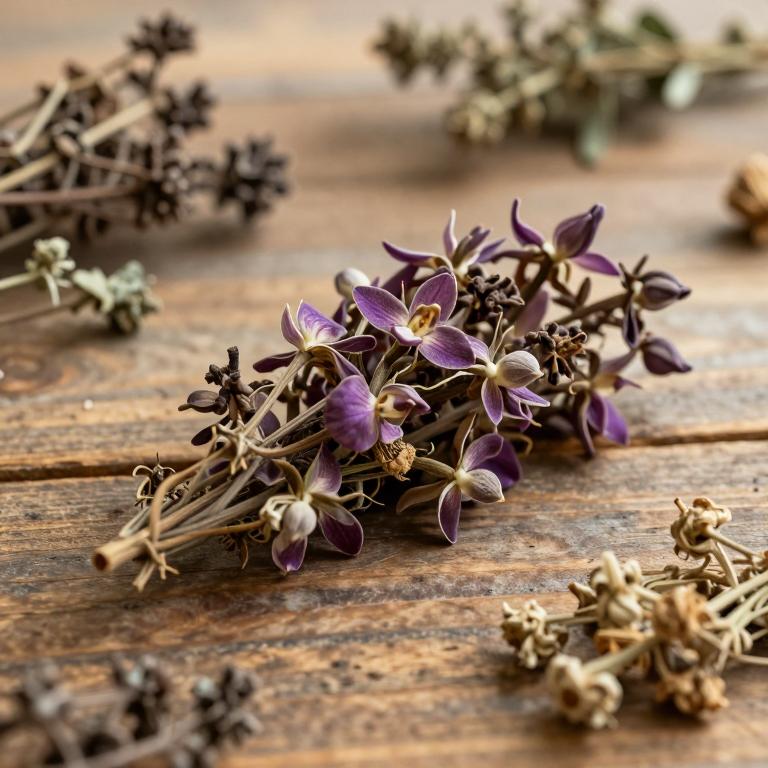
Orchis purpurea, scientifically known as Orchis purpurea, is a striking perennial orchid native to Europe's woodlands and grasslands. Distinguished by its intricate, lip-like labellum and vibrant purple hues, this resilient species plays a vital role in biodiversity, offering a fascinating glimpse into the delicate complexity of wild ecosystems.
- Family
- Not available
- Native range
- Europe
- Parts used
- Flower · Leaf
- Common names
- Not available
- Scientific synonyms
- Not available
Names and Synonyms
Scientific Names
Accepted name
Orchis purpureaDistribution
This plant exhibits a wide distribution across several key regions of the European continent. In Northern Europe, its presence can be recorded in both Denmark and Great Britain. Moving into Middle Europe, the species is found within the borders of Austria. It also inhabits parts of Belgium, contributing to its central European range. Finally, the distribution extends through the Czechia-Slovakia region.
| Region | Area |
|---|---|
| Northern Europe | Denmark |
| Northern Europe | Great Britain |
| Middle Europe | Austria |
| Middle Europe | Belgium |
| Middle Europe | Czechia-Slovakia |
| Middle Europe | Germany |
| Middle Europe | Hungary |
| Middle Europe | Netherlands |
| Middle Europe | Poland |
| Middle Europe | Switzerland |
Sources: The World Checklist of Vascular Plants (WCVP)
Botanical Identification
Ecology
The ecology of Orchis purpurea is characterized by its preference for specific environmental conditions found within forest ecosystems and mountainous regions. It typically flourishes in well-drained, calcareous soils, often occupying the dappled sunlight of deciduous or mixed woodlands where the leaf litter provides necessary organic matter. In mountain habitats, the plant occupies diverse altitudinal ranges, adapting to the varying moisture levels and temperature fluctuations typical of sloping terrain. Its distribution is closely tied to the presence of specific mycorrhizal fungi in the soil, which are essential for its nutrient uptake and early developmental stages. Furthermore, its presence is often indicative of stable, semi-natural forest structures where the light availability and soil composition remain relatively undisturbed.
- Habitat :
- forest, mountains
Life history
The life history of Orchis purpurea is characterized by a perennial lifecycle, allowing the plant to persist in its habitat through multiple growing seasons. As a cryptophyte, it survives unfavorable periods by retreating to underground storage organs, specifically functioning as a geophyte where its vital parts are protected beneath the soil surface. The plant exhibits a deciduous nature, shedding its above-ground foliage during its dormant phase, which ensures its survival through seasonal shifts before emerging again to complete its reproductive cycle.
- Deciduousness :
- deciduous
- Life form :
- geophyte
- Life form :
- cryptophyte
- Lifecycle :
- perennial
Morphology
The morphology of Orchis purpurea is characterized by its growth form as a non-woody herb, existing as a self-supporting plant that does not require climbing structures. It is a terrestrial species, functioning as an independent organism rather than a parasite or epiphyte. The plant typically exhibits a modest stature, with a height that generally ranges from a minimum of 0.3 m to a maximum of 0.8 m, maintaining an average plant height of approximately 0.282 m.
- Aquatic :
- terrestrial
- Climber :
- self-supporting
- Epiphyte :
- terrestrial
- Growth form :
- herb
- Parasite :
- independent
- Plant height max:
- 0.8 m
- Plant height mean:
- 0.282 m
- Plant height min:
- 0.3 m
- Woodiness :
- non-woody
Physiology
The physiology of Orchis purpurea is characterized by a C3 photosynthetic pathway, which is typical for most temperate terrestrial orchids operating under moderate light and moisture conditions. The plant exhibits a mean leaf size of approximately 83.0125 cm², providing a substantial surface area for light interception and gas exchange. This leaf morphology is further quantified by a mean Specific Leaf Area (SLA) of 286.2 cm²/g, a value that reflects the relationship between the leaf's photosynthetic capacity and its structural biomass. Additionally, the species is strictly non-carnivorous, relying on autotrophic processes and symbiotic mycorrhizal associations for nutrient acquisition rather than the capture of prey.
- Carnivory :
- non-carnivorous
- Leaf size mean:
- 83.0125 cm²
- Photosynthetic pathway :
- C3
- Specific Leaf Area (SLA) mean:
- 286.2 cm²/g
Reproduction
The reproduction of Orchis purpurea is a complex biological process driven primarily by biotic interactions and specialized dispersal mechanisms. The flowering period typically commences in April and extends through June. During this time, the plant relies on a biotic pollination syndrome, specifically utilizing insects such as bees to facilitate the transfer of pollen. Notably, self-fertilization is absent in this species, necessitating these insect intermediaries for successful sexual reproduction. Once fertilization is achieved, the plant develops a capsule as its fruit type. This capsule is dehiscent, meaning it opens at maturity to release its contents. The dispersal of the resulting seeds follows an anemochorous syndrome, where the seeds are dispersed by the wind (anemocorous), allowing for widespread distribution across the landscape. Furthermore, the plant does not utilize asexual reproduction, relying entirely on its sexual cycle for propagation.
- Dehiscence :
- dehiscent
- Dispersal syndrome :
- anemochorous
- Flowering time :
- Apr
- Flowering time :
- Jun
- Fruit type :
- capsule
- Pollination syndrome :
- insect
- Pollination syndrome :
- bee
- Pollination syndrome :
- biotic
- Reproduction asexual :
- absent
- Self fertilization :
- absent
Sources: Global Inventory of Floras and Traits (GIFT)
Plant Parts
Orchis purpurea has 4 reported plant parts identified across 4 scientific publications and several other databases that are studied for medicinal purposes. The most consistently reported plant part include flower, leaf, root, stem.
| Plant part | Supporting sources | Consensus |
|---|---|---|
| Flower | 1 supporting sources | ★☆☆☆☆ |
| Leaf | 1 supporting sources | ★☆☆☆☆ |
| Root | 1 supporting sources | ★☆☆☆☆ |
| Stem | 1 supporting sources | ★☆☆☆☆ |
Flower
- Plants (Basel, Switzerland)
Leaf
- Plants (Basel, Switzerland)
Root
- Plants (Basel, Switzerland)
Stem
- Plants (Basel, Switzerland)