Sour Pickle
Opuntia tuna · Accepted scientific name
Scientific literature: Very Sparse (43 studies) · ★☆☆☆☆
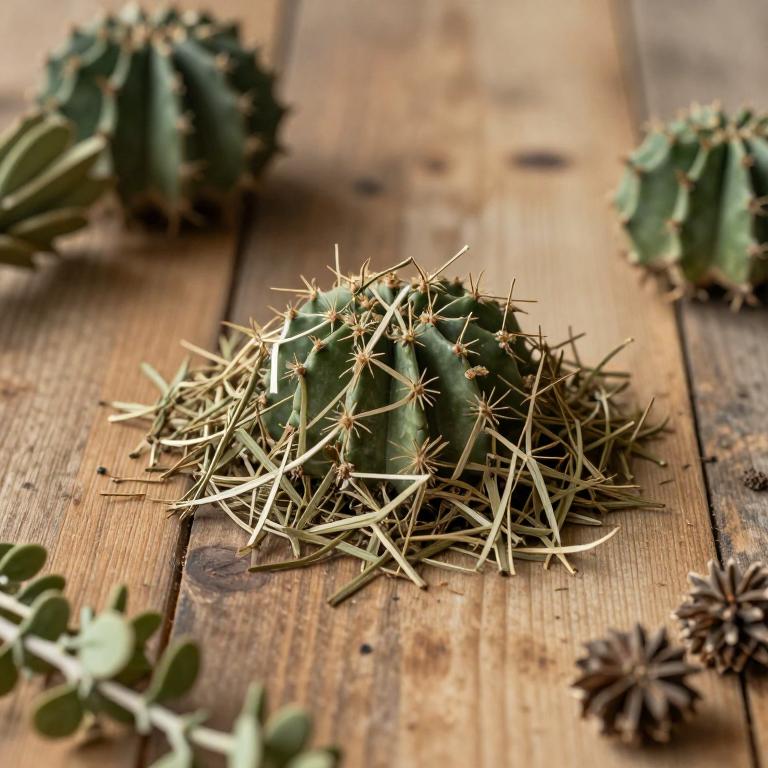
Sour Pickle, scientifically known as Opuntiia tuna, is a resilient cactus native to arid regions. Renowned for its nutritional value, it offers essential antioxidants and fiber. Beyond its culinary use in tangy preserves, this medicinal plant provides therapeutic benefits, supporting digestive health and aiding in the management of inflammation.
- Family
- Cactaceae
- Native range
- Europe
- Parts used
- Seed · Fruit
- Common names
- Sour Pickle · Tuna
- Scientific synonyms
- Cactus Opuntia Var. Tuna · Opuntia Dillenii Subsp. Melanosperma · 9 more
Names and Synonyms
Common Names
- Sour Pickle
- tuna
Scientific Names
Accepted name
Opuntia tunaSynonyms
- Cactus opuntia var. tuna
- Opuntia dillenii subsp. melanosperma
- Cactus dillenii
- Opuntia zebrina
- Opuntia melanosperma
- Opuntia stricta var. dillenii
- Opuntia dillenii var. minor
- Opuntia dillenii var. orbiculata
- Cactus tuna
- Opuntia maritima
- Opuntia dillenii
Regional and Traditional Names
Spanish:
- Cactus tuna
Sources: Wikidata, Catalogue of Life
Taxonomical Classification
This plant belongs to the kingdom Plantae within the phylum Streptophyta and the class Equisetopsida. It is further classified under the subclass Magnoliidae and the order Caryophyllales, falling into the family Cactaceae. Ultimately, its taxonomic identity is defined by the genus Opuntia.
| Rank | Classification |
|---|---|
| Kingdom | Plantae |
| Phylum | Streptophyta |
| Class | Equisetopsida |
| Subclass | Magnoliidae |
| Order | Caryophyllales |
| Family | Cactaceae |
| Genus | Opuntia |
Sources: The World Checklist of Vascular Plants (WCVP)
Distribution
This plant exhibits a widespread distribution across several key regions of the Mediterranean basin. In Southwestern Europe, it can be found growing throughout the territories of France, Portugal, and Spain. Its presence also extends into Southeastern Europe, specifically within the country of Italy. Furthermore, the species is well-established in Northern Africa, particularly in Tunisia. These diverse locations highlight the plant's adaptability to the Mediterranean climate.
| Region | Area |
|---|---|
| Southwestern Europe | France |
| Southwestern Europe | Portugal |
| Southwestern Europe | Spain |
| Southeastern Europe | Italy |
| Northern Africa | Tunisia |
| Macaronesia | Canary Is. |
| West-Central Tropical Africa | Gulf of Guinea Is. |
| Western Indian Ocean | Mauritius |
| Western Indian Ocean | Madagascar |
| Arabian Peninsula | Saudi Arabia |
Sources: The World Checklist of Vascular Plants (WCVP)
Botanical Identification
Ecology
The ecology of Opuntia tuna is characterized by its adaptation to specific environmental niches, typically thriving at a mean elevation of 240 m AMSL. This species is strategically equipped with morphological adaptations for survival in its habitat, most notably regarding its defense mechanisms; it possesses a varied presence of defensive structures, meaning the expression of these traits can be categorized as yes or no depending on the specific specimen or environmental stress levels encountered. These defenses are crucial for protecting its succulent tissues from herbivory within its ecological zone.
- Defense :
- yes
- Elevational range mean:
- 240 m AMSL
Life history
The life history of Opuntia tuna is characterized by its nature as a perennial plant, allowing it to persist through multiple growing seasons and establish a stable presence in its habitat. As an evergreen species, it maintains its fleshy, photosynthetic cladodes throughout the year, providing a continuous source of energy and structural stability regardless of seasonal shifts. This combination of a long-lived lifecycle and constant foliage enables the plant to endure varying environmental conditions while maintaining its physiological functions over an extended period.
- Deciduousness :
- evergreen
- Lifecycle :
- perennial
Morphology
The morphology of Opuntia tuna is characterized by a shrubby growth form, typically manifesting as a self-supporting plant that does not rely on climbing structures. It functions as an independent organism, existing as a terrestrial species rather than an aquatic, semiaquatic, or epiphytic one. The plant exhibits variable woodiness in its structure, with a physical stature that reaches a mean height of approximately 1 meter, though it can attain a maximum height of up to 2 meters.
- Aquatic :
- terrestrial
- Climber :
- self-supporting
- Epiphyte :
- terrestrial
- Growth form :
- shrub
- Parasite :
- independent
- Plant height max:
- 2 m
- Plant height mean:
- 1 m
- Woodiness :
- variable
Physiology
The physiology of Opuntia tuna is characterized by specialized adaptations for survival in arid environments, most notably through Crassulacean Acid Metabolism (CAM), which allows the plant to fix carbon dioxide at night to minimize transpirational water loss. This metabolic pathway enables the plant to maintain high water-use efficiency by keeping stomata closed during the heat of the day. The plant's anatomy features succulent, cladode-like stems that serve as primary photosynthetic organs and water storage reservoirs, facilitating drought tolerance. Regarding nutrient cycling, Opuntia tuna is not a nitrogen fixer; it lacks the symbiotic relationship with diazotrophic bacteria necessary to convert atmospheric nitrogen into usable forms, meaning its nitrogen uptake is dependent on the availability of nitrates or ammonium within the soil substrate. Its physiological processes are further defined by a robust root system capable of rapid moisture absorption following infrequent rainfall events, supporting its overall metabolic demands in nutrient-poor soils.
- Nitrogen fixer :
- no
Reproduction
The reproduction of Opuntia tuna is characterized by a specific flowering and fruiting cycle that relies on the development of distinct floral and fruit structures. The flowering period typically commences in May and concludes in September, though the timing can be variable throughout the year. During this stage, the plant produces flowers that can reach a maximum width of 5 cm and are distinguished by their vibrant orange colour. Following pollination, the plant develops fleshy fruits that range in length from a minimum of 5 cm to a maximum of 7.5 cm. These fruits also exhibit a variation in width, spanning from 3.5 cm to a maximum of 5 cm, and are characterized by a green colour during their development.
- Flower colour :
- orange
- Flower width max:
- 5 cm
- Flowering time :
- May
- Flowering time :
- Sep
- Fruit colour :
- green
- Fruit length max:
- 7.5 cm
- Fruit length min:
- 5 cm
- Fruit width max:
- 5 cm
- Fruit width min:
- 3.5 cm
Sources: Global Inventory of Floras and Traits (GIFT)
Plant Parts
Opuntia tuna has 2 reported plant parts identified across 3 scientific publications and several other databases that are studied for medicinal purposes. The most consistently reported plant part include seed, fruit.
| Plant part | Supporting sources | Consensus |
|---|---|---|
| Seed | 2 supporting sources | ★☆☆☆☆ |
| Fruit | 1 supporting sources | ★☆☆☆☆ |
Seed
- TheScientificWorldJournal
- Molecules (Basel, Switzerland)
Fruit
- Journal of pharmacopuncture
Chemicals
Opuntia tuna has 15 reported phytochemicals identified across 3 scientific publications and several other databases. The most consistently reported chemicals include ascorbic acid, (E)-Ferulic acid, Betalains, Betanin, CATECHIN.
| Chemical | Supporting sources | Consensus |
|---|---|---|
| ascorbic acid | 2 supporting sources | ★☆☆☆☆ |
| (E)-Ferulic acid | 1 supporting sources | ★☆☆☆☆ |
| Betalains | 1 supporting sources | ★☆☆☆☆ |
| Betanin | 1 supporting sources | ★☆☆☆☆ |
| CATECHIN | 1 supporting sources | ★☆☆☆☆ |
| Daucosterol | 1 supporting sources | ★☆☆☆☆ |
| Flavonoids | 1 supporting sources | ★☆☆☆☆ |
| L-(-)-Malic acid | 1 supporting sources | ★☆☆☆☆ |
| Melanin | 1 supporting sources | ★☆☆☆☆ |
| Opuntiol | 1 supporting sources | ★☆☆☆☆ |
ascorbic acid
- Journal of pharmacopuncture
- Saudi pharmaceutical journal : SPJ : the official publication of the Saudi Pharmaceutical Society
(E)-Ferulic acid
- Zhongguo Zhong yao za zhi = Zhongguo zhongyao zazhi = China journal of Chinese materia medica
Betalains
- Journal of pharmacopuncture
Betanin
- Saudi pharmaceutical journal : SPJ : the official publication of the Saudi Pharmaceutical Society
CATECHIN
- Natural product research
Daucosterol
- Zhongguo Zhong yao za zhi = Zhongguo zhongyao zazhi = China journal of Chinese materia medica
Flavonoids
- Saudi pharmaceutical journal : SPJ : the official publication of the Saudi Pharmaceutical Society
L-(-)-Malic acid
- Zhongguo Zhong yao za zhi = Zhongguo zhongyao zazhi = China journal of Chinese materia medica
Melanin
- Scientific reports
Opuntiol
- Zhongguo Zhong yao za zhi = Zhongguo zhongyao zazhi = China journal of Chinese materia medica
Activities
Opuntia tuna has 11 reported activities identified across 3 scientific publications and several other databases. The most consistently reported activities include Antioxidant, Antibacterial, Hepatoprotective, Hypotensive, Neuroprotective.
| Activity | Supporting sources | Consensus |
|---|---|---|
| Antioxidant | 4 supporting sources | ★★☆☆☆ |
| Antibacterial | 2 supporting sources | ★☆☆☆☆ |
| Hepatoprotective | 2 supporting sources | ★☆☆☆☆ |
| Hypotensive | 2 supporting sources | ★☆☆☆☆ |
| Neuroprotective | 2 supporting sources | ★☆☆☆☆ |
| Anticancer | 1 supporting sources | ★☆☆☆☆ |
| Antidiabetic | 1 supporting sources | ★☆☆☆☆ |
| Antifungal | 1 supporting sources | ★☆☆☆☆ |
| Antihyperglycemic | 1 supporting sources | ★☆☆☆☆ |
| Antihyperlipidemic | 1 supporting sources | ★☆☆☆☆ |
Antioxidant
- Natural product research
- Journal of pharmacopuncture
- TheScientificWorldJournal
- Saudi pharmaceutical journal : SPJ : the official publication of the Saudi Pharmaceutical Society
Antibacterial
- Natural product research
- Saudi pharmaceutical journal : SPJ : the official publication of the Saudi Pharmaceutical Society
Hepatoprotective
- Journal of pharmacopuncture
- Saudi pharmaceutical journal : SPJ : the official publication of the Saudi Pharmaceutical Society
Hypotensive
- Journal of pharmacopuncture
- Saudi pharmaceutical journal : SPJ : the official publication of the Saudi Pharmaceutical Society
Neuroprotective
- Journal of pharmacopuncture
- Saudi pharmaceutical journal : SPJ : the official publication of the Saudi Pharmaceutical Society
Anticancer
- Saudi pharmaceutical journal : SPJ : the official publication of the Saudi Pharmaceutical Society
Antidiabetic
- Phytomedicine : international journal of phytotherapy and phytopharmacology
Antifungal
- Saudi pharmaceutical journal : SPJ : the official publication of the Saudi Pharmaceutical Society
Antihyperglycemic
- Phytomedicine : international journal of phytotherapy and phytopharmacology
Antihyperlipidemic
- TheScientificWorldJournal
Preparations
Opuntia tuna has 3 reported preparations identified across 3 scientific publications and several other databases. The most consistently reported preparations include seed oil, 80% ethanolic extract of its stems, Seed Oil.
| Preparation | Supporting sources | Consensus |
|---|---|---|
| Seed oil | 2 supporting sources | ★☆☆☆☆ |
| 80% ethanolic extract of its stems | 1 supporting sources | ★☆☆☆☆ |
| Seed oil | 1 supporting sources | ★☆☆☆☆ |
Seed oil
- TheScientificWorldJournal
- Molecules (Basel, Switzerland)
80% ethanolic extract of its stems
- Zhongguo Zhong yao za zhi = Zhongguo zhongyao zazhi = China journal of Chinese materia medica
Seed oil
- Molecules (Basel, Switzerland)