Cotton Thistle
Onopordum acanthium · Accepted scientific name
Scientific literature: Sparse (55 studies) · ★★☆☆☆
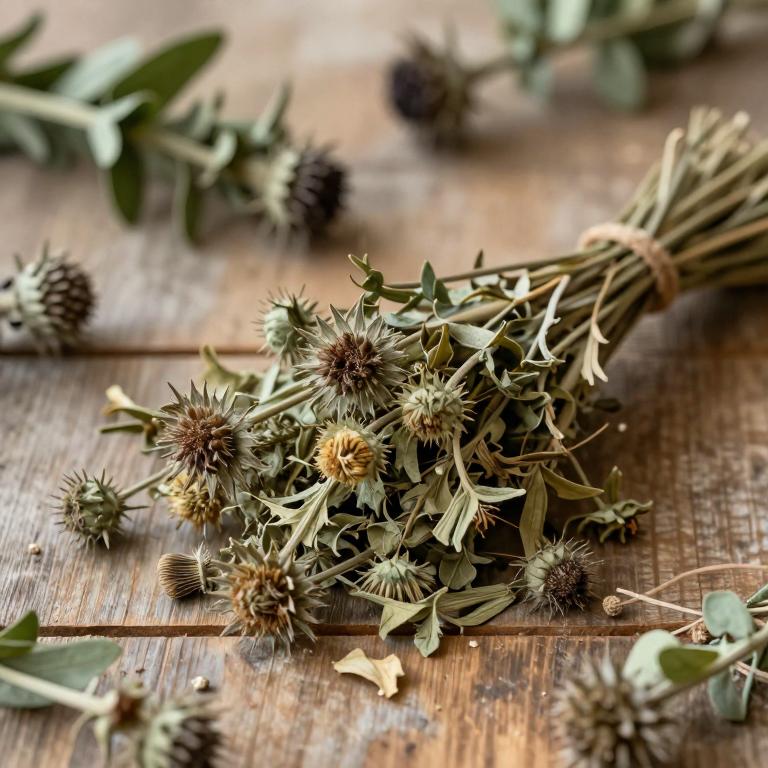
Cotton Thistle, scientifically known as Onopordum acanthium, is a striking perennial herb celebrated for its impressive height and silver-green foliage. Renowned in traditional medicine, it possesses potent anti-inflammatory and antioxidant properties, often utilized to support digestive health, liver function, and overall metabolic wellness through its diverse bioactive compounds.
- Family
- Asteraceae
- Native range
- Europe
- Parts used
- Root
- Common names
- Cotton-Thistle · Scotch-Thistle · 8 more
- Scientific synonyms
- Not available
Names and Synonyms
Common Names
- Cotton-thistle
- Scotch-thistle
- Scotch cotton-thistle
- Scotch thistle
- heraldic thistle
- Cotton Thistle
- Scottish thistle
- giant thistle
- woolly thistle
- Scotch cotton thistle
Scientific Names
Accepted name
Onopordum acanthiumRegional and Traditional Names
Spanish:
- pitilin
- Cardo-borriquero
- Alcachofa borriquera
- Acanto salvaje armado de espinas
- Encinas de Tierra de Campos
- Manto de judas
- Cardo burriquero
- Alcachofa ruda
- Carnina
- Cardo-toba
- Cardo burricon
- Yesquero
- Acanos
- Cardo burricón
- Acanto bastardo
- Alcachofa salvaje
- Anacarnina
- Cardo ruso
- Manta de Judas
- Atoba
- Alcachofas borriqueñas
- Cardo toba
- Cardo-espinhoso-nobre
- Cardo borriquero
German:
- Eselsdistel
- Wolldistel
- Krebsdistel
- Gemeine Eselsdistel
- Gewöhnliche Eselsdistel
- Krampfdistel
- gewöhnliche Eselsdistel
- Eselsdistel
- Krampfdistel
- Krebsdistel
- Wolldistel
French:
- Chardon aux ânes
- Onopordon faux-acanthe
- Chardon aux anes
- onoporde acanthe
- onoporde acanthe
- Onopordon faux-acanthe
- Onopordon à feuilles d'acanthe
- chardon aux ânes
Sources: Wikidata, Catalogue of Life
Taxonomical Classification
This plant belongs to the kingdom Plantae and is classified under the phylum Streptophyta and the class Equisetopsida. Within the subclass Magnoliidae, it is organized under the order Asterales and the family Asteraceae. Finally, it is specifically identified by its genus name, Onoṕordum.
| Rank | Classification |
|---|---|
| Kingdom | Plantae |
| Phylum | Streptophyta |
| Class | Equisetopsida |
| Subclass | Magnoliidae |
| Order | Asterales |
| Family | Asteraceae |
| Genus | Onopordum |
Sources: The World Checklist of Vascular Plants (WCVP)
Distribution
This plant is primarily distributed across several regions within Northern Europe. Specifically, its presence can be observed throughout the territories of Denmark and Great Britain. It also inhabits the landscapes of Ireland, extending its range into the northern reaches of the continent. Furthermore, the species is found within the borders of Norway. Finally, its geographical reach includes the country of Sweden.
| Region | Area |
|---|---|
| Northern Europe | Denmark |
| Northern Europe | Great Britain |
| Northern Europe | Ireland |
| Northern Europe | Norway |
| Northern Europe | Sweden |
| Middle Europe | Austria |
| Middle Europe | Belgium |
| Middle Europe | Czechia-Slovakia |
| Middle Europe | Germany |
| Middle Europe | Hungary |
Sources: The World Checklist of Vascular Plants (WCVP)
Botanical Identification
Ecology
The ecology of Onopordum acanthium is characterized by its ability to thrive across a broad altitudinal gradient, ranging from sea level (0 m AMSL) up to a maximum elevation of 2400 m AMSL. This species is highly adaptable to disturbed environments, frequently colonizing anthropogenic landscapes such as crop fields, old fields, and various rudeural sites. Furthermore, its biological associations include a lack of mycorrhizal dependency, as it does not form mycorrhizal relationships (no).
- Elevational range max:
- 2400 m AMSL
- Elevational range min:
- 0 m AMSL
- Habitat :
- crop fields, old fields, ruderal sites
- Mycorrhiza :
- no
Life history
The life history of Onopordum acanthium is characterized by a biennial lifecycle, meaning it typically completes its developmental stages over a period of two years. During its initial phase, the plant focuses on vegetative growth, before transitioning to its reproductive stage in the second year. As a deciduous species, it sheds its foliage according to seasonal shifts, which is a key aspect of its survival strategy. In terms of its botanical classification regarding growth habits, the plant exhibits characteristics of both a hemicryptophyte, where the perennating buds are located at the soil surface, and a therophyte, reflecting its ability to complete its life cycle through seed production that allows for seasonal persistence.
- Deciduousness :
- deciduous
- Life form :
- hemicryptophyte
- Life form :
- therophyte
- Lifecycle :
- biennial
Morphology
The morphology of Onopordum acanthium is characterized by its growth form as a non-woody herb and forb. This self-supporting plant is strictly terrestrial in its habitat, functioning as an independent organism rather than a parasite or epiphyte. It exhibits a variable stature, with plant heights ranging from a minimum of 0.3 m to a maximum of 3 m, maintaining an average height of approximately 1.51 m. As a self-supporting species, it does not exhibit climbing or vining behaviors.
- Aquatic :
- terrestrial
- Climber :
- self-supporting
- Epiphyte :
- terrestrial
- Growth form :
- herb
- Growth form :
- forb
- Parasite :
- independent
- Plant height max:
- 3 m
- Plant height mean:
- 1.51 m
- Plant height min:
- 0.3 m
- Woodiness :
- non-woody
Physiology
The physiology of Onopordum acanthium is characterized by a C3 photosynthetic pathway, which dictates its metabolic processes and carbon fixation efficiency. As a non-carnivorous species, it relies on traditional nutrient uptake from the soil rather than insectivory, and it does not function as a nitrogen fixer. The plant's vegetative morphology exhibits significant variability in leaf dimensions, with leaf lengths ranging from a minimum of 10 cm to a maximum of 35 cm, maintaining an average length of 20 cm. The leaf width fluctuates between 3 cm and 15 cm, resulting in a mean width of 9.5 cm. These dimensional traits contribute to a mean leaf size of 49.285 cm², while the Specific Leaf Area (SLA) averages 142.5 cm²/g, reflecting its structural investment in leaf tissue density and surface area for light interception.
- Carnivory :
- non-carnivorous
- Leaf length max:
- 35 cm
- Leaf length mean:
- 20 cm
- Leaf length min:
- 10 cm
- Leaf size mean:
- 49.285 cm²
- Leaf width max:
- 15 cm
- Leaf width mean:
- 9.5 cm
- Leaf width min:
- 3 cm
- Nitrogen fixer :
- no
- Photosynthetic pathway :
- C3
- Specific Leaf Area (SLA) mean:
- 142.5 cm²/g
Reproduction
The reproduction of Onopordum acanthium is characterized by a sexual reproductive cycle that follows a monocarpous pattern, with asexual reproduction being absent. The flowering period typically commences in July and extends through September. This process relies on biotic pollination syndromes, specifically utilizing insects such as bees to facilitate fertilization, although self-fertilization is also present. Following successful pollination, the plant produces indehiscent fruits categorized as achenes. These fruits maintain a consistent length of approximately 0.6 cm. The resulting seeds are small, with a mean length of 5 mm, a mean width of 2 mm, and a mean mass of 0.010062 g (ranging from a minimum of 0.0024 g to a maximum of 0.0118 g). Dispersal is achieved through an anemochorous syndrome, meaning the seeds are primarily dispersed by the wind.
- Dehiscence :
- indehiscent
- Dispersal syndrome :
- anemochorous
- Flowering time :
- Jul
- Flowering time :
- Sep
- Fruit length max:
- 0.6 cm
- Fruit type :
- achene
- Monocarpy :
- monocarp
- Pollination syndrome :
- insect
- Pollination syndrome :
- bee
- Pollination syndrome :
- biotic
- Reproduction asexual :
- absent
- Seed length mean:
- 5 mm
- Seed mass max:
- 0.0118 g
- Seed mass mean:
- 0.010062 g
- Seed mass min:
- 0.0024 g
- Seed width mean:
- 2 mm
- Self fertilization :
- present
Sources: Global Inventory of Floras and Traits (GIFT)
Plant Parts
Onopordum acanthium has 1 reported plant parts identified across 1 scientific publications and several other databases that are studied for medicinal purposes. The most consistently reported plant part include root.
| Plant part | Supporting sources | Consensus |
|---|---|---|
| Root | 1 supporting sources | ★☆☆☆☆ |
Root
- Planta medica
Chemicals
Onopordum acanthium has 21 reported phytochemicals identified across 1 scientific publications and several other databases. The most consistently reported chemicals include CHLOROGENIC ACID, Flavonoids, apigenin, luteolin, quercetin.
| Chemical | Supporting sources | Consensus |
|---|---|---|
| CHLOROGENIC ACID | 2 supporting sources | ★☆☆☆☆ |
| Flavonoids | 2 supporting sources | ★☆☆☆☆ |
| apigenin | 2 supporting sources | ★☆☆☆☆ |
| luteolin | 2 supporting sources | ★☆☆☆☆ |
| quercetin | 2 supporting sources | ★☆☆☆☆ |
| 13-Oxo-9Z,11E-octadecadienoic acid | 1 supporting sources | ★☆☆☆☆ |
| 24-Methylenecholesterol | 1 supporting sources | ★☆☆☆☆ |
| Flavonoid | 1 supporting sources | ★☆☆☆☆ |
| Hispidulin | 1 supporting sources | ★☆☆☆☆ |
| Lignans | 1 supporting sources | ★☆☆☆☆ |
CHLOROGENIC ACID
- Protoplasma
- Life (Basel, Switzerland)
Flavonoids
- Plants (Basel, Switzerland)
- Life (Basel, Switzerland)
apigenin
- Planta medica
- Protoplasma
luteolin
- Planta medica
- Protoplasma
quercetin
- Protoplasma
- PeerJ
13-Oxo-9Z,11E-octadecadienoic acid
- Planta medica
24-Methylenecholesterol
- Planta medica
Flavonoid
- Protoplasma
Hispidulin
- Planta medica
Lignans
- Plants (Basel, Switzerland)
Activities
Onopordum acanthium has 15 reported activities identified across 1 scientific publications and several other databases. The most consistently reported activities include ACE-Inhibitor, Antibacterial, Anticancer, Anticholinesterase, Antidiabetic.
| Activity | Supporting sources | Consensus |
|---|---|---|
| ACE-Inhibitor | 1 supporting sources | ★☆☆☆☆ |
| Antibacterial | 1 supporting sources | ★☆☆☆☆ |
| Anticancer | 1 supporting sources | ★☆☆☆☆ |
| Anticholinesterase | 1 supporting sources | ★☆☆☆☆ |
| Antidiabetic | 1 supporting sources | ★☆☆☆☆ |
| Antifungal | 1 supporting sources | ★☆☆☆☆ |
| Antimicrobial | 1 supporting sources | ★☆☆☆☆ |
| Antioxidant | 1 supporting sources | ★☆☆☆☆ |
| Antiproliferative | 1 supporting sources | ★☆☆☆☆ |
| Antitumor | 1 supporting sources | ★☆☆☆☆ |
ACE-Inhibitor
- Enzyme and microbial technology
Antibacterial
- PeerJ
Anticancer
- PeerJ
Anticholinesterase
- Protoplasma
Antidiabetic
- Protoplasma
Antifungal
- Protoplasma
Antimicrobial
- Protoplasma
Antioxidant
- Protoplasma
Antiproliferative
- Plants (Basel, Switzerland)
Antitumor
- Plants (Basel, Switzerland)
Conditions
Onopordum acanthium has 6 reported investigations on conditions identified across 1 scientific publications and several other databases. The most consistently reported conditions include HeLa cells, Staphylococcus aureus, cardiotonic, neurodegenerative disorders, oxidative stress.
| Condition | Supporting sources | Consensus |
|---|---|---|
| Hela cells | 1 supporting sources | ★☆☆☆☆ |
| Staphylococcus aureus | 1 supporting sources | ★☆☆☆☆ |
| Cardiotonic | 1 supporting sources | ★☆☆☆☆ |
| Neurodegenerative disorders | 1 supporting sources | ★☆☆☆☆ |
| Oxidative stress | 1 supporting sources | ★☆☆☆☆ |
| Sleep disorders | 1 supporting sources | ★☆☆☆☆ |
Hela cells
- Archives of gynecology and obstetrics
Staphylococcus aureus
- PeerJ
Cardiotonic
- Plants (Basel, Switzerland)
Neurodegenerative disorders
- Protoplasma
Oxidative stress
- Protoplasma
Sleep disorders
- Forschende Komplementarmedizin (2006)
Preparations
Onopordum acanthium has 3 reported preparations identified across 1 scientific publications and several other databases. The most consistently reported preparations include MeOH extract prepared from aerial parts, aqueous extract, mix powder.
| Preparation | Supporting sources | Consensus |
|---|---|---|
| Meoh extract prepared from aerial parts | 1 supporting sources | ★☆☆☆☆ |
| Aqueous extract | 1 supporting sources | ★☆☆☆☆ |
| Mix powder | 1 supporting sources | ★☆☆☆☆ |
Meoh extract prepared from aerial parts
- Planta medica
Aqueous extract
- Journal of ethnopharmacology
Mix powder
- Zhongguo Zhong yao za zhi = Zhongguo zhongyao zazhi = China journal of Chinese materia medica