Wild olive
Olea europaea subsp. cuspidata · Accepted scientific name
Scientific literature: Very Sparse (6 studies) · ★☆☆☆☆
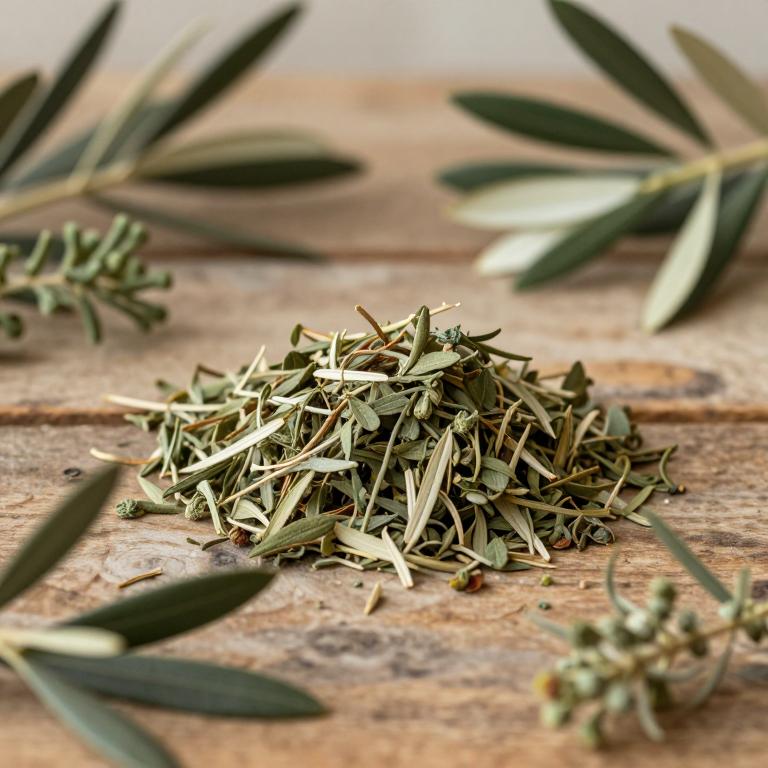
Wild olive, scientifically known as Olea europaea subsp. cuspidata, is a resilient Mediterranean shrub prized for its potent therapeutic properties. Renowned for its antioxidant and anti-inflammatory benefits, this subspecies offers unique bioactive compounds. Traditionally used in holistic remedies, it serves as a vital natural resource for modern medicinal applications.
Names and Synonyms
Common Names
- African olive
- brown olive
- wild olive
- Asian Brown Olive
- Indian olive
Scientific Names
Accepted name
Olea europaea subsp. cuspidataSynonyms
- Olea chrysophylla var. aucheri
- Olea chrysophylla var. cuspidata
- Olea indica
- Olea chrysophylla var. ferruginea
- Olea europaea var. cuspidata
- Olea cuspidata
- Olea aucheri
- Olea chrysophylla
Regional and Traditional Names
French:
- Olea europaea cuspidata
- Olea europaea africana
- Olea chrysophylla
- Olivier brun
Sources: Wikidata, Catalogue of Life
Taxonomical Classification
This plant, taxonomically known as Olea europaea subsp. cuspidata, belongs to the kingdom Plantae and the phylum Streptophyta. It is classified within the class Equisetopsida and the subclass Magnoliidae, falling under the order Lamiales. Finally, it is a member of the Oleaceae family and the genus Olea.
| Rank | Classification |
|---|---|
| Kingdom | Plantae |
| Phylum | Streptophyta |
| Class | Equisetopsida |
| Subclass | Magnoliidae |
| Order | Lamiales |
| Family | Oleaceae |
| Genus | Olea |
Sources: The World Checklist of Vascular Plants (WCVP)
Distribution
This plant exhibits a specific distribution pattern concentrated within the arid regions of Western Asia and the Arabian Peninsula. In Western Asia, its presence is recorded in the countries of Afghanistan and Iran. Moving toward the southern regions, the species can be found across the Arabian Peninsula. Specifically, it inhabits the landscapes of Oman and Saudi Arabia. Finally, its geographical range extends into the territory of Yemen.
| Region | Area |
|---|---|
| Western Asia | Afghanistan |
| Western Asia | Iran |
| Arabian Peninsula | Oman |
| Arabian Peninsula | Saudi Arabia |
| Arabian Peninsula | Yemen |
| China | China South-Central |
| Indian Subcontinent | Nepal |
| Indian Subcontinent | Pakistan |
| Indian Subcontinent | West Himalaya |
| Malesia | Jawa |
Sources: The World Checklist of Vascular Plants (WCVP)
Plant Parts
Olea europaea subsp. cuspidata has 1 reported plant parts identified across 1 scientific publications and several other databases that are studied for medicinal purposes. The most consistently reported plant part include leaf.
| Plant part | Supporting sources | Consensus |
|---|---|---|
| Leaf | 1 supporting sources | ★☆☆☆☆ |
Leaf
- Photodiagnosis and photodynamic therapy
Activities
Olea europaea subsp. cuspidata has 2 reported activities identified across 1 scientific publications and several other databases. The most consistently reported activities include Antibacterial, Antioxidant.
| Activity | Supporting sources | Consensus |
|---|---|---|
| Antibacterial | 1 supporting sources | ★☆☆☆☆ |
| Antioxidant | 1 supporting sources | ★☆☆☆☆ |
Antibacterial
- Photodiagnosis and photodynamic therapy
Antioxidant
- Photodiagnosis and photodynamic therapy
Conditions
Olea europaea subsp. cuspidata has 1 reported investigations on conditions identified across 1 scientific publications and several other databases. The most consistently reported conditions include atopic eczema.
| Condition | Supporting sources | Consensus |
|---|---|---|
| Atopic eczema | 1 supporting sources | ★☆☆☆☆ |
Atopic eczema
- Journal of ethnobiology and ethnomedicine
Preparations
Olea europaea subsp. cuspidata has 2 reported preparations identified across 1 scientific publications and several other databases. The most consistently reported preparations include extracts, leaf extract.
| Preparation | Supporting sources | Consensus |
|---|---|---|
| Extracts | 1 supporting sources | ★☆☆☆☆ |
| Leaf extract | 1 supporting sources | ★☆☆☆☆ |
Extracts
- Pakistan journal of pharmaceutical sciences
Leaf extract
- Photodiagnosis and photodynamic therapy