Nymphaea nouchali caerulea
Nymphaea nouchali var. caerulea · Accepted scientific name
Scientific literature: Very Sparse (20 studies) · ★☆☆☆☆
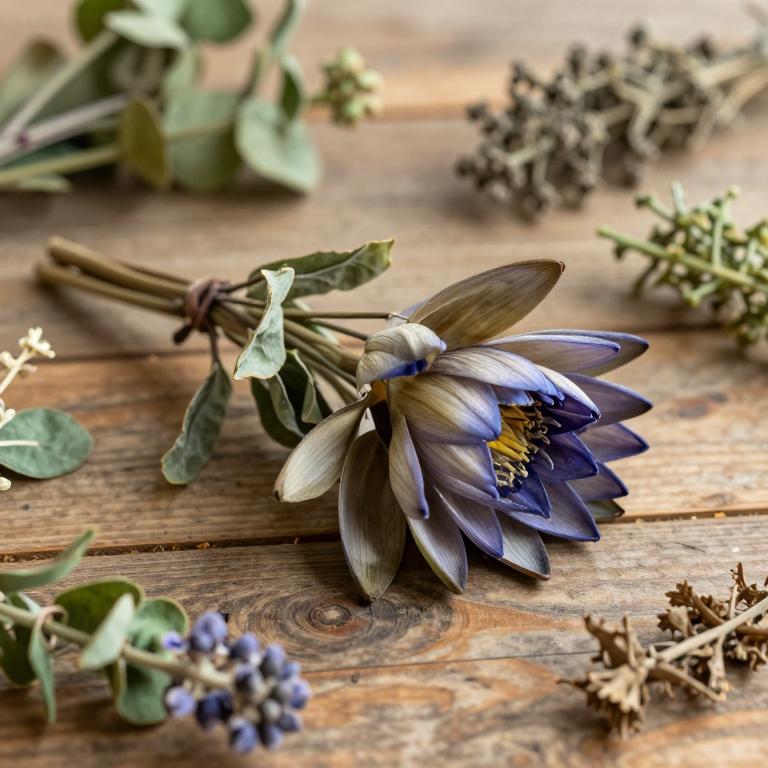
Nymphaea nouchali caerulea, scientifically known as Nymphaea nouchali var. caerulea, is a sacred blue water lily revered in Ayurvedic traditions. Renowned for its calming properties, this medicinal aquatic plant is utilized to soothe the nervous system, reduce inflammation, and promote mental clarity through its potent, natural bioactive compounds.
Names and Synonyms
Common Names
- Blue Lotus
- Blue Water Lily
- Cape Blue Water-lily
- Cape Waterlily
- Egyptian Blue Lotus
- Egyptian Blue Water Lily
Scientific Names
Accepted name
Nymphaea nouchali var. caeruleaSynonyms
- Nymphaea capensis var. madagascariensis
- Leuconymphaea emirnensis
- Castalia caerulea
- Nymphaea spectabilis
- Nymphaea capensis
- Nymphaea cyclophylla
- Nymphaea caerulea
- Nymphaea nubica
- Nymphaea madagascariensis
- Nymphaea magnifica
- Nymphaea radiata
- Leuconymphaea berneriana
- Castalia scutifolia
- Leuconymphaea caerulea
- Castalia capensis
- Nymphaea muschleriana
- Nymphaea calliantha var. tenuis
- Nymphaea mildbraedii
- Nymphaea caerulea var. albiflora
- Nymphaea scutifolia
- Nymphaea calliantha var. nelsonii
- Nymphaea edgeworthii
- Nymphaea emirnensis
- Nymphaea engleri
- Nymphaea capensis var. alba
- Nymphaea calliantha
- Nymphaea bernieriana
- Nymphaea sphaerantha
- Nymphaea caerulea var. eigii
- Nymphaea caerulea var. versicolor
- Nymphaea stellata vulgaris
- Nymphaea stellata distans
- Nymphaea stellata approximata
- Nymphaea stellata spiralis
- Nymphaea stellata maculata
- Nymphaea stellata immaculata
- Nymphaea stellata lilacina
- Nymphaea stellata lilacina
- Nymphaea stellata adscendens
- Nymphaea stellata maculata
- Nymphaea stellata f. caerulea
- Nymphaea stellata immaculata
- Nymphaea stellata punctata
- Nymphaea stellata albida
- Nymphaea stellata coerulea
Regional and Traditional Names
Spanish:
- Loto azul
- Nenúfar azul del Cabo
- loto azul egipcio
German:
- Blaue Ägyptische Seerose
Sources: Wikidata, Catalogue of Life
Taxonomical Classification
This plant belongs to the kingdom Plantae within the phylum Streptophyta and the class Equisetopsida. Classified under the subclass Magnoliidae and the order Nymphaeales, it is a member of the family Nymphaeaceae. Its specific taxonomic placement concludes within the genus Nymphaea as the variety caerulea.
| Rank | Classification |
|---|---|
| Kingdom | Plantae |
| Phylum | Streptophyta |
| Class | Equisetopsida |
| Subclass | Magnoliidae |
| Order | Nymphaeales |
| Family | Nymphaeaceae |
| Genus | Nymphaea |
Sources: The World Checklist of Vascular Plants (WCVP)
Distribution
This plant exhibits a diverse geographical distribution spanning across multiple regions of the African continent. In Northern Africa, its presence is specifically noted within the country of Egypt. Moving towards the central regions, it is widely found throughout West-Central Tropical Africa. This includes its occurrence in Burundi, Rwanda, and the Congo. Furthermore, the species is also documented to grow within the Democratic Republic of the Congo.
| Region | Area |
|---|---|
| Northern Africa | Egypt |
| West-Central Tropical Africa | Burundi |
| West-Central Tropical Africa | Congo |
| West-Central Tropical Africa | Rwanda |
| West-Central Tropical Africa | DR Congo |
| Northeast Tropical Africa | Chad |
| Northeast Tropical Africa | Ethiopia |
| Northeast Tropical Africa | Somalia |
| Northeast Tropical Africa | Sudan-South Sudan |
| East Tropical Africa | Kenya |
Sources: The World Checklist of Vascular Plants (WCVP)
Plant Parts
Nymphaea nouchali var. caerulea has 2 reported plant parts identified across 2 scientific publications and several other databases that are studied for medicinal purposes. The most consistently reported plant part include flower, leaf.
| Plant part | Supporting sources | Consensus |
|---|---|---|
| Flower | 1 supporting sources | ★☆☆☆☆ |
| Leaf | 1 supporting sources | ★☆☆☆☆ |
Flower
- Phytochemistry
Leaf
- Journal of ethnopharmacology
Chemicals
Nymphaea nouchali var. caerulea has 15 reported phytochemicals identified across 2 scientific publications and several other databases. The most consistently reported chemicals include 2s,3s,4s-trihydroxypentanoic acid, 4-METHOXYBENZOIC ACID, BETA-SITOSTEROL, ETHYL GALLATE, Gallic acid.
| Chemical | Supporting sources | Consensus |
|---|---|---|
| 2s,3s,4s-trihydroxypentanoic acid | 1 supporting sources | ★☆☆☆☆ |
| 4-METHOXYBENZOIC ACID | 1 supporting sources | ★☆☆☆☆ |
| BETA-SITOSTEROL | 1 supporting sources | ★☆☆☆☆ |
| ETHYL GALLATE | 1 supporting sources | ★☆☆☆☆ |
| Gallic acid | 1 supporting sources | ★☆☆☆☆ |
| Isosalipurposide | 1 supporting sources | ★☆☆☆☆ |
| Kaempferol 3-O-beta-D-glucoside | 1 supporting sources | ★☆☆☆☆ |
| Myricetin 3-O-alpha-L-rhamnoside | 1 supporting sources | ★☆☆☆☆ |
| Nuciferine | 1 supporting sources | ★☆☆☆☆ |
| Quercetin 3-O-alpha-L-rhamnoside | 1 supporting sources | ★☆☆☆☆ |
2s,3s,4s-trihydroxypentanoic acid
- Phytochemistry
4-METHOXYBENZOIC ACID
- Phytochemistry
BETA-SITOSTEROL
- Phytochemistry
ETHYL GALLATE
- Phytochemistry
Gallic acid
- Phytochemistry
Isosalipurposide
- Phytochemistry
Kaempferol 3-O-beta-D-glucoside
- Phytochemistry
Myricetin 3-O-alpha-L-rhamnoside
- Phytochemistry
Nuciferine
- Journal of ethnopharmacology
Quercetin 3-O-alpha-L-rhamnoside
- Phytochemistry
Activities
Nymphaea nouchali var. caerulea has 3 reported activities identified across 2 scientific publications and several other databases. The most consistently reported activities include Antimicrobial, Antioxidant, Psychotropic.
| Activity | Supporting sources | Consensus |
|---|---|---|
| Antimicrobial | 1 supporting sources | ★☆☆☆☆ |
| Antioxidant | 1 supporting sources | ★☆☆☆☆ |
| Psychotropic | 1 supporting sources | ★☆☆☆☆ |
Antimicrobial
- Journal of ethnopharmacology
Antioxidant
- Phytochemistry
Psychotropic
- Scientific reports
Preparations
Nymphaea nouchali var. caerulea has 1 reported preparations identified across 2 scientific publications and several other databases. The most consistently reported preparations include Nuciferine.
| Preparation | Supporting sources | Consensus |
|---|---|---|
| Nuciferine | 1 supporting sources | ★☆☆☆☆ |
Nuciferine
- Journal of ethnopharmacology