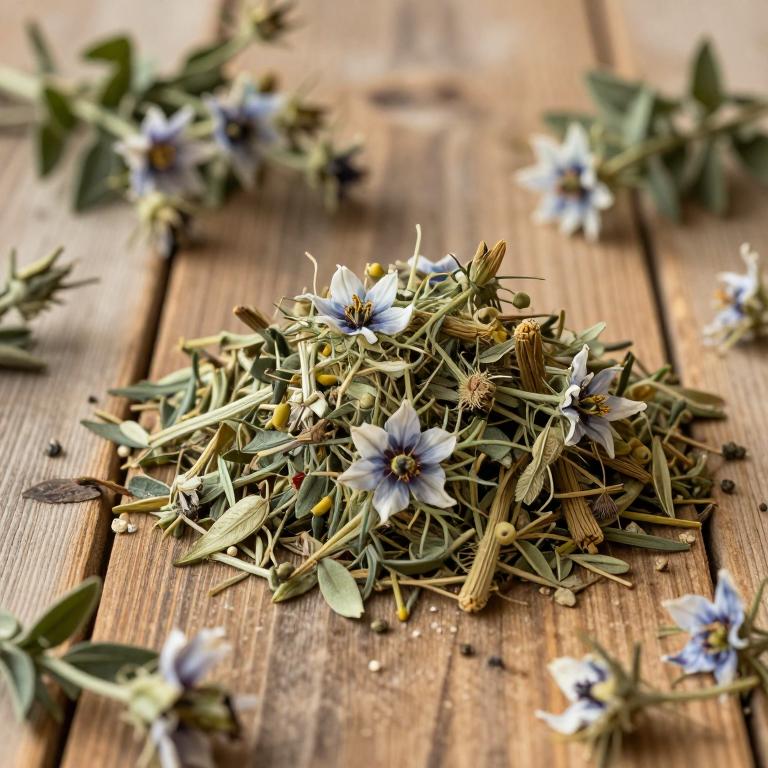
yellow fennel flower
Nigella orientalis · Accepted scientific name
Scientific literature: Very Sparse (7 studies) · ★☆☆☆☆
Yellow fennel flower, scientifically known as Nigella orientalis, is a distinctive medicinal herb cherished in traditional healing practices. Renowned for its delicate blooms and potent bioactive compounds, this plant offers therapeutic benefits, particularly in soothing digestive ailments and reducing inflammation, making it a valuable subject in ethnopharmacology.
- Family
- Ranunculaceae
- Native range
- Europe
- Parts used
- Not available
- Common names
- Yellow Nigella
- Scientific synonyms
- Nigellastrum Orientale · Nigellastrum Corniculatum · 2 more
Names and Synonyms
Common Names
- yellow nigella
Scientific Names
Accepted name
Nigella orientalisSynonyms
- Nigellastrum orientale
- Nigellastrum corniculatum
- Nigellastrum flavum
- Nigella corniculata
Sources: Wikidata, Catalogue of Life
Taxonomical Classification
This plant, known scientifically as Nigella orientalis, belongs to the kingdom Plantae and the phylum Streptophyta. Within the class Equisetopsida and subclass Magnoliidae, it is categorized under the order Ranunculales. Finally, it is classified under the family Ranunculaceae within the genus Nigella.
| Rank | Classification |
|---|---|
| Kingdom | Plantae |
| Phylum | Streptophyta |
| Class | Equisetopsida |
| Subclass | Magnoliidae |
| Order | Ranunculales |
| Family | Ranunculaceae |
| Genus | Nigella |
Sources: The World Checklist of Vascular Plants (WCVP)
Distribution
This plant exhibits a diverse range of habitats across several distinct regions. In Southeastern Europe, its presence is documented in Bulgaria, Greece, and the European portion of Türkiye. Moving eastward, the species can be found within the territories of South European Russia. Furthermore, its distribution extends into the Caucasus region, specifically within the Transcaucasus. Together, these locations highlight a broad geographical spread across Eastern and Southeastern Europe and the Caucasus.
| Region | Area |
|---|---|
| Southeastern Europe | Bulgaria |
| Southeastern Europe | Greece |
| Southeastern Europe | Türkiye-in-Europe |
| Eastern Europe | South European Russia |
| Caucasus | Transcaucasus |
| Western Asia | East Aegean Is. |
| Western Asia | Iran |
| Western Asia | Lebanon-Syria |
| Western Asia | Türkiye |
Sources: The World Checklist of Vascular Plants (WCVP)
Botanical Identification
Ecology
The ecology of Nigella orientalis is characterized by its adaptability to diverse and often challenging environments, ranging from disturbed agricultural landscapes to rugged natural terrains. This species is frequently found colonizing crop fields, where it thrives in the nutrient-rich, disturbed soils typical of human cultivation. Beyond anthropogenic landscapes, its ecological range extends into more primitive and wild habitats, including the rocky and sloped terrains of mountains and the expansive, open stretches of the steppe. Such varied distribution suggests a high degree of resilience to different soil compositions and microclimates, allowing it to occupy niches that transition from the high-intensity disturbance of farmland to the more stable, yet seasonally extreme, conditions of mountainous and semi-arid steppe ecosystems.
- Habitat :
- crop fields, mountains, steppe
Life history
The life history of Nigella orientalis is characterized by an annual lifecycle, meaning the plant completes its entire developmental process from germination to seed production within a single growing season. As a therophyte, its biological strategy relies on surviving unfavorable environmental conditions through the production of seeds, which remain dormant until the following season. This life form dictates its structure and growth pattern, as it lacks persistent underground organs or woody stems, instead focusing its energy on rapid seasonal growth to achieve reproductive maturity before the onset of seasonal stress.
- Life form :
- therophyte
- Lifecycle :
- annual
Morphology
The morphology of Nigella orientalis is characterized by its growth form as a herb, exhibiting a non-woody structure throughout its vegetative development. This plant demonstrates a flexible ecological adaptation regarding its moisture requirements, as its habit can range from terrestrial to semiaquatic or even aquatic environments.
- Aquatic :
- terrestrial
- Growth form :
- herb
- Woodiness :
- non-woody
Reproduction
The reproduction of Nigella orientalis is primarily driven by its seasonal flowering cycle, which dictates its reproductive window within its habitat. The flowering process typically begins in May, marking the onset of its reproductive phase. This period of bloom continues through the early summer months, with the flowering stage concluding in June. This relatively concentrated reproductive window ensures that the plant's pollination and subsequent seed development occur during specific environmental conditions characteristic of the late spring and early summer seasons.
- Flowering time :
- May
- Flowering time :
- Jun
Sources: Global Inventory of Floras and Traits (GIFT)
Chemicals
Nigella orientalis has 5 reported phytochemicals identified across 0 scientific publications and several other databases. The most consistently reported chemicals include Albumin, Alkaline Phosphatase (ALP), bilirubin, urea, uric acid.
| Chemical | Supporting sources | Consensus |
|---|---|---|
| Albumin | 1 supporting sources | ★☆☆☆☆ |
| Alkaline Phosphatase (ALP) | 1 supporting sources | ★☆☆☆☆ |
| bilirubin | 1 supporting sources | ★☆☆☆☆ |
| urea | 1 supporting sources | ★☆☆☆☆ |
| uric acid | 1 supporting sources | ★☆☆☆☆ |
Albumin
- Phytotherapy research : PTR
Alkaline Phosphatase (ALP)
- Phytotherapy research : PTR
bilirubin
- Phytotherapy research : PTR
urea
- Phytotherapy research : PTR
uric acid
- Phytotherapy research : PTR
Conditions
Nigella orientalis has 2 reported investigations on conditions identified across 0 scientific publications and several other databases. The most consistently reported conditions include VLDL-cholesterol, bilirubin.
| Condition | Supporting sources | Consensus |
|---|---|---|
| Vldl-cholesterol | 1 supporting sources | ★☆☆☆☆ |
| Bilirubin | 1 supporting sources | ★☆☆☆☆ |
Vldl-cholesterol
- Phytotherapy research : PTR
Bilirubin
- Phytotherapy research : PTR
Preparations
Nigella orientalis has 1 reported preparations identified across 0 scientific publications and several other databases. The most consistently reported preparations include fixed oils.
| Preparation | Supporting sources | Consensus |
|---|---|---|
| Fixed oils | 1 supporting sources | ★☆☆☆☆ |
Fixed oils
- Phytotherapy research : PTR