black-bread-weed
Nigella arvensis · Accepted scientific name
Scientific literature: Very Sparse (5 studies) · ★☆☆☆☆
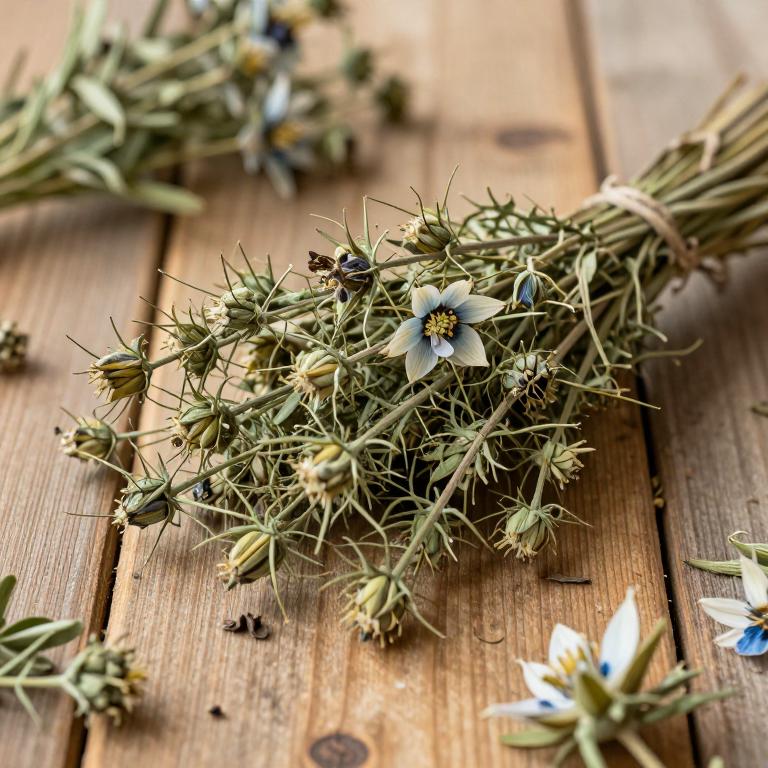
black-bread-weed, scientifically known as Nigella arvensis, is a distinctive annual herb belonging to the mustard family. Primarily found in disturbed soils and agricultural lands, this plant is recognized by its small, yellowish flowers. While less common in modern herbalism, it remains a fascinating subject in botanical and ecological studies.
- Family
- Ranunculaceae
- Native range
- Europe
- Parts used
- Not available
- Common names
- Black-Bread-Weed · Wild Fennel · 1 more
- Scientific synonyms
- Not available
Names and Synonyms
Common Names
- black-bread-weed
- wild fennel
- wild fennel-flower
Scientific Names
Accepted name
Nigella arvensisRegional and Traditional Names
German:
- Acker-Schwarzkümmel
- Ackerschwarzkümmel
- Acker-Schwarzkümmel
- Acker-Schwarzkuemmel
- Ackerschwarzkümmel
French:
- Nigelle des champs
- nigelle des champs
- Nigelle des champs
Sources: Wikidata, Catalogue of Life
Taxonomical Classification
This plant, known scientifically as Nigella arvensis, belongs to the kingdom Plantae and the phylum Streptophyta. It is classified under the class Equisetopsida and subclass Magnoliidae within the order Ranunculales. Ultimately, it is a member of the family Ranunculaceae and falls under the genus Nigella.
| Rank | Classification |
|---|---|
| Kingdom | Plantae |
| Phylum | Streptophyta |
| Class | Equisetopsida |
| Subclass | Magnoliidae |
| Order | Ranunculales |
| Family | Ranunculaceae |
| Genus | Nigella |
Sources: The World Checklist of Vascular Plants (WCVP)
Distribution
This plant, known as Nigella arvensis, exhibits a specific distribution across various regions of Middle Europe. It can be found growing within the borders of Austria, contributing to the local flora. The species is also documented in Belgium, extending its presence towards the western parts of the continent. Moving eastward, its range encompasses the territories of Czechia and Slovakia. Finally, this medicinal plant is well-established in both Germany and Hungary.
| Region | Area |
|---|---|
| Middle Europe | Austria |
| Middle Europe | Belgium |
| Middle Europe | Czechia-Slovakia |
| Middle Europe | Germany |
| Middle Europe | Hungary |
| Middle Europe | Netherlands |
| Middle Europe | Poland |
| Middle Europe | Switzerland |
| Southwestern Europe | France |
| Southwestern Europe | Sardegna |
Sources: The World Checklist of Vascular Plants (WCVP)
Botanical Identification
Ecology
The ecology of Nigella arvensis is characterized by its remarkable adaptability to diverse and often disturbed environments. It thrives across a wide range of landscapes, establishing itself frequently within crop fields and inhabited places where soil disturbance is common. Its ecological niche extends to more rugged and varied terrains, including mountainous regions, open steppe environments, and stony places. This ability to colonize both agricultural settings and natural, rocky habitats suggests a high tolerance for varying soil compositions and competitive pressures, allowing it to persist in both anthropogenic and wild ecosystems.
- Habitat :
- crop fields, inhabited places, mountains, steppe, stony places
Life history
The life history of Nigella arvensis is characterized by its status as an annual plant, completing its entire reproductive cycle within a single growing season. As a therophyte, it survives unfavorable conditions through highly resilient seeds rather than maintaining any permanent vegetative structures above or below the ground. This plant is deciduous, shedding its foliage as it concludes its seasonal development. Its biological strategy focuses on rapid growth and efficient seed production to ensure the continuation of the species before the onset of environmental stress.
- Deciduousness :
- deciduous
- Life form :
- therophyte
- Lifecycle :
- annual
Morphology
The morphology of Nigella arvensis is characterized by a non-woody, herbaceous growth form, appearing as both a general herb and a forb. This self-supporting plant is terrestrial in nature and functions as an independent organism, lacking any parasitic tendencies. In terms of stature, it is a relatively small species, with a plant height that typically ranges from a minimum of 0.05 m to a maximum of 0.45 m, maintaining an average height of approximately 0.23 m.
- Aquatic :
- terrestrial
- Climber :
- self-supporting
- Growth form :
- herb
- Parasite :
- independent
- Plant height max:
- 0.45 m
- Plant height mean:
- 0.23 m
- Plant height min:
- 0.05 m
- Woodiness :
- non-woody
Physiology
The physiology of Nigella arvensis is characterized by a C3 photosynthetic pathway, which dictates its carbon fixation processes and metabolic efficiency in its natural habitat. The plant exhibits a non-carnivorous nutritional strategy, relying entirely on autotrophic production through soil nutrient uptake and photosynthesis rather than capturing prey. Morphologically, its leaves possess a mean surface area of approximately 1.8854 cm², contributing to its overall canopy structure. Furthermore, the plant maintains a mean Specific Leaf Area (SLA) of 266.3 cm²/g, a value that reflects its leaf density and the investment of biomass per unit of photosynthetic surface area.
- Carnivory :
- non-carnivorous
- Leaf size mean:
- 1.8854 cm²
- Photosynthetic pathway :
- C3
- Specific Leaf Area (SLA) mean:
- 266.3 cm²/g
Reproduction
The reproduction of Nigella arvensis is driven by sexual processes, as asexual reproduction is entirely absent in this species. The flowering period typically begins in July and extends through September. During this time, the plant utilizes a biotic pollination syndrome, specifically relying on insects, with bees serving as a key pollinator. Notably, self-fertilization is absent, necessitating these insect interactions for successful fertilization. Following pollination, the plant develops fruit in the form of a capsule. This fruit is dehiscent, meaning it opens at maturity to release its seeds. The seeds produced are very small and consistent in size, with a mean, minimum, and maximum seed mass of 0.002 g. Once released, the seeds are dispersed via an anemochorous syndrome, relying on wind for movement to new locations.
- Dehiscence :
- dehiscent
- Dispersal syndrome :
- anemochorous
- Flowering time :
- Jul
- Flowering time :
- Sep
- Fruit type :
- capsule
- Pollination syndrome :
- insect
- Pollination syndrome :
- bee
- Pollination syndrome :
- biotic
- Reproduction asexual :
- absent
- Seed mass mean:
- 0.002 g
- Self fertilization :
- absent
Sources: Global Inventory of Floras and Traits (GIFT)
Chemicals
Nigella arvensis has 4 reported phytochemicals identified across 0 scientific publications and several other databases. The most consistently reported chemicals include Carotenoid, Chlorophylls, H2O2, proline.
| Chemical | Supporting sources | Consensus |
|---|---|---|
| Carotenoid | 1 supporting sources | ★☆☆☆☆ |
| Chlorophylls | 1 supporting sources | ★☆☆☆☆ |
| H2O2 | 1 supporting sources | ★☆☆☆☆ |
| proline | 1 supporting sources | ★☆☆☆☆ |
Carotenoid
- The Science of the total environment
Chlorophylls
- The Science of the total environment
H2O2
- The Science of the total environment
proline
- The Science of the total environment
Preparations
Nigella arvensis has 5 reported preparations identified across 0 scientific publications and several other databases. The most consistently reported preparations include Essential oils, chloroform, methanol, various extracts, water.
| Preparation | Supporting sources | Consensus |
|---|---|---|
| Essential oils | 1 supporting sources | ★☆☆☆☆ |
| Chloroform | 1 supporting sources | ★☆☆☆☆ |
| Methanol | 1 supporting sources | ★☆☆☆☆ |
| Various extracts | 1 supporting sources | ★☆☆☆☆ |
| Water | 1 supporting sources | ★☆☆☆☆ |
Essential oils
- Pakistan journal of pharmaceutical sciences
Chloroform
- Turkish journal of medical sciences
Methanol
- Turkish journal of medical sciences
Various extracts
- Pakistan journal of pharmaceutical sciences
Water
- Turkish journal of medical sciences