Pitcher plant
Nepenthes khasiana · Accepted scientific name
Scientific literature: Very Sparse (3 studies) · ★☆☆☆☆
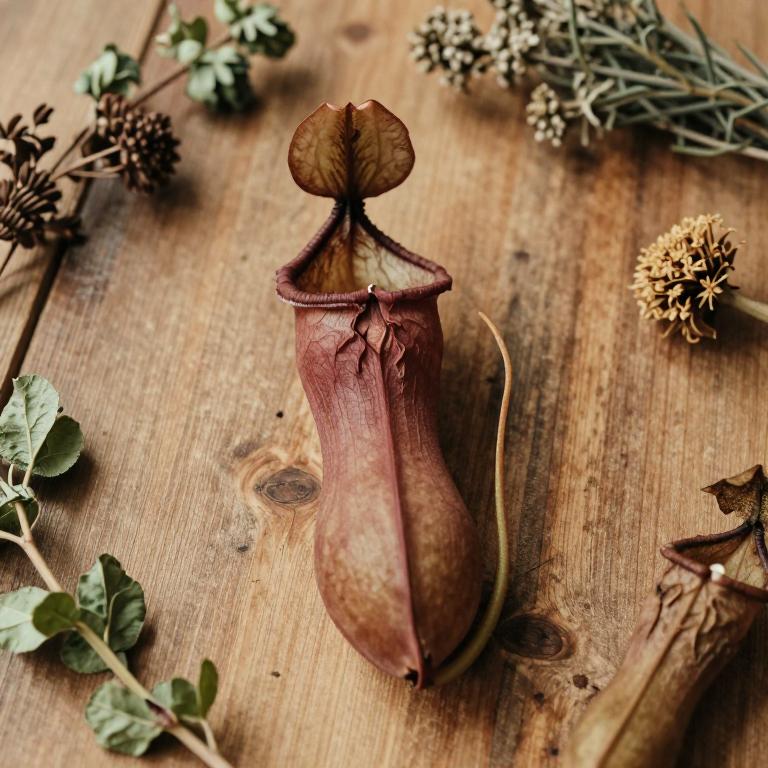
Pitcher plant, scientifically known as Nepenthis khasiana, is a unique carnivorous species endemic to the Khasi Hills of Meghalaya, India. Beyond its striking morphology, this plant holds significant ethnobotanical value, traditionally used by local communities to treat ailments ranging from digestive issues to respiratory infections and skin wounds.
- Family
- Nepenthaceae
- Native range
- Asia-Tropical
- Parts used
- Not available
- Common names
- Indian Pitcher Plant
- Scientific synonyms
- Nepenthes Rubra
Names and Synonyms
Common Names
- Indian pitcher plant
Scientific Names
Accepted name
Nepenthes khasianaSynonyms
- Nepenthes rubra
Sources: Wikidata, Catalogue of Life
Taxonomical Classification
This plant, Nepenthes khasiana, belongs to the kingdom Plantae and is classified under the phylum Streptophyta and class Equisetopsida. Within the subclass Magnoliidae and order Caryophyllales, it is a member of the family Nepenthaceae. It is further categorized under the genus Nepenthes.
| Rank | Classification |
|---|---|
| Kingdom | Plantae |
| Phylum | Streptophyta |
| Class | Equisetopsida |
| Subclass | Magnoliidae |
| Order | Caryophyllales |
| Family | Nepenthaceae |
| Genus | Nepenthes |
Sources: The World Checklist of Vascular Plants (WCVP)
Distribution
This plant is a unique carnivorous species primarily found within the Indian Subcontinent. Its natural habitat is specifically concentrated in the state of Assam, where it thrives in certain ecological niches. In addition to its presence in India, the species can also be found across the borders in Bangladesh. This limited geographical range makes it an important subject for studying regional biodiversity. Consequently, understanding its distribution is vital for the conservation efforts of this specific flora.
| Region | Area |
|---|---|
| Indian Subcontinent | Assam |
| Indian Subcontinent | Bangladesh |
Sources: The World Checklist of Vascular Plants (WCVP)
Botanical Identification
Morphology
The morphology of Nepenthes khasiana is characterized by its growth habit as a climber, specifically functioning as a liana or a vine that often requires support, though it can exhibit varying degrees of being self-supporting depending on its developmental stage and environmental context. Structurally, the plant possesses a woody nature, providing the necessary rigidity to navigate its habitat. Its vegetative architecture typically involves elongated stems that facilitate its climbing movement, leading to the development of specialized tendril-like structures that eventually transform into complex, pitcher-shaped traps.
- Climber :
- liana
- Woodiness :
- woody
Reproduction
The reproduction of Nepenthes khasiana involves a complex biological process that facilitates its survival in specific ecological niches. The plant produces flowers that are typically unisexual, necessitating cross-pollination to ensure genetic diversity. Following successful fertilization, the development of seeds is a critical stage in its life cycle. The dispersal of these seeds is characterized by a multifaceted dispersal syndrome; while the plant exhibits anemochorous tendencies, where wind plays a significant role in transporting lightweight seeds, its reproductive strategy is not limited to a single method. The dispersal syndrome encompasses anemochorous, zoochorous, autochorous, hydrochorous, and unspecialized mechanisms, allowing the species to utilize wind, animals, self-dispersal, water, and general environmental factors to spread its progeny across varying landscapes.
- Dispersal syndrome :
- anemochorous
Sources: Global Inventory of Floras and Traits (GIFT)
Chemicals
Nepenthes khasiana has 2 reported phytochemicals identified across 0 scientific publications and several other databases. The most consistently reported chemicals include Flavonoids, polyphenols.
| Chemical | Supporting sources | Consensus |
|---|---|---|
| Flavonoids | 1 supporting sources | ★☆☆☆☆ |
| polyphenols | 1 supporting sources | ★☆☆☆☆ |
Flavonoids
- Journal of photochemistry and photobiology. B, Biology
polyphenols
- Journal of photochemistry and photobiology. B, Biology
Preparations
Nepenthes khasiana has 1 reported preparations identified across 0 scientific publications and several other databases. The most consistently reported preparations include aqueous extract.
| Preparation | Supporting sources | Consensus |
|---|---|---|
| Aqueous extract | 1 supporting sources | ★☆☆☆☆ |
Aqueous extract
- Journal of photochemistry and photobiology. B, Biology