Angel's-tears
Narcissus triandrus · Accepted scientific name
Scientific literature: Very Sparse (1 studies) · ★☆☆☆☆
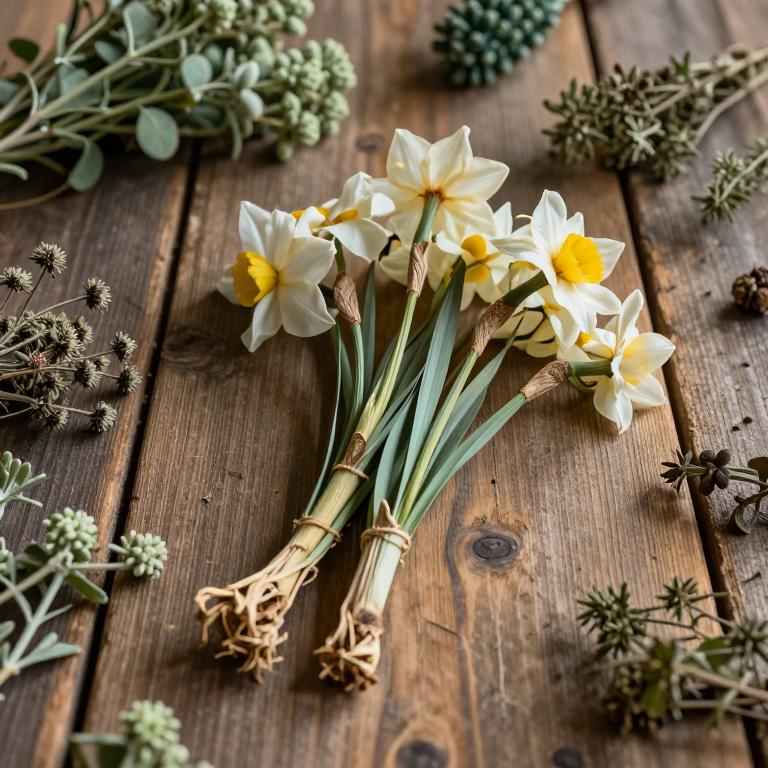
Angel's-tears, scientifically known as Narcissus triandrus, is a delicate perennial bulb native to East Asia. Renowned for its elegant, white trumpet-shaped blooms and subtle fragrance, this species holds significant value in traditional herbal medicine. It is frequently studied for its unique bioactive compounds and potential therapeutic applications.
- Family
- Amaryllidaceae
- Native range
- Europe
- Parts used
- Not available
- Common names
- Angel'S-Tears
- Scientific synonyms
- Ganymedes Triandrus · Narcissus × Calathinus Var. Triandrus · 2 more
Names and Synonyms
Common Names
- Angel's-tears
Scientific Names
Accepted name
Narcissus triandrusSynonyms
- Ganymedes triandrus
- Narcissus × calathinus var. triandrus
- Illus triandrus
- Queltia triandra
Regional and Traditional Names
Spanish:
- Narcissus sección Ganymedes
- Narcissus seccion Ganymedes
- Junquillo Blanco
- Candiles
German:
- Engelstränen-Narzisse
- Engelstränen-Narzisse
French:
- Narcisse triandre
- Narcisse à trois étamines
Sources: Wikidata, Catalogue of Life
Taxonomical Classification
This plant belongs to the kingdom Plantae and is classified within the phylum Streptophyta and the class Equisetopsida. Under the subclass Magnoliidae, it is ordered within Asparagales and falls under the family Amaryllidaceae. Finally, its specific taxonomic identity is defined by the genus Narcissus.
| Rank | Classification |
|---|---|
| Kingdom | Plantae |
| Phylum | Streptophyta |
| Class | Equisetopsida |
| Subclass | Magnoliidae |
| Order | Asparagales |
| Family | Amaryllidaceae |
| Genus | Narcissus |
Sources: The World Checklist of Vascular Plants (WCVP)
Distribution
This plant exhibits a specific distribution across several regions of the European continent. In Northern Europe, its presence can be documented within Great Britain. Moving toward the southern regions, it is also found throughout Southwestern Europe. Specifically, it inhabits the landscapes of both France and Portugal. Finally, its range extends across the territory of Spain.
| Region | Area |
|---|---|
| Northern Europe | Great Britain |
| Southwestern Europe | France |
| Southwestern Europe | Portugal |
| Southwestern Europe | Spain |
Sources: The World Checklist of Vascular Plants (WCVP)
Botanical Identification
Life history
The life history of Narcissus triandrus is defined by its specialized survival strategies, characterized primarily as a cryptophyte and a geophyte. As a cryptophyte, the plant ensures its persistence through underground organs that protect its vital structures from unfavorable environmental conditions, such as extreme temperatures or seasonal droughts. Specifically, its classification as a geophyte indicates that it relies on geophytic organs, such as bulbs, which remain buried beneath the soil surface to facilitate dormancy and rapid regrowth during favorable growing seasons. This life cycle allows the plant to navigate seasonal shifts by storing energy reserves underground, enabling it to emerge as a perennial herb when environmental cues trigger its developmental stages.
- Life form :
- geophyte
- Life form :
- cryptophyte
Morphology
The morphology of Narcissus triandrus is characterized by a non-woody growth habit, consisting of herbaceous structures that lack lignified tissue. As a terrestrial plant, it grows directly in the soil rather than as an epiphyte, establishing its root system within the ground to obtain necessary nutrients and moisture. The plant does not exhibit any climbing behavior, functioning as a self-supporting organism that maintains its structural integrity without the need for external support. Furthermore, it is an independent species, showing no parasitic tendencies toward other plants, and relies entirely on its own physiological processes for survival.
- Climber :
- self-supporting
- Epiphyte :
- terrestrial
- Parasite :
- independent
- Woodiness :
- non-woody
Sources: Global Inventory of Floras and Traits (GIFT)
Chemicals
Narcissus triandrus has 1 reported phytochemicals identified across 0 scientific publications and several other databases. The most consistently reported chemicals include Coumarins.
| Chemical | Supporting sources | Consensus |
|---|---|---|
| Coumarins | 1 supporting sources | ★☆☆☆☆ |
Coumarins
- Journal of clinical medicine