common daffodil
Narcissus pseudonarcissus · Accepted scientific name
Scientific literature: Very Sparse (3 studies) · ★☆☆☆☆
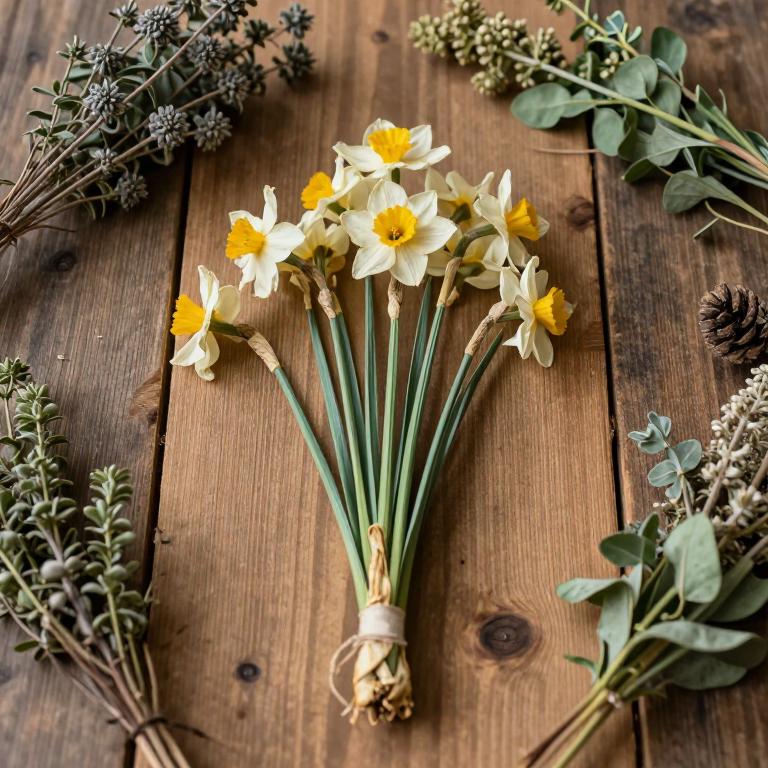
Common daffodil, scientifically known as Narcissus pseudonarcissus, is a resilient perennial valued for its striking blooms and historical medicinal uses. While primarily ornamental, various species possess bioactive compounds. However, caution is essential, as many parts are toxic if ingested, requiring careful application in traditional herbal practices and pharmacology.
Names and Synonyms
Common Names
- daffodil
- trumpet narcissus
- Tenby daffodil
- buttercup
- lent-lily
- wild daffodil
- Lent Lily
- common daffodil
Scientific Names
Accepted name
Narcissus pseudonarcissusSynonyms
- Ajax cambricus
- Narcissus pseudonarcissus f. lobularis
- Narcissus pseudonarcissus var. plenissimus
- Ajax pseudonarcissus var. luteus
- Narcissus pseudonarcissus f. pleniflorus
- Narcissus eystettensis
- Narcissus serratus
- Oileus hexangularis
- Ajax praelongus
- Narcissus major var. telamonius
- Narcissus radians
- Ajax hexangularis
- Narcissus festalis var. serratus
- Narcissus renaudii
- Narcissus pseudonarcissus var. serratus
- Ajax lobularis
- Narcissus pseudonarcissus var. festinus
- Narcissus pseudonarcissus var. humilis
- Ajax cuneifolius
- Narcissus pseudonarcissus var. minoriformis
- Narcissus sylvestris
- Narcissus pseudonarcissus var. montinus
- Ajax fenestralis
- Narcissus pseudonarcissus var. platylobus
- Narcissus telamonius
- Narcissus pseudonarcissus var. pisanus
- Ajax festinus
- Narcissus pseudonarcissus var. porrigens
- Narcissus pseudonarcissus f. serratus
- Ajax gayi
- Narcissus gayi
- Narcissus pseudonarcissus f. cambricus
- Ajax breviflos
- Narcissus gayi var. praelongus
- Narcissus glaucus
- Ajax festalis var. scoticus
- Ajax festalis var. plenus
- Ajax festalis var. plenissimus
- Ajax capax
- Ajax serratus var. suavis
- Ajax multicus
- Ajax telamonius var. grandiplenus
- Narcissus pisanus
- Ajax montinus
- Ajax platylobus
- Narcissus breviflos
- Ajax porrigens
- Narcissus horsfeldii
- Narcissus ajax
- Ajax pseudonarcissus
- Ajax radians
- Narcissus andersonii
- Ajax rudbeckii
- Ajax sabiniamus
- Narcissus pseudonarcissus var. grandiplenus
- Ajax serratus
- Ajax sexangularis
- Narcissus pseudonarcissus var. plenus
- Ajax telamonius
- Ajax lobularis var. amplicorona
- Narcissus gandogeri
- Ajax lobularis var. scotica
- Ajax fenestralis var. scoticus
- Ajax pseudonarcissus var. pallidus
- Ajax pseudonarcissus var. plenissimus
- Ajax pseudonarcissus var. pleurus
- Ajax pseudonarcissus var. ryticarpus
- Ajax pseudonarcissus var. telamonius
- Ajax serratus var. praecox
- Ajax serratus var. radians
- Ajax pseudonarcissus var. albus
Regional and Traditional Names
Spanish:
- Capilotes
- Flor de ángel
- Narcissus portensis
- Grillandas
- Narcissus pseudonarcissus subsp. portensis
- Tragón
- Narcissus pseudonarcissus subsp. nevadensis
- Narcissus pseudonarcissus subsp alpestris
- Flor de angel
- Narcissus pseudonarcissus subsp. albescens
- Narcissus pseudonarcissus subsp nobilis
- Tragon
- Narcissus pseudonarcissus subsp. macrolobus
- Falso narciso
- Narciso trompon
- Narcissus pseudonarcissus subsp moschatus
- Narcissus pseudonarcissus subsp major
- Cebolla de oro
- Narcissus pseudonarcissus subsp. pisanus
- Narcissus pseudonarcissus subsp albescens
- Narcissus pseudonarcissus subsp leonensis
- Narcissus pseudonarcissus subsp pallidiflorus
- Tragapan
- Narcissus pseudonarcissus subsp. confusus
- Narcissus pseudonarcissus subsp pisanus
- Ajax pseudonarcissus
- Narciso de los prados
- Cebolla de lechuguilla
- Narcissus pseudonarcissus subsp. alpestris
- Manteigueras
- Narcissus pseudonarcissus subsp pseudonarcissus
- Narciso sevillano
- Cebolla de los prados
- Falso-narciso
- Narcissus pseudonarcissus subsp macrolobus
- Narciso trompón
- Narcissus pseudonarcissus subsp nevadensis
- Campanillas grandes
- Capillejas
- Trompon
- Campanilla tragona
- Narcissus pseudonarcissus subsp portensis
- Narcissus pseudonarcissus subsp confusus
- Narciso trompón
German:
- Gelbe Narzisse
- Osterglöckchen
- Falscher Narzissus
- Trompeten-Narzisse
- Osterglocken
- Osterglocke
- Gelbe Narzisse
- Aprilglocke
- Maerzglocke
- Osterglocke
French:
- Narcisse jaune
- Ailault
- Aillault
- Narcisse trompette
- Porillon
- Jeannette jaune
- Faux narcisse
- jonquille
- jonquille
- narcisse faux-narcisse
- narcisse jaune
- narcisse trompette
- Jonquille des bois
- Narcisse faux narcisse
Sources: Wikidata, Catalogue of Life
Taxonomical Classification
This plant belongs to the kingdom Plantae and the phylum Streptophyta, falling under the class Equisetopsida and subclass Magnoliidae. Within the order Asparagales, it is classified under the family Amaryllidaceae. Finally, it is identified by its genus, Narcissus.
| Rank | Classification |
|---|---|
| Kingdom | Plantae |
| Phylum | Streptophyta |
| Class | Equisetopsida |
| Subclass | Magnoliidae |
| Order | Asparagales |
| Family | Amaryllidaceae |
| Genus | Narcissus |
Sources: The World Checklist of Vascular Plants (WCVP)
Distribution
This plant exhibits a specific geographical range across several regions of Europe. In Northern Europe, its presence is noted within the borders of Great Britain. Moving into Middle Europe, it can be found inhabiting the landscapes of Austria and Belgium. The distribution continues through the central territories of Czechia-Slovakia. Finally, the species is also documented growing within Germany.
| Region | Area |
|---|---|
| Northern Europe | Great Britain |
| Middle Europe | Austria |
| Middle Europe | Belgium |
| Middle Europe | Czechia-Slovakia |
| Middle Europe | Germany |
| Middle Europe | Netherlands |
| Middle Europe | Switzerland |
| Southwestern Europe | France |
| Southwestern Europe | Portugal |
| Southwestern Europe | Spain |
Sources: The World Checklist of Vascular Plants (WCVP)
Botanical Identification
Ecology
The ecology of Narcissus pseudo-narcissus is primarily characterized by its preference for lowland environments, where it thrives in stable, nutrient-rich landscapes. In these low-lying regions, the species typically colonizes moist to mesic habitats, such as damp meadows, pastures, and woodland clearings, where the soil moisture remains relatively consistent. The lowland positioning provides a buffered microclimate that supports its seasonal growth cycle, allowing it to exploit the early spring moisture availability before the onset of summer droughts. Its distribution within these lowlands is often influenced by soil composition and light availability, frequently occurring in areas with alluvial soils or moderate shade provided by scattered vegetation.
- Habitat :
- Lowland
Life history
The life history of Narcissus pseudo-narcissus is characterized by its status as a perennial organism, allowing it to persist through multiple growing seasons. As a cryptophyte, it survives unfavorable environmental periods by sheltering its vital organs underground. Specifically, it functions as a geophyte, utilizing specialized underground storage organs to endure dormancy and facilitate regrowth. The plant exhibits a deciduous nature, shedding its above-ground foliage during its dormant phase to conserve energy and resources.
- Deciduousness :
- deciduous
- Life form :
- geophyte
- Life form :
- cryptophyte
- Lifecycle :
- perennial
Morphology
The morphology of Narcissus pseudo-narcissus is characterized by its growth form as a non-woody herb, specifically classified as a forb. This plant is a self-supporting species that does not function as a climber or a liana, and it maintains an independent existence as it is not a parasite or an epiphyte, typically inhabiting terrestrial environments. In terms of stature, the plant exhibits a relatively modest height, with individual specimens ranging from a minimum of 0.15 m to a maximum of 0.6 m, resulting in a mean plant height of approximately 0.2625 m.
- Aquatic :
- terrestrial
- Climber :
- self-supporting
- Epiphyte :
- terrestrial
- Growth form :
- herb
- Growth form :
- forb
- Parasite :
- independent
- Plant height max:
- 0.6 m
- Plant height mean:
- 0.2625 m
- Plant height min:
- 0.15 m
- Woodiness :
- non-woody
Physiology
The physiology of Narcissus pseudo narcisus is characterized by a C3 photosynthetic pathway, indicating a reliance on the standard Calvin cycle for carbon fixation. As a non-carnivorous species, it obtains its nutrients through soil uptake rather than insectivory. The plant's foliage exhibits significant morphological variation, with leaf lengths ranging from a minimum of 15 cm to a maximum of 50 cm. The width of these leaves is relatively narrow, spanning from 0.5 cm to a maximum of 2 cm, resulting in a mean leaf size of approximately 17.735 cm². Furthermore, the plant demonstrates a mean Specific Leaf Area (SLA) of 193 cm²/g, a metric that reflects the relationship between its leaf surface area and its dry mass, providing insight into its resource allocation and leaf thickness strategies.
- Carnivory :
- non-carnivorous
- Leaf length max:
- 50 cm
- Leaf length min:
- 15 cm
- Leaf size mean:
- 17.735 cm²
- Leaf width max:
- 2 cm
- Leaf width min:
- 0.5 cm
- Photosynthetic pathway :
- C3
- Specific Leaf Area (SLA) mean:
- 193 cm²/g
Reproduction
The reproduction of Narcissus pseudo-narcissus is characterized by a sexual process, as asexual reproduction is notably absent. The flowering period typically begins in March and concludes in April, though the timing can be variable. The plant relies on biotic pollination syndromes, specifically involving insects, with bees serving as a primary pollinator. Successful fertilization is supported by the presence of self-fertilization capabilities. Following pollination, the plant develops a capsule fruit that is dehiscent, meaning it opens at maturity to release its seeds. These seeds are quite small, with a mean mass of approximately 0.00556475 g, ranging from a minimum of 0.00385 g to a maximum of 0.00641 g. The dispersal of the species is facilitated by unspecialized mechanisms, though it also exhibits anthropochorous tendencies, where human activity plays a role in seed movement.
- Dehiscence :
- dehiscent
- Dispersal syndrome :
- unspecialized
- Dispersal syndrome :
- anthropochorous
- Flowering time :
- Mar
- Flowering time :
- Apr
- Fruit type :
- capsule
- Pollination syndrome :
- insect
- Pollination syndrome :
- bee
- Pollination syndrome :
- biotic
- Reproduction asexual :
- absent
- Seed mass max:
- 0.00641 g
- Seed mass mean:
- 0.00556475 g
- Seed mass min:
- 0.00385 g
- Self fertilization :
- present
Sources: Global Inventory of Floras and Traits (GIFT)
Chemicals
Narcissus pseudonarcissus has 1 reported phytochemicals identified across 0 scientific publications and several other databases. The most consistently reported chemicals include galanthamine.
| Chemical | Supporting sources | Consensus |
|---|---|---|
| galanthamine | 1 supporting sources | ★☆☆☆☆ |
galanthamine
- Plants (Basel, Switzerland)
Conditions
Narcissus pseudonarcissus has 1 reported investigations on conditions identified across 0 scientific publications and several other databases. The most consistently reported conditions include Alzheimer's disease.
| Condition | Supporting sources | Consensus |
|---|---|---|
| Alzheimer's disease | 1 supporting sources | ★☆☆☆☆ |
Alzheimer's disease
- Plants (Basel, Switzerland)