Narcissus confusus
Narcissus confusus · Accepted scientific name
Scientific literature: Very Sparse (1 studies) · ★☆☆☆☆
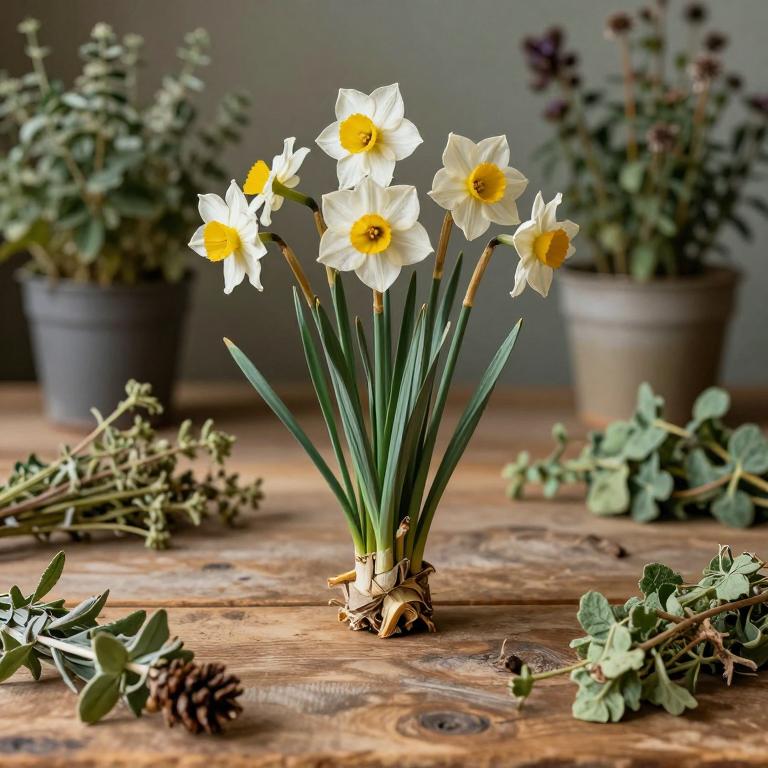
, scientifically known as Narcissus confusus, is a fascinating medicinal plant prized for its unique therapeutic properties. Often found in specific ecological niches, this species offers potential applications in traditional healing practices. Understanding its botanical characteristics and bioactive compounds is essential for exploring its role in modern pharmacological research.
- Family
- Amaryllidaceae
- Native range
- Europe
- Parts used
- Not available
- Common names
- Not available
- Scientific synonyms
- Narcissus Pseudonarcissus Subsp. Confusus · Narcissus Genesii-Lopezii · 10 more
Names and Synonyms
Scientific Names
Accepted name
Narcissus confususSynonyms
- Narcissus pseudonarcissus subsp. confusus
- Narcissus genesii-lopezii
- Narcissus hispanicus subsp. radinganorum
- Narcissus portensis var. albidotepaloideus
- Narcissus hispanicus subsp. confusus
- Narcissus pseudonarcissus subsp. radinganorum
- Narcissus pseudonarcissus subsp. calcicarpetanus
- Narcissus longispathus var. genesii-lopezii
- Narcissus pseudonarcissus subsp. pugsleyanus
- Narcissus longispathus var. radinganorum
- Narcissus radinganorum
- Narcissus calcicarpetanus
Sources: Wikidata, Catalogue of Life
Taxonomical Classification
This plant belongs to the kingdom Plantae and is classified under the phylum Streptophyta within the class Equisetopsida. As a member of the subclass Magnoliidae and the order Asparagales, it is further categorized into the family Amaryllidaceae. Finally, its taxonomic identity is defined by its placement within the genus Narcissus.
| Rank | Classification |
|---|---|
| Kingdom | Plantae |
| Phylum | Streptophyta |
| Class | Equisetopsida |
| Subclass | Magnoliidae |
| Order | Asparagales |
| Family | Amaryllidaceae |
| Genus | Narcissus |
Sources: The World Checklist of Vascular Plants (WCVP)
Distribution
This plant is a specialized species with a very limited natural range. Its geographical distribution is centered primarily within Southwestern Europe. Specifically, it can be found growing in the wild across the country of Spain. This narrow habitat suggests that the species may be endemic to certain Mediterranean environments. Consequently, its survival is closely tied to the specific ecological conditions found in this particular region.
| Region | Area |
|---|---|
| Southwestern Europe | Spain |
Sources: The World Checklist of Vascular Plants (WCVP)
Botanical Identification
Life history
The life history of Narcissus confusus is characterized by its specialized survival strategies, functioning primarily as a geophyte and a cryptophyte. As a geophyte, the plant relies on underground storage organs, such as bulbs, to endure unfavorable environmental conditions and seasonal changes, allowing it to remain dormant during periods of drought or extreme temperatures. This evolutionary adaptation ensures that the plant can rapidly regenerate and emerge when favorable growing conditions return. Simultaneously, its classification as a cryptophyte underscores its reliance on these protected, subterranean structures to shield its vital tissues from external stressors, ensuring long-term persistence within its ecological niche through cyclic periods of growth and dormancy.
- Life form :
- geophyte
- Life form :
- cryptophyte
Morphology
The morphology of Narcissus confusus is characterized by its growth habit as a self-supporting climber, meaning it does not rely on external structures to maintain its vertical orientation. It functions as an independent organism, showing no parasitic tendencies toward other plants. Furthermore, it is a terrestrial species rather than an epiphyte, establishing its root system and biological processes directly within the soil.
- Climber :
- self-supporting
- Epiphyte :
- terrestrial
- Parasite :
- independent
Sources: Global Inventory of Floras and Traits (GIFT)
Chemicals
Narcissus confusus has 1 reported phytochemicals identified across 0 scientific publications and several other databases. The most consistently reported chemicals include GAL.
| Chemical | Supporting sources | Consensus |
|---|---|---|
| GAL | 1 supporting sources | ★☆☆☆☆ |
GAL
- Plants (Basel, Switzerland)