rush-leaf jonquil
Narcissus assoanus · Accepted scientific name
Scientific literature: Very Sparse (1 studies) · ★☆☆☆☆
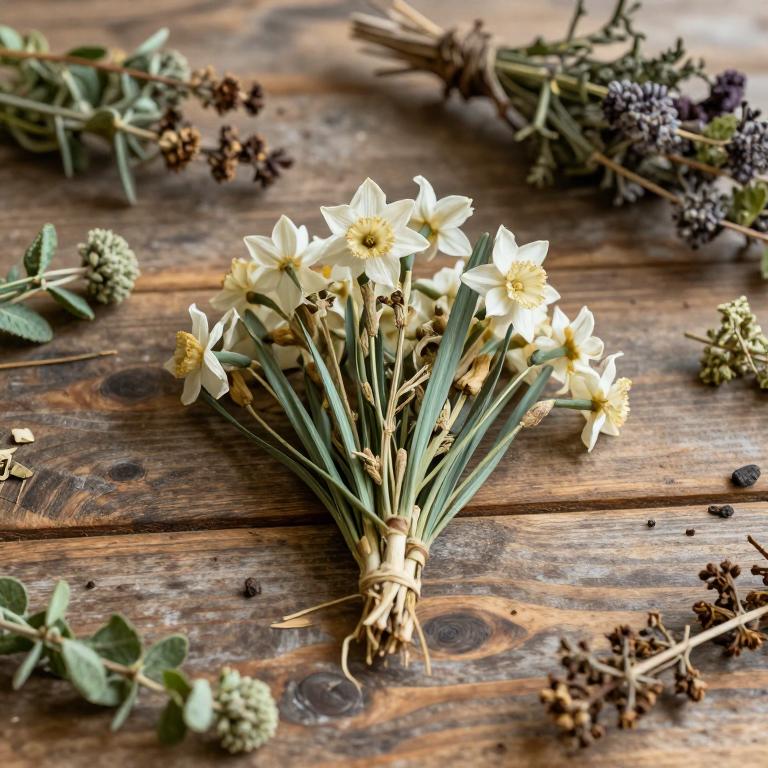
Rush-leaf jonquil, scientifically known as Narcissus assoanus, is a delicate perennial bulb native to the Mediterranean. Renowned for its slender, grass-like foliage and pale yellow blooms, this plant holds historical significance in traditional herbalism. While primarily ornamental, its unique botanical characteristics offer fascinating insights into natural medicinal history.
- Family
- Amaryllidaceae
- Native range
- Europe
- Parts used
- Not available
- Common names
- Rush-Leaf Jonquil · Rushleaf Jonquil
- Scientific synonyms
- Narcissus × Odorus Subsp. Assoanus · Queltia Assoana · 1 more
Names and Synonyms
Common Names
- rush-leaf jonquil
- rushleaf jonquil
Scientific Names
Accepted name
Narcissus assoanusSynonyms
- Narcissus × odorus subsp. assoanus
- Queltia assoana
- Narcissus juncifolius var. assoanus
Regional and Traditional Names
Spanish:
- Narcissus juncifolius var. assoanus
- Narcissus × odorus subsp. assoanus
- Queltia assoana
- Narciso gallego
German:
- Narcissus requienii
French:
- Narcisse d'Asso
- Narcisse d'Asso
- Narcisse de Requien
- Narcisse à feuilles de jonc
Sources: Wikidata, Catalogue of Life
Taxonomical Classification
This plant belongs to the kingdom Plantae and is classified under the phylum Streptophyta within the class Equisetopsida. It falls under the subclass Magnoliidae and the order Asparagales, specifically within the family Amaryllidaceae. Finally, its taxonomic placement is completed at the genus level as Narcissus.
| Rank | Classification |
|---|---|
| Kingdom | Plantae |
| Phylum | Streptophyta |
| Class | Equisetopsida |
| Subclass | Magnoliidae |
| Order | Asparagales |
| Family | Amaryllidaceae |
| Genus | Narcissus |
Sources: The World Checklist of Vascular Plants (WCVP)
Distribution
This plant exhibits a diverse geographical range spanning several continents and distinct climatic zones. In Middle Europe, its presence can be noted within the borders of Germany. Its distribution extends into Southwestern Europe, where it is found in both France and Spain. Moving eastward, the species is also established across Western Asia, specifically in Türkiye. Interestingly, the plant has reached the Southeastern United States, with documented occurrences in Louisiana.
| Region | Area |
|---|---|
| Middle Europe | Germany |
| Southwestern Europe | France |
| Southwestern Europe | Spain |
| Western Asia | Türkiye |
| Southeastern U.S.A. | Louisiana |
Sources: The World Checklist of Vascular Plants (WCVP)
Botanical Identification
Life history
The life history of Narcissus assoanus is characterized by a perennial lifecycle, allowing the plant to persist through multiple growing seasons. As a cryptophyte, it relies on specialized underground structures to survive unfavorable environmental conditions, ensuring its long-term survival in its natural habitat. Specifically, its biological classification identifies it as a geophyte, meaning it stores essential nutrients and water in underground organs such as bulbs, which facilitate its seasonal growth patterns and resilience.
- Life form :
- geophyte
- Life form :
- cryptophyte
- Lifecycle :
- perennial
Morphology
The morphology of Narcissus assoanus is characterized by its growth form as a non-woody herb, specifically classified as a forb. As a terrestrial organism, it exists as an independent species rather than a parasite or epiphyte, thriving in its natural soil-based habitat. Regarding its structural support, the plant is self-supporting and does not exhibit any climbing behavior, such as being obligatory or facultative.
- Climber :
- self-supporting
- Epiphyte :
- terrestrial
- Growth form :
- herb
- Growth form :
- forb
- Parasite :
- independent
- Woodiness :
- non-woody
Physiology
The physiology of Narcissus assoanus is characterized by a specialized metabolic framework optimized for its specific environmental niches, most notably through its utilization of the C3 photosynthetic pathway. As a C3 plant, its carbon fixation process occurs directly through the Calvin cycle, where the enzyme RuBisCO catalyzes the initial carboxylation of CO2 into a three-carbon molecule, typically 3-phosphoglycerate. This metabolic strategy is highly efficient under the temperate or Mediterranean-type conditions in which the species typically resides, allowing for steady biomass production during periods of adequate moisture. The plant's physiological rhythm is closely tied to seasonal water availability, utilizing its bulbous storage organs to manage energy reserves and sustain metabolic activities during dormancy. Consequently, its physiological performance, including gas exchange and stomatal conductance, is intricately linked to the efficiency of this C3 pathway and the plant's ability to regulate transpiration in response to fluctuating environmental stressors.
- Photosynthetic pathway :
- C3
Sources: Global Inventory of Floras and Traits (GIFT)
Chemicals
Narcissus assoanus has 1 reported phytochemicals identified across 0 scientific publications and several other databases. The most consistently reported chemicals include lycorine.
| Chemical | Supporting sources | Consensus |
|---|---|---|
| lycorine | 1 supporting sources | ★☆☆☆☆ |
lycorine
- Life sciences