blue myrtle-cactus
Myrtillocactus geometrizans · Accepted scientific name
Scientific literature: Very Sparse (5 studies) · ★☆☆☆☆
Blue myrtle-cactus, scientifically known as Myrtillocactus geometrizans, is a resilient succulent native to arid regions. Renowned for its striking bluish-green columns, this plant offers more than aesthetic beauty. Traditionally utilized in folk medicine, its unique chemical properties provide therapeutic potential, making it a fascinating subject for ethnobotanical study.
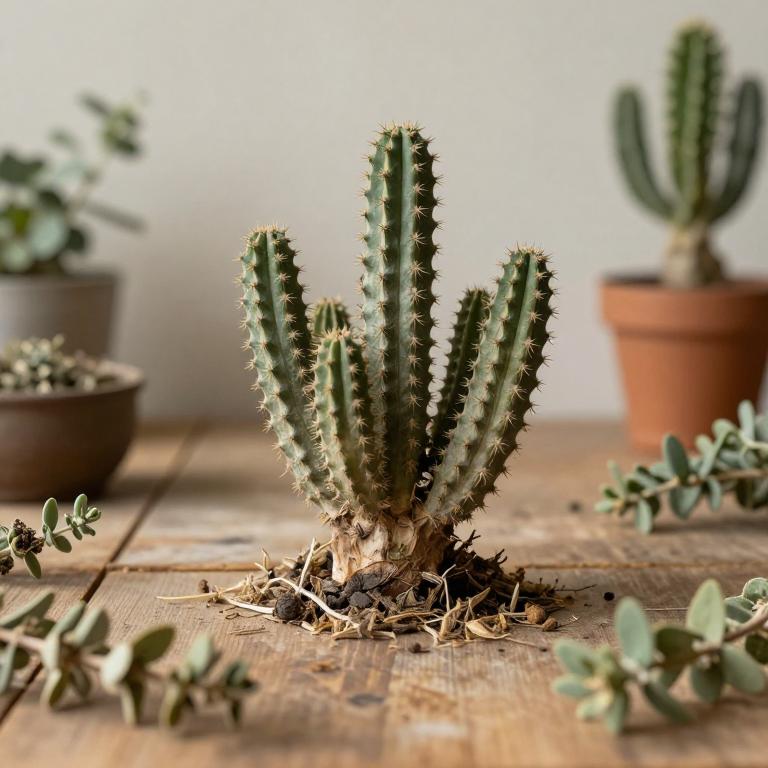
Names and Synonyms
Common Names
- blue-flame
- our-father
- Blue Myrtle-cactus
Scientific Names
Accepted name
Myrtillocactus geometrizansSynonyms
- Cereus geometrizans var. pugionifer
- Cereus pugionifer
- Myrtillocactus geometrizans var. grandiareolatus
- Cereus gladiator
- Cereus geometrizans var. quadrangularispinus
- Cereus geometrizans
- Cereus gladiator var. geometrizans
- Myrtillocactus geometrizans f. cristatus
- Cereus pugionifer var. quadrangulispinus
- Cereus garambello
- Myrtillocactus geometrizans f. hintonii
- Cereus aquicaulensis
- Myrtillocactus grandiareolatus
- Myrtillocactus pugionifer
- Myrtillocactus hertrichii
- Myrtillocactus geometrizans var. pugionifera
Regional and Traditional Names
Spanish:
- Cereus geometrizans
- Cereus pugioniferus
- Myrtillocactus grandiareolatus
- Myrtillocactus pugionifer
- garambullo
- padre nuestro
German:
- Cereus geometrizans
- Heidelbeerkaktus
French:
- Chandelle bleue
Sources: Wikidata, Catalogue of Life
Taxonomical Classification
This plant belongs to the kingdom Plantae and is classified under the phylum Streptophyta and the class Equisetopsida. Within the subclass Magnoliidae, it is categorized under the order Caryophyllales and the family Cactaceae. Finally, its specific taxonomic identity is defined by the genus Myrtillocactus.
| Rank | Classification |
|---|---|
| Kingdom | Plantae |
| Phylum | Streptophyta |
| Class | Equisetopsida |
| Subclass | Magnoliidae |
| Order | Caryophyllales |
| Family | Cactaceae |
| Genus | Myrtillocactus |
Sources: The World Checklist of Vascular Plants (WCVP)
Distribution
This plant, Myrcollocactus geometrizans, exhibits a fascinating and wide-ranging geographical distribution. Within the country of Mexico, it can be found across several diverse regions including Mexico Central, Mexico Northeast, Mexico Gulf, and Mexico Northwest. Beyond the borders of North America, its presence extends remarkably far into Southwestern Europe. Specifically, it has been identified as growing within the territory of Spain. This extensive range demonstrates the species' ability to adapt to varied environmental conditions across different continents.
| Region | Area |
|---|---|
| Southwestern Europe | Spain |
| Mexico | Mexico Central |
| Mexico | Mexico Northeast |
| Mexico | Mexico Gulf |
| Mexico | Mexico Northwest |
| Mexico | Mexico Southwest |
Sources: The World Checklist of Vascular Plants (WCVP)
Botanical Identification
Morphology
The morphology of Myrtillocactus geometrizans is characterized by a woody structure and a growth form classified as a shrub. As a terrestrial species, it does not exhibit aquatic or semiaquatic tendencies, nor does it function as an epiphyte. The plant is entirely independent, lacking any parasitic behavior, and is structurally self-supporting rather than acting as a climber, liana, or vine.
- Aquatic :
- terrestrial
- Climber :
- self-supporting
- Epiphyte :
- terrestrial
- Growth form :
- shrub
- Parasite :
- independent
- Woodiness :
- woody
Sources: Global Inventory of Floras and Traits (GIFT)
Chemicals
Myrtillocactus geometrizans has 3 reported phytochemicals identified across 0 scientific publications and several other databases. The most consistently reported chemicals include Chichipegenin, Macdougallin, Peniocerol.
| Chemical | Supporting sources | Consensus |
|---|---|---|
| Chichipegenin | 1 supporting sources | ★☆☆☆☆ |
| Macdougallin | 1 supporting sources | ★☆☆☆☆ |
| Peniocerol | 1 supporting sources | ★☆☆☆☆ |
Chichipegenin
- Zeitschrift fur Naturforschung. C, Journal of biosciences
Macdougallin
- Zeitschrift fur Naturforschung. C, Journal of biosciences
Peniocerol
- Zeitschrift fur Naturforschung. C, Journal of biosciences