horehound
Mesosphaerum suaveolens · Accepted scientific name
Scientific literature: Very Extensive (321 studies) · ★★★★★
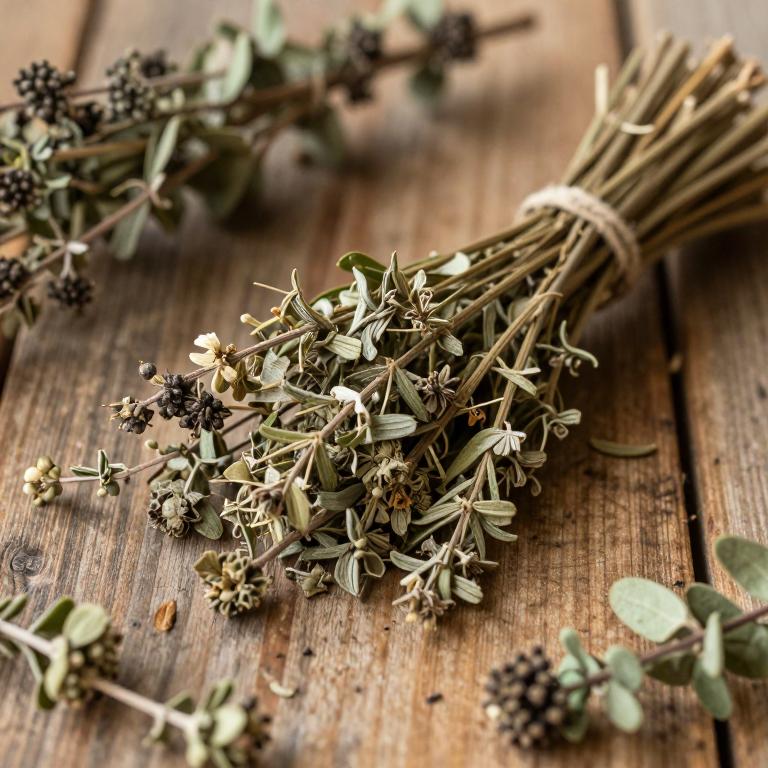
Horehound, scientifically known as MesoSphaerum suaveolenis, is a versatile medicinal herb prized for its aromatic properties. Traditionally utilized in herbal remedies, it is primarily recognized for supporting respiratory health and soothing coughs. This potent plant offers unique therapeutic benefits, making it a staple in various holistic healing practices worldwide.
Names and Synonyms
Common Names
- horehound
- mintbush
- mintweed
- pignut
- wild spikenard
- American Mint
- Hyptis
- Wide Spikenard
Scientific Names
Accepted name
Mesosphaerum suaveolensSynonyms
- Bystropogon suaveolens
- Hyptis suaveolens
- Bystropogon graveolens
- Hyptis plumieri
- Hyptis graveolens
- Hyptis congesta
- Gnoteris villosa
- Schaueria graveolens
Regional and Traditional Names
Spanish:
- chan
- chao
- hierba de las muelas
- confiturilla
French:
- gros baume
- hyptis à odeur
Sources: Wikidata, Catalogue of Life
Taxonomical Classification
This plant belongs to the kingdom Plantae and is classified under the phylum Streptophyta and class Equisetopsida. Within the subclass Magnoliidae, it is ordered under Lamiales and placed in the family Lamiaceae. It is specifically identified by the genus Mesosphaerum, which includes the species Mesosphaerum suaveolens.
| Rank | Classification |
|---|---|
| Kingdom | Plantae |
| Phylum | Streptophyta |
| Class | Equisetopsida |
| Subclass | Magnoliidae |
| Order | Lamiales |
| Family | Lamiaceae |
| Genus | Mesosphaerum |
Sources: The World Checklist of Vascular Plants (WCVP)
Distribution
This plant, Mesocephaleum suaveolens, is primarily distributed across the West Tropical Africa region. Within this expansive geographical area, it can be found growing in the nation of Benin. The species also inhabits various territories in Burkina and The Gambia. Furthermore, its presence extends into the coastal and inland landscapes of Ghana. Finally, the plant's natural range includes the country of Guinea-Bissau.
| Region | Area |
|---|---|
| West Tropical Africa | Benin |
| West Tropical Africa | Burkina |
| West Tropical Africa | Gambia |
| West Tropical Africa | Ghana |
| West Tropical Africa | Guinea-Bissau |
| West Tropical Africa | Guinea |
| West Tropical Africa | Ivory Coast |
| West Tropical Africa | Liberia |
| West Tropical Africa | Mali |
| West Tropical Africa | Nigeria |
Sources: The World Checklist of Vascular Plants (WCVP)
Botanical Identification
Ecology
The ecology of Mesosphaerum suaveolenis is characterized by a broad vertical distribution across diverse landscapes, spanning an elevational range from sea level (0 m AMSL) up to a maximum of 1600 m AMSL. While specific specialized habitat classifications are not currently detailed, its ability to thrive across such a significant altitudinal gradient suggests a high degree of ecological plasticity, allowing it to inhabit various environmental conditions found between coastal lowlands and mid-elevation montane zones.
- Elevational range max:
- 1600 m AMSL
- Elevational range min:
- 0 m AMSL
- Habitat :
- -
Genetics
The genetics of Mesosphaerum suaveolens are characterized by a notable degree of chromosomal variation within its populations. Cytogenetic analysis reveals that the species exhibits a polyploid or aneuploid nature, as evidenced by fluctuating chromosome numbers. Specifically, the chromosome number for this plant is recorded as 28, 30, or 32, indicating a complex genomic structure that may contribute to its evolutionary adaptability and phenotypic plasticity.
- Chromosome number :
- 28, 30, 32
Life history
The life history of Mesosphaerum suaveolens is characterized by an annual lifecycle, meaning the plant completes its entire developmental process—from germination to seed production—within a single growing season. In terms of its structural growth habit, it is classified as a therophyte, a life form where the plant survives unfavorable seasons as ephemeral seeds, rapidly producing a complete vegetative structure once conditions become favorable. This classification as a therophyte remains consistent across its morphological categorization, defining its strategy of avoiding environmental stress through a rapid, seasonal life cycle.
- Life form :
- therophyte
- Lifecycle :
- annual
Morphology
The morphology of Mesosphaerum suaveolens is characterized by its growth form as a non-woody herb and forb. This plant is a self-supporting species, lacking the climbing habits of lianas or vines, and it functions as an independent organism rather than a parasite. It is a terrestrial species, not categorized as aquatic or epiphytic. In terms of stature, the plant exhibits significant variation in height, ranging from a minimum of 0.5 m to a maximum of 3 m, with an average plant height of approximately 1.45 m.
- Aquatic :
- terrestrial
- Climber :
- self-supporting
- Epiphyte :
- terrestrial
- Growth form :
- herb
- Growth form :
- forb
- Parasite :
- independent
- Plant height max:
- 3 m
- Plant height mean:
- 1.45 m
- Plant height min:
- 0.5 m
- Woodiness :
- non-woody
Physiology
The physiology of Meso spheresium suaveolens is characterized by specific morphological dimensions of its foliage and its metabolic relationship with soil nutrients. The leaves exhibit significant variability in size, with individual lengths ranging from a minimum of 3 cm to a maximum of 10 cm. In terms of lateral expansion, the leaf width varies between a minimum of 2 cm and a maximum of 6 cm, defining the overall surface area available for photosynthetic activity. Regarding its nutrient acquisition strategies, the plant does not function as a nitrogen fixer, meaning it lacks the symbiotic relationship with nitrogen-fixing bacteria required to convert atmospheric nitrogen into a usable form, relying instead on the uptake of available nitrogen from the substrate.
- Leaf length max:
- 10 cm
- Leaf length min:
- 3 cm
- Leaf width max:
- 6 cm
- Leaf width min:
- 2 cm
- Nitrogen fixer :
- no
Reproduction
The reproduction of Mesosphaerum suaveolens is characterized by the production of small fruits, which typically measure between a minimum of 0.12 cm and a maximum of 0.15 cm in length. Within these fruits, the seeds exhibit a specific range of mass, with the smallest recorded seed weighing 0.00108 g and the largest reaching up to 0.0074 g, resulting in an average seed mass of approximately 0.004285714 g. The dispersal of these seeds follows a zoochorous syndrome, indicating that the plant relies on animals for the distribution of its offspring across the environment.
- Dispersal syndrome :
- zoochorous
- Fruit length max:
- 0.15 cm
- Fruit length min:
- 0.12 cm
- Seed mass max:
- 0.0074 g
- Seed mass mean:
- 0.004285714 g
- Seed mass min:
- 0.00108 g
Sources: Global Inventory of Floras and Traits (GIFT)
Plant Parts
Mesosphaerum suaveolens has 2 reported plant parts identified across 2 scientific publications and several other databases that are studied for medicinal purposes. The most consistently reported plant part include leaf, stem.
| Plant part | Supporting sources | Consensus |
|---|---|---|
| Leaf | 1 supporting sources | ★☆☆☆☆ |
| Stem | 1 supporting sources | ★☆☆☆☆ |
Leaf
- Antibiotics (Basel, Switzerland)
Stem
- Zhong yao cai = Zhongyaocai = Journal of Chinese medicinal materials
Chemicals
Mesosphaerum suaveolens has 64 reported phytochemicals identified across 2 scientific publications and several other databases. The most consistently reported chemicals include 1,8-Cineole, Bicyclogermacrene, LIMONENE, SABINENE, caffeic acid.
| Chemical | Supporting sources | Consensus |
|---|---|---|
| 1,8-Cineole | 3 supporting sources | ★★☆☆☆ |
| Bicyclogermacrene | 2 supporting sources | ★☆☆☆☆ |
| LIMONENE | 2 supporting sources | ★☆☆☆☆ |
| SABINENE | 2 supporting sources | ★☆☆☆☆ |
| caffeic acid | 2 supporting sources | ★☆☆☆☆ |
| quercetin | 2 supporting sources | ★☆☆☆☆ |
| (E)-Caryophyllene | 1 supporting sources | ★☆☆☆☆ |
| (E)-beta-ocimene | 1 supporting sources | ★☆☆☆☆ |
| (Z)-BETA-OCIMENE | 1 supporting sources | ★☆☆☆☆ |
| 2,5-Dimethyl-3-methylene-1,5-heptadiene | 1 supporting sources | ★☆☆☆☆ |
1,8-Cineole
- Dr. Duke
- Phytochemistry
- Acta tropica
Bicyclogermacrene
- Acta tropica
- Environmental science and pollution research international
LIMONENE
- Dr. Duke
- Phytochemistry
SABINENE
- Dr. Duke
- Phytochemistry
caffeic acid
- Journal of ethnopharmacology
- Antibiotics (Basel, Switzerland)
quercetin
- Journal of ethnopharmacology
- Antibiotics (Basel, Switzerland)
(E)-Caryophyllene
- Acta tropica
(E)-beta-ocimene
- Dr. Duke
(Z)-BETA-OCIMENE
- Dr. Duke
2,5-Dimethyl-3-methylene-1,5-heptadiene
- Dr. Duke
Activities
Mesosphaerum suaveolens has 233 reported activities identified across 2 scientific publications and several other databases. The most consistently reported activities include Antioxidant, (-)-Chronotropic, (-)-Inotropic, ACE-Inhibitor, AChE-Inhibitor.
| Activity | Supporting sources | Consensus |
|---|---|---|
| Antioxidant | 2 supporting sources | ★☆☆☆☆ |
| (-)-Chronotropic | 1 supporting sources | ★☆☆☆☆ |
| (-)-Inotropic | 1 supporting sources | ★☆☆☆☆ |
| ACE-Inhibitor | 1 supporting sources | ★☆☆☆☆ |
| AChE-Inhibitor | 1 supporting sources | ★☆☆☆☆ |
| Acaricide | 1 supporting sources | ★☆☆☆☆ |
| Aldose-Reductase-Inhibitor | 1 supporting sources | ★☆☆☆☆ |
| Allelochemic | 1 supporting sources | ★☆☆☆☆ |
| Allelopathic | 1 supporting sources | ★☆☆☆☆ |
| Allergenic | 1 supporting sources | ★☆☆☆☆ |
Antioxidant
- Dr. Duke
- Journal of ethnopharmacology
(-)-Chronotropic
- Dr. Duke
(-)-Inotropic
- Dr. Duke
ACE-Inhibitor
- Dr. Duke
AChE-Inhibitor
- Dr. Duke
Acaricide
- Dr. Duke
Aldose-Reductase-Inhibitor
- Dr. Duke
Allelochemic
- Dr. Duke
Allelopathic
- Dr. Duke
Allergenic
- Dr. Duke
Conditions
Mesosphaerum suaveolens has 1 reported investigations on conditions identified across 2 scientific publications and several other databases. The most consistently reported conditions include Candida.
| Condition | Supporting sources | Consensus |
|---|---|---|
| Candida | 1 supporting sources | ★☆☆☆☆ |
Candida
- Antibiotics (Basel, Switzerland)
Preparations
Mesosphaerum suaveolens has 18 reported preparations identified across 2 scientific publications and several other databases. The most consistently reported preparations include essential oils, hexane extract, Aqueous extracts, Essential Oils, Hyptis suaveolens extract.
| Preparation | Supporting sources | Consensus |
|---|---|---|
| Essential oils | 3 supporting sources | ★★☆☆☆ |
| Hexane extract | 2 supporting sources | ★☆☆☆☆ |
| Aqueous extracts | 1 supporting sources | ★☆☆☆☆ |
| Essential oils | 1 supporting sources | ★☆☆☆☆ |
| Hyptis suaveolens extract | 1 supporting sources | ★☆☆☆☆ |
| Aerial parts (aeapms) | 1 supporting sources | ★☆☆☆☆ |
| Aqueous extracts of leaves (aelms) | 1 supporting sources | ★☆☆☆☆ |
| Chloroform extract | 1 supporting sources | ★☆☆☆☆ |
| Crude drug | 1 supporting sources | ★☆☆☆☆ |
| Crude extract preparations | 1 supporting sources | ★☆☆☆☆ |
Essential oils
- Phytochemistry
- Acta tropica
- Environmental science and pollution research international
Hexane extract
- Molecules (Basel, Switzerland)
- Parasitology research
Aqueous extracts
- Journal of ethnopharmacology
Essential oils
- Infection and drug resistance
Hyptis suaveolens extract
- Molecules (Basel, Switzerland)
Aerial parts (aeapms)
- Antibiotics (Basel, Switzerland)
Aqueous extracts of leaves (aelms)
- Antibiotics (Basel, Switzerland)
Chloroform extract
- Parasitology research
Crude drug
- Journal of ethnopharmacology
Crude extract preparations
- Journal of ethnopharmacology