kajeput
Melaleuca · Accepted scientific name
Scientific literature: Very Sparse (9 studies) · ★☆☆☆☆
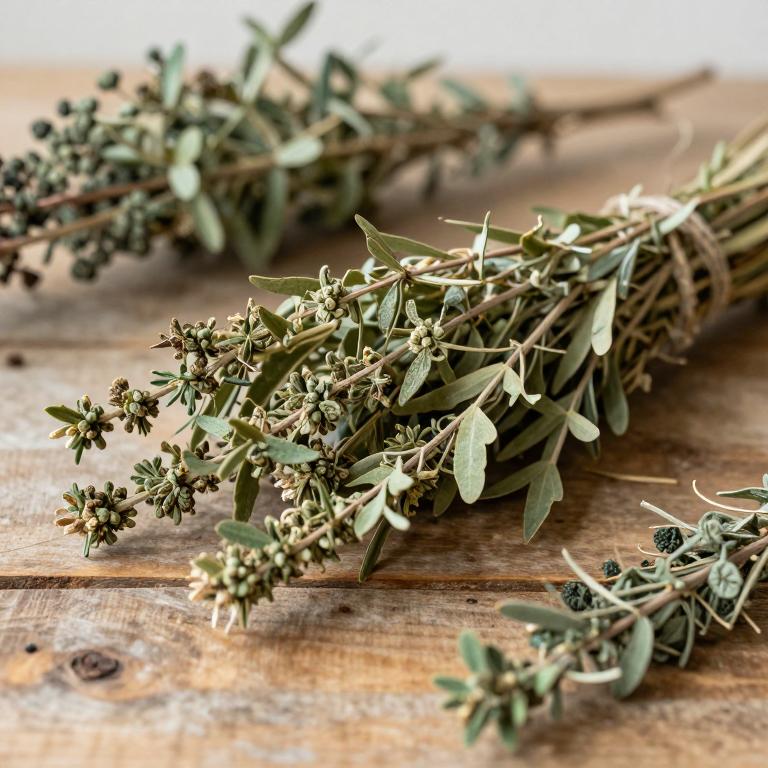
Kajeput, scientifically known as Melaleuca, is a versatile medicinal plant prized for its powerful antimicrobial properties. Native to Australia, its aromatic leaves yield essential oils used to treat skin infections, respiratory issues, and inflammation. This resilient shrub remains a cornerstone in natural healing and therapeutic aromatherapy worldwide.
- Family
- Myrtaceae
- Native range
- Europe
- Parts used
- Flower · Leaf
- Common names
- Bottlebrush · Bottlebrushes
- Scientific synonyms
- Ozandra · Conothamnus · 10 more
Names and Synonyms
Common Names
- bottlebrush
- bottlebrushes
Scientific Names
Accepted name
MelaleucaSynonyms
- Ozandra
- Conothamnus
- Callistemon
- Calothamnus
- Beaufortia
- Eremaea
- Lamarchea
- Schizopleura
- Petraeomyrtus
- Billottia
- Phymatocarpus
- Kajuputi
Regional and Traditional Names
Spanish:
- Limpiabotellas
German:
- Myrtenheiden
- kajeput
- Myrtenheiden
- Teebaum
Sources: Wikidata, Catalogue of Life
Taxonomical Classification
This plant belongs to the kingdom Plantae within the phylum Streptophyta and the class Equisetopsida. It is further classified under the subclass Magnoliidae, the order Myrtales, and the family Myrtaceae. Finally, it is categorized under the genus Melaleuca.
| Rank | Classification |
|---|---|
| Kingdom | Plantae |
| Phylum | Streptophyta |
| Class | Equisetopsida |
| Subclass | Magnoliidae |
| Order | Myrtales |
| Family | Myrtaceae |
| Genus | Melaleuca |
Sources: The World Checklist of Vascular Plants (WCVP)
Distribution
This plant exhibits a diverse geographical distribution spanning several distinct regions across Europe and its surrounding islands. In Northern Europe, its presence can be noted within the territory of Great Britain. Moving toward the Mediterranean, it is found in the Baleares of Southwestern Europe and throughout Italy in Southeastern Europe. The plant also inhabits the Northwest Balkan Peninsula, marking another significant area in Southeastern Europe. Finally, its range extends to the Macaronesian region, specifically including the Canary Islands.
| Region | Area |
|---|---|
| Northern Europe | Great Britain |
| Southwestern Europe | Baleares |
| Southeastern Europe | Italy |
| Southeastern Europe | NW. Balkan Pen. |
| Macaronesia | Canary Is. |
| Macaronesia | Madeira |
| West Tropical Africa | Benin |
| West-Central Tropical Africa | Gabon |
| West-Central Tropical Africa | Gulf of Guinea Is. |
| East Tropical Africa | Kenya |
Sources: The World Checklist of Vascular Plants (WCVP)
Plant Parts
Melaleuca has 3 reported plant parts identified across 3 scientific publications and several other databases that are studied for medicinal purposes. The most consistently reported plant part include flower, leaf, stem.
| Plant part | Supporting sources | Consensus |
|---|---|---|
| Flower | 1 supporting sources | ★☆☆☆☆ |
| Leaf | 1 supporting sources | ★☆☆☆☆ |
| Stem | 1 supporting sources | ★☆☆☆☆ |
Flower
- Planta medica
Leaf
- Planta medica
Stem
- Planta medica
Activities
Melaleuca has 4 reported activities identified across 3 scientific publications and several other databases. The most consistently reported activities include Antibacterial, Antifungal, Antioxidant, Neuroprotective.
| Activity | Supporting sources | Consensus |
|---|---|---|
| Antibacterial | 1 supporting sources | ★☆☆☆☆ |
| Antifungal | 1 supporting sources | ★☆☆☆☆ |
| Antioxidant | 1 supporting sources | ★☆☆☆☆ |
| Neuroprotective | 1 supporting sources | ★☆☆☆☆ |
Antibacterial
- Phytotherapy research : PTR
Antifungal
- Phytotherapy research : PTR
Antioxidant
- Phytomedicine : international journal of phytotherapy and phytopharmacology
Neuroprotective
- Phytomedicine : international journal of phytotherapy and phytopharmacology
Conditions
Melaleuca has 1 reported investigations on conditions identified across 3 scientific publications and several other databases. The most consistently reported conditions include colon cancer.
| Condition | Supporting sources | Consensus |
|---|---|---|
| Colon cancer | 1 supporting sources | ★☆☆☆☆ |
Colon cancer
- Antioxidants (Basel, Switzerland)