Pine Paperbark
Melaleuca linearis var. linearis · Accepted scientific name
Scientific literature: Very Sparse (3 studies) · ★☆☆☆☆
Pine Paperbark, scientifically known as Melaleuca linearis var. linearis, is a resilient Australian shrub renowned for its distinctive papery bark. Highly valued in traditional medicine, this plant possesses potent antimicrobial and antiseptic properties. Its essential oils offer therapeutic benefits, making it a significant species in both ethnobotany and pharmacology.
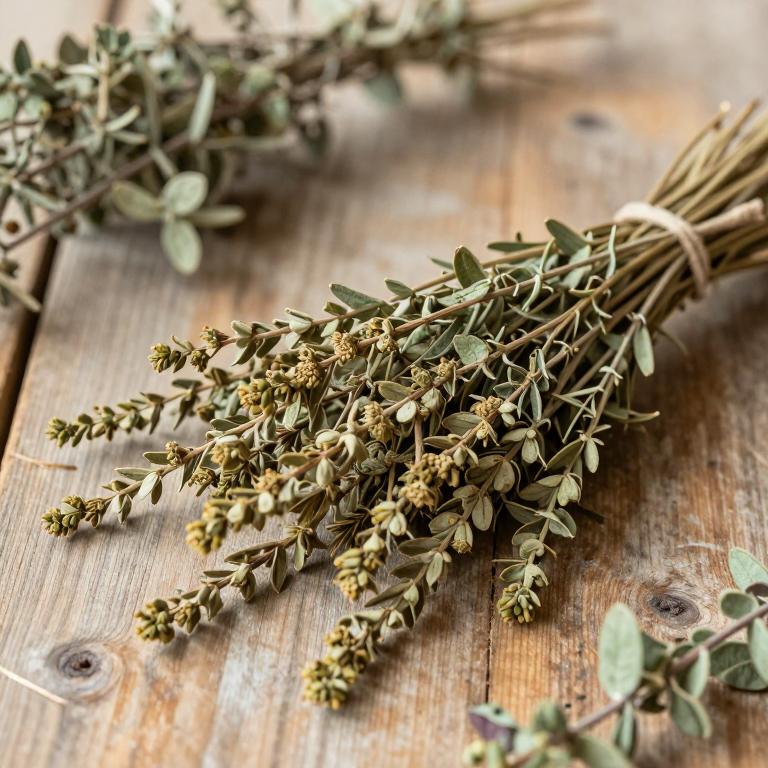
Names and Synonyms
Common Names
- Pine Paperbark
- Stiff Bottlebrush
- Stiff-leaved Bottlebrush
Scientific Names
Accepted name
Melaleuca linearis var. linearisSynonyms
- Metrosideros glandulosa
- Metrosideros rigida
- Metrosideros rigidifolia
- Metrosideros aspera
- Callistemon rigidus
Sources: Wikidata, Catalogue of Life
Taxonomical Classification
This plant belongs to the kingdom Plantae and the phylum Streptophyta, falling under the class Equisetopsida and subclass Magnoliidae. Within the order Myrtales, it is classified under the family Myrtaceae and the genus Melaleuca. Specifically, its taxonomic designation is Melaleuca linearis var. linearis.
| Rank | Classification |
|---|---|
| Kingdom | Plantae |
| Phylum | Streptophyta |
| Class | Equisetopsida |
| Subclass | Magnoliidae |
| Order | Myrtales |
| Family | Myrtaceae |
| Genus | Melaleuca |
Sources: The World Checklist of Vascular Plants (WCVP)
Distribution
This plant exhibits a remarkably wide and scattered geographical distribution across several continents. In Northern Europe, its presence can be noted within Great Britain. Moving toward warmer climates, it is found in East Tropical Africa, specifically in Tanzania, as well as in the Cape Provinces of Southern Africa. Its range extends into the Indian Subcontinent, where it grows in the Assam region. Finally, the species is also well-established in Australia, particularly within New South Wales.
| Region | Area |
|---|---|
| Northern Europe | Great Britain |
| East Tropical Africa | Tanzania |
| Southern Africa | Cape Provinces |
| Indian Subcontinent | Assam |
| Australia | New South Wales |
| Australia | Queensland |
| New Zealand | New Zealand North |
Sources: The World Checklist of Vascular Plants (WCVP)
Plant Parts
Melaleuca linearis var. linearis has 1 reported plant parts identified across 1 scientific publications and several other databases that are studied for medicinal purposes. The most consistently reported plant part include stem.
| Plant part | Supporting sources | Consensus |
|---|---|---|
| Stem | 1 supporting sources | ★☆☆☆☆ |
Stem
- Biological & pharmaceutical bulletin
Chemicals
Melaleuca linearis var. linearis has 2 reported phytochemicals identified across 1 scientific publications and several other databases. The most consistently reported chemicals include Scirpusin B, piceatannol.
| Chemical | Supporting sources | Consensus |
|---|---|---|
| Scirpusin B | 1 supporting sources | ★☆☆☆☆ |
| piceatannol | 1 supporting sources | ★☆☆☆☆ |
Scirpusin B
- Biological & pharmaceutical bulletin
piceatannol
- Biological & pharmaceutical bulletin
Preparations
Melaleuca linearis var. linearis has 1 reported preparations identified across 1 scientific publications and several other databases. The most consistently reported preparations include stem bark.
| Preparation | Supporting sources | Consensus |
|---|---|---|
| Stem bark | 1 supporting sources | ★☆☆☆☆ |
Stem bark
- Biological & pharmaceutical bulletin