twin-spine cactus
Mammillaria geminispina · Accepted scientific name
Scientific literature: Very Sparse (8 studies) · ★☆☆☆☆
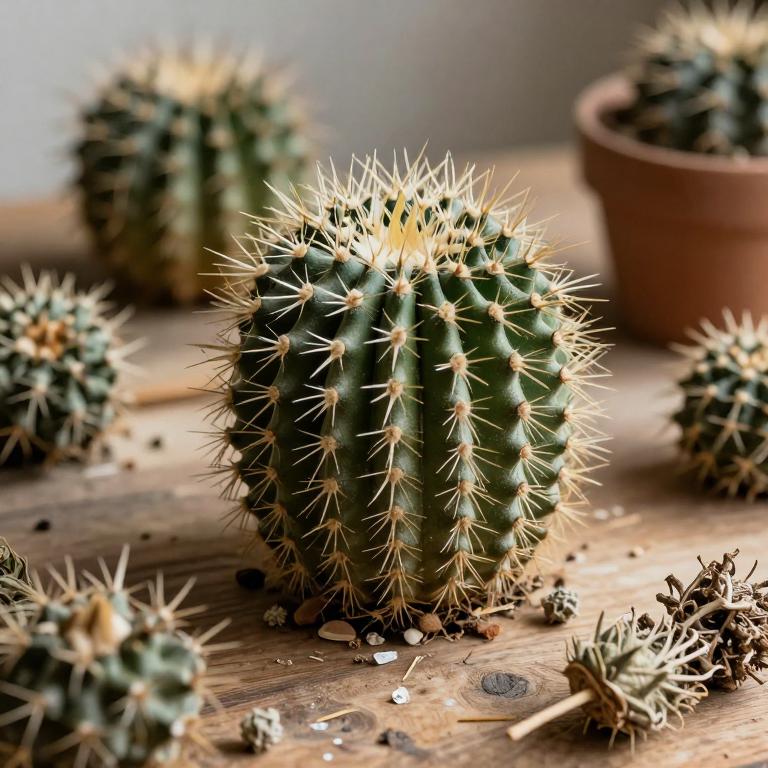
Twin-spine cactus, scientifically known as Mammillaria geminispina, is a captivating succulent native to Mexico. Renowned for its distinctive paired spines and delicate pink blossoms, this resilient species is prized in traditional medicine and ornamental horticulture. Its compact, globular form makes it a fascinating subject for botanical study and cultivation.
- Family
- Cactaceae
- Native range
- Northern America
- Parts used
- Not available
- Common names
- Twin-Spine Cactus · Whitey
- Scientific synonyms
- Mammillaria Bicolor F. Nivea · Mammillaria Geminispina Var. Brevispina · 54 more
Names and Synonyms
Common Names
- twin-spine cactus
- whitey
Scientific Names
Accepted name
Mammillaria geminispinaSynonyms
- Mammillaria bicolor f. nivea
- Mammillaria geminispina var. brevispina
- Cactus geminispinus
- Mammillaria geminispina var. monacantha
- Mammillaria geminispina subsp. leucocentra
- Mammillaria geminispina var. nobilis
- Mammillaria geminispina var. tetracantha
- Mammillaria elegans var. aureispina
- Cactus columnaris
- Mammillaria elegans var. micracantha
- Mammillaria elegans var. longicaudata
- Mammillaria elegans var. klugii
- Cactus dyckianus
- Mammillaria elegans var. minor
- Mammillaria elegans var. lupina
- Cactus klugii
- Mammillaria elegans var. globosa
- Mammillaria elegans var. teyuca
- Mammillaria nivea var. brevispina
- Cactus leucocentrus
- Mammillaria nivea var. daedalea
- Mammillaria elegans
- Mammillaria acanthophlegma var. monacantha
- Cactus niveus
- Mammillaria acanthophlegma var. abducta
- Mammillaria bellatula
- Mammillaria acanthophlegma var. decandollei
- Cactus meissneri
- Mammillaria acanthophlegma var. elegans
- Mammillaria bicolor
- Mammillaria acanthophlegma var. leucocephala
- Cactus bellatulus
- Mammillaria bicolor f. cristata
- Mammillaria albata
- Cactus acanthophlegma
- Mammillaria bicolor f. nobilis
- Mammillaria albata var. longispina
- Mammillaria bicolor var. cristata
- Mammillaria bicolor var. longispina
- Mammillaria albata var. sanciro
- Mammillaria bicolor var. nivea
- Mammillaria bicolor var. nobilis
- Neomammillaria geminispina
- Mammillaria acanthophlegma
- Mammillaria klugii
- Mammillaria toaldoae
- Mammillaria splendens
- Mammillaria eburnea
- Mammillaria dyckiana
- Neomammillaria elegans
- Mammillaria daedalea
- Mammillaria nivea
- Mammillaria nobilis
- Mammillaria recta
- Mammillaria leucocentra
- Mammillaria nivea subsp. leucocentra
Regional and Traditional Names
Spanish:
- Mammillaria albata
- Mammillaria elengans
- Mammillaria leucocentra
- Biznaga metzolle
German:
- Mammillaria geminispina var. brevispina
- Mammillaria geminispina var. nivea
- Mammillaria albata
- Mammillaria albata var. longispina
- Mammillaria geminispina var. tetracantha
- Mammillaria leucocentra
- Mammillaria nobilis
- Mammillaria albata var. sanciro
- Mammillaria geminispina var. monacantha
- Mammillaria elegans
- Mammillaria geminispina var. nobilis
French:
- Mammillaria fraileana
Sources: Wikidata, Catalogue of Life
Taxonomical Classification
This plant belongs to the kingdom Plantae within the phylum Streptophyta and the class Equisetopsida. It is further classified under the subclass Magnoliidae and the order Caryophyllales, falling into the family Cactaceae. Ultimately, it is identified by the genus Mammillaria.
| Rank | Classification |
|---|---|
| Kingdom | Plantae |
| Phylum | Streptophyta |
| Class | Equisetopsida |
| Subclass | Magnoliidae |
| Order | Caryophyllales |
| Family | Cactaceae |
| Genus | Mammillaria |
Sources: The World Checklist of Vascular Plants (WCVP)
Distribution
This plant is a cactus species with a specific and localized distribution within Mexico. Its presence is primarily documented in the northeastern regions of the country. Additionally, it can be found throughout the coastal areas of the Mexican Gulf. These distinct locations suggest that the species thrives in certain environmental conditions found in these zones. Consequently, understanding these specific habitats is essential for the conservation of Mammillaria geminispina.
| Region | Area |
|---|---|
| Mexico | Mexico Northeast |
| Mexico | Mexico Gulf |
Sources: The World Checklist of Vascular Plants (WCVP)
Botanical Identification
Morphology
The morphology of Mammillaria geminispina is characterized by a compact, globose to cylindrical stem structure that functions as a self-supporting growth form. As a terrestrial species, it does not exhibit aquatic or semiaquatic tendencies, nor does it function as an epiphyte, maintaining a strictly soil-based existence. The plant is entirely independent, lacking any parasitic behavior, and its structural integrity is defined by a woody core within the succulent tissue. Unlike climbers or lianas, it lacks any vine-like or obligatory climbing habits, instead utilizing its sturdy, non-climbing architecture to remain upright.
- Aquatic :
- terrestrial
- Climber :
- self-supporting
- Epiphyte :
- terrestrial
- Growth form :
- tree
- Parasite :
- independent
- Woodiness :
- woody
Sources: Global Inventory of Floras and Traits (GIFT)
Chemicals
Mammillaria geminispina has 5 reported phytochemicals identified across 0 scientific publications and several other databases. The most consistently reported chemicals include CHLOROGENIC ACID, Diosmetin, Saponins, Tannins, gentisic acid.
| Chemical | Supporting sources | Consensus |
|---|---|---|
| CHLOROGENIC ACID | 1 supporting sources | ★☆☆☆☆ |
| Diosmetin | 1 supporting sources | ★☆☆☆☆ |
| Saponins | 1 supporting sources | ★☆☆☆☆ |
| Tannins | 1 supporting sources | ★☆☆☆☆ |
| gentisic acid | 1 supporting sources | ★☆☆☆☆ |
CHLOROGENIC ACID
- Plants (Basel, Switzerland)
Diosmetin
- Plants (Basel, Switzerland)
Saponins
- Plants (Basel, Switzerland)
Tannins
- Plants (Basel, Switzerland)
gentisic acid
- Plants (Basel, Switzerland)
Activities
Mammillaria geminispina has 3 reported activities identified across 0 scientific publications and several other databases. The most consistently reported activities include Antimicrobial, Antioxidant, Cytotoxic.
| Activity | Supporting sources | Consensus |
|---|---|---|
| Antimicrobial | 1 supporting sources | ★☆☆☆☆ |
| Antioxidant | 1 supporting sources | ★☆☆☆☆ |
| Cytotoxic | 1 supporting sources | ★☆☆☆☆ |
Antimicrobial
- Plants (Basel, Switzerland)
Antioxidant
- Plants (Basel, Switzerland)
Cytotoxic
- Plants (Basel, Switzerland)
Preparations
Mammillaria geminispina has 1 reported preparations identified across 0 scientific publications and several other databases. The most consistently reported preparations include ethanol extracts.
| Preparation | Supporting sources | Consensus |
|---|---|---|
| Ethanol extracts | 1 supporting sources | ★☆☆☆☆ |
Ethanol extracts
- Plants (Basel, Switzerland)