Magnolia ovata
Magnolia ovata · Accepted scientific name
Scientific literature: Very Sparse (14 studies) · ★☆☆☆☆
, scientifically known as Magnolia ovata, is a versatile medicinal plant cherished in traditional healing practices. Renowned for its potent antioxidant and anti-inflammatory properties, it is frequently utilized to soothe digestive ailments, reduce stress, and promote overall wellness. This botanical treasure offers a natural approach to holistic health.
- Family
- Magnoliaceae
- Native range
- Southern America
- Parts used
- Leaf
- Common names
- Not available
- Scientific synonyms
- Talauma Dubia · Talauma Ovata
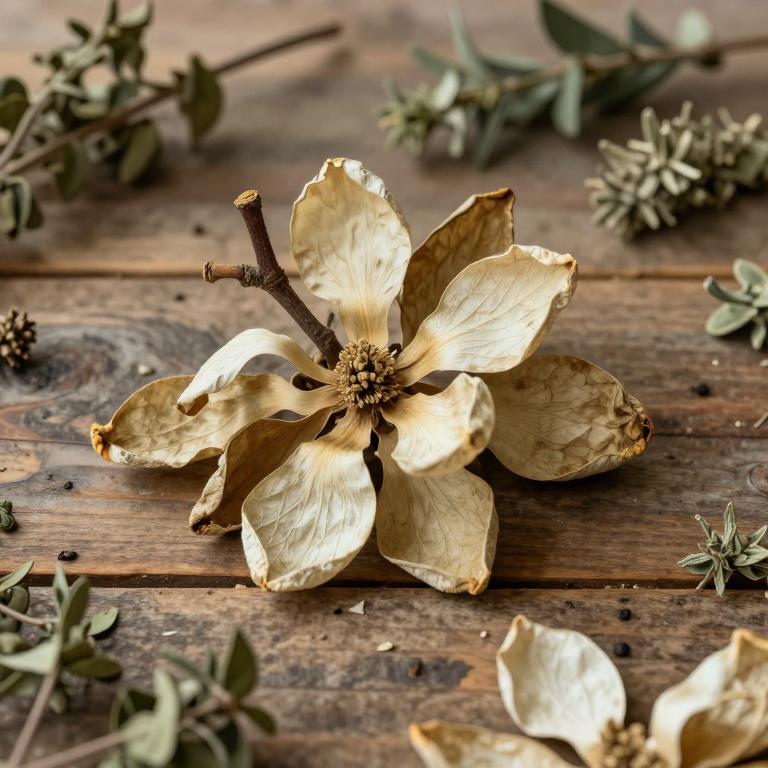
Names and Synonyms
Scientific Names
Accepted name
Magnolia ovataSynonyms
- Talauma dubia
- Talauma ovata
Regional and Traditional Names
French:
- Talauma dubia
Sources: Wikidata, Catalogue of Life
Taxonomical Classification
This plant belongs to the kingdom Plantae and is classified under the phylum Streptophyta and class Equisetopsida. Within the subclass Magnoliidae and order Magnoliales, it is a member of the family Magnoliaceae. Finally, it is situated under the genus Magnolia, specifically identified as the species Magnolia ovata.
| Rank | Classification |
|---|---|
| Kingdom | Plantae |
| Phylum | Streptophyta |
| Class | Equisetopsida |
| Subclass | Magnoliidae |
| Order | Magnoliales |
| Family | Magnoliaceae |
| Genus | Magnolia |
Sources: The World Checklist of Vascular Plants (WCVP)
Distribution
This plant, Magnolia ovata, exhibits a diverse geographical presence across several major regions of Brazil. It can be found growing within the West-Central part of the country, contributing to its local biodiversity. Furthermore, its distribution extends into the Northeast region, where it adapts to specific environmental conditions. The plant is also documented in the Southeast, showcasing its ability to thrive in varied climates. Finally, its reach continues into the South, completing a widespread range across the Brazilian landscape.
| Region | Area |
|---|---|
| Brazil | Brazil West-Central |
| Brazil | Brazil Northeast |
| Brazil | Brazil Southeast |
| Brazil | Brazil South |
Sources: The World Checklist of Vascular Plants (WCVP)
Botanical Identification
Ecology
The ecology of Magnolia ovata is fundamentally tied to high-moisture environments, specifically occurring within Ciliary Forests or Gallery Forests, as well as Ombrophilous Forests (Rainforests). These habitats provide the consistent humidity and stable temperature regimes necessary for its development, often characterized by dense canopy cover that regulates light penetration and maintains a damp forest floor. As a component of these fluvial or pluvial ecosystems, the species thrives in areas where soil moisture is abundant and nutrient cycling is rapid, typically found in riparian zones where the proximity to water bodies supports the lush, stratified vegetation typical of these forest types.
- Habitat :
- Floresta Ciliar ou Galeria, Floresta Ombrófila (= Floresta Pluvial)
Life history
The life history of Magnolia ovata is characterized by its status as a perennial organism, ensuring its presence in the ecosystem across multiple growing seasons. As a phanerophyte, the plant maintains its reproductive buds at a significant height above the ground, typically supported by a robust woody structure. This phanerophyte life form allows it to thrive in diverse forest environments by elevating its foliage and flowering structures. Furthermore, the plant exhibits an evergreen deciduousness, retaining its foliage throughout various seasonal shifts rather than shedding it entirely, which provides a continuous photosynthetic capacity and structural stability throughout its lifespan.
- Deciduousness :
- evergreen
- Life form :
- phanerophyte
- Lifecycle :
- perennial
Morphology
The morphology of Magnolia ovata is characterized by its growth form as a woody tree that functions as an independent organism, lacking any parasitic tendencies. It is a terrestrial species, neither aquatic nor epiphytic, and is classified as a self-supporting plant rather than a climber, liana, or vine. In terms of its physical stature, the plant exhibits significant vertical development, with a height that typically ranges from a minimum of 20 meters to a maximum of 30 meters, maintaining an average plant height of approximately 25 meters.
- Aquatic :
- terrestrial
- Climber :
- self-supporting
- Epiphyte :
- terrestrial
- Growth form :
- tree
- Parasite :
- independent
- Plant height max:
- 30 m
- Plant height mean:
- 25 m
- Plant height min:
- 20 m
- Woodiness :
- woody
Physiology
The physiology of Magnolia ovata is characterized by a standard C3 photosynthetic pathway, where carbon fixation occurs via the Calvin cycle directly within the mesophyll cells, a process typical of most woody dicotyledonous trees. This metabolic strategy involves the primary fixation of atmospheric carbon dioxide by the enzyme RuBisCO to produce three-carbon compounds. Regarding its nutrient acquisition, the plant does not function as a nitrogen fixer, meaning it lacks the symbiotic relationship with nitrogen-fixing bacteria (such as Rhizobium or Frankia) required to convert atmospheric nitrogen into bioavailable forms; instead, it relies on the uptake of nitrates or ammonium from the soil through its root system.
- Nitrogen fixer :
- no
- Photosynthetic pathway :
- C3
Reproduction
The reproduction of Magnolia ovata is characterized by the production of specific seed types that exhibit highly consistent physical dimensions. The seeds produced by this species are uniform in their morphology, with a mean seed length of 12 mm, a value that remains constant across the minimum and maximum recorded measurements (12 mm). Furthermore, the seed mass demonstrates remarkable stability, maintaining a consistent mean, minimum, and maximum value of 0.2 g. This lack of variance in both length and mass suggests a highly standardized reproductive output for the plant.
- Seed length mean:
- 12 mm
- Seed mass mean:
- 0.2 g
Sources: Global Inventory of Floras and Traits (GIFT)
Plant Parts
Magnolia ovata has 1 reported plant parts identified across 1 scientific publications and several other databases that are studied for medicinal purposes. The most consistently reported plant part include leaf.
| Plant part | Supporting sources | Consensus |
|---|---|---|
| Leaf | 1 supporting sources | ★☆☆☆☆ |
Leaf
- Journal of natural products
Chemicals
Magnolia ovata has 10 reported phytochemicals identified across 1 scientific publications and several other databases. The most consistently reported chemicals include parthenolide, Acuminatin, Costunolide, Kadsurenin M, LICARIN A.
| Chemical | Supporting sources | Consensus |
|---|---|---|
| parthenolide | 2 supporting sources | ★☆☆☆☆ |
| Acuminatin | 1 supporting sources | ★☆☆☆☆ |
| Costunolide | 1 supporting sources | ★☆☆☆☆ |
| Kadsurenin M | 1 supporting sources | ★☆☆☆☆ |
| LICARIN A | 1 supporting sources | ★☆☆☆☆ |
| Phytosteroids | 1 supporting sources | ★☆☆☆☆ |
| Saponins | 1 supporting sources | ★☆☆☆☆ |
| Spathulenol | 1 supporting sources | ★☆☆☆☆ |
| Tannins | 1 supporting sources | ★☆☆☆☆ |
| oleiferin C | 1 supporting sources | ★☆☆☆☆ |
parthenolide
- Journal of natural products
- Journal of pharmaceutical sciences
Acuminatin
- Journal of natural products
Costunolide
- Journal of pharmaceutical sciences
Kadsurenin M
- Journal of natural products
LICARIN A
- Journal of natural products
Phytosteroids
- Journal of ethnopharmacology
Saponins
- Journal of ethnopharmacology
Spathulenol
- Journal of natural products
Tannins
- Journal of ethnopharmacology
oleiferin C
- Journal of natural products
Activities
Magnolia ovata has 2 reported activities identified across 1 scientific publications and several other databases. The most consistently reported activities include Antimicrobial, Free-Radical Scavenging.
| Activity | Supporting sources | Consensus |
|---|---|---|
| Antimicrobial | 1 supporting sources | ★☆☆☆☆ |
| Free-Radical Scavenging | 1 supporting sources | ★☆☆☆☆ |
Antimicrobial
- Journal of natural products
Free-Radical Scavenging
- Journal of natural products
Preparations
Magnolia ovata has 2 reported preparations identified across 1 scientific publications and several other databases. The most consistently reported preparations include leaves, petroleum ether extract.
| Preparation | Supporting sources | Consensus |
|---|---|---|
| Leaves | 1 supporting sources | ★☆☆☆☆ |
| Petroleum ether extract | 1 supporting sources | ★☆☆☆☆ |
Leaves
- Journal of natural products
Petroleum ether extract
- Journal of pharmaceutical sciences