Macadamia nut species
Macadamia integrifolia · Accepted scientific name
Scientific literature: Very Sparse (4 studies) · ★☆☆☆☆
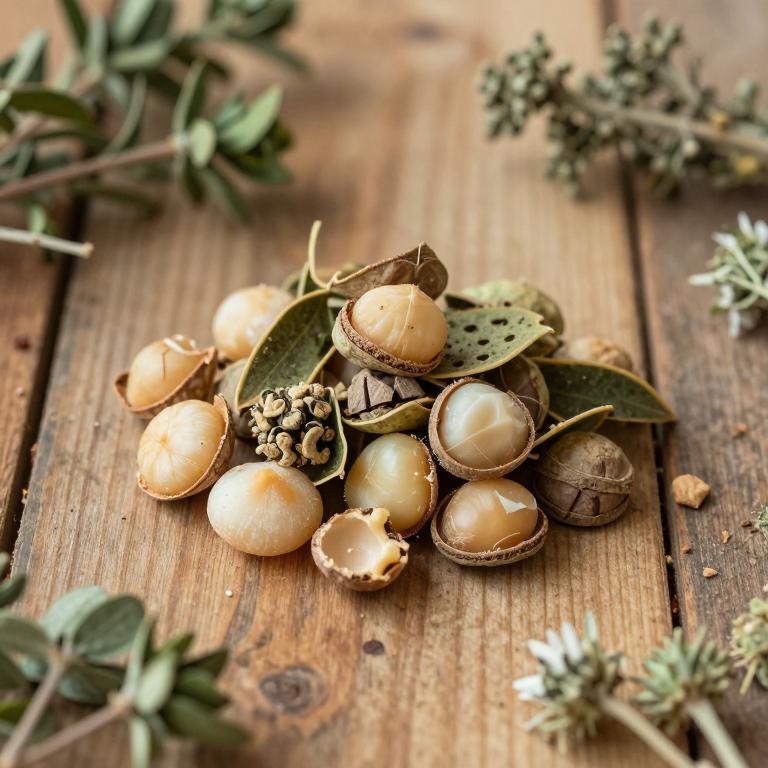
Macadamia nut species, scientifically known as Macadamia integrifolia, is a versatile evergreen tree native to Australian rainforests. Beyond its culinary fame, it holds significant medicinal potential. Rich in essential fatty acids and antioxidants, it is traditionally utilized for skin nourishment, promoting wound healing, and supporting overall cardiovascular health.
- Family
- Proteaceae
- Native range
- Africa
- Parts used
- Not available
- Common names
- Bush Nut · Nut Oak · 9 more
- Scientific synonyms
- Macadamia Ternifolia Var. Integrifolia
Names and Synonyms
Common Names
- Bush Nut
- Nut Oak
- Queensland Nut Tree
- Smooth-shelled Macadamia
- Bauplenut
- bopplenut
- macadamia-nut
- nut-oak
- poppelnut
- smooth-shell Queenslandnut
- Macadamia Tree
Scientific Names
Accepted name
Macadamia integrifoliaSynonyms
- Macadamia ternifolia var. integrifolia
Regional and Traditional Names
Spanish:
- macadamia
- Nuez de Macadamia
German:
- Macadamianuß
- Queenslandnuß
- echte Macadamianuß
- glattschalige Macadamia
French:
- Noyer du Queensland
- Macadamier
- macadamier
- noix du Queensland
- Noyer du Queensland
Sources: Wikidata, Catalogue of Life
Taxonomical Classification
This plant belongs to the kingdom Plantae within the phylum Streptophyta and is classified under the class Equisetopsida. As a member of the subclass Magnoliidae and the order Proteales, it falls within the family Proteaceae. Specifically, its taxonomic identity is defined by the genus Macadamia, with the species being Macadamia integrifolia.
| Rank | Classification |
|---|---|
| Kingdom | Plantae |
| Phylum | Streptophyta |
| Class | Equisetopsida |
| Subclass | Magnoliidae |
| Order | Proteales |
| Family | Proteaceae |
| Genus | Macadamia |
Sources: The World Checklist of Vascular Plants (WCVP)
Distribution
This plant exhibits a diverse geographical distribution spanning across two major continents. In Africa, its range extends through South Tropical Africa, specifically within Mozambique. It is also well-established in Southern Africa, where it can be found in the Northern Provinces and KwaZulu-Natal. Moving to the Australian continent, the species is widely distributed across the state of New South Wales. Furthermore, it maintains a significant presence throughout the subtropical regions of Queensland.
| Region | Area |
|---|---|
| South Tropical Africa | Mozambique |
| Southern Africa | KwaZulu-Natal |
| Southern Africa | Northern Provinces |
| Australia | New South Wales |
| Australia | Queensland |
| Southwestern U.S.A. | California |
| Central America | Belize |
| Central America | Costa Rica |
| Central America | El Salvador |
| Central America | Honduras |
Sources: The World Checklist of Vascular Plants (WCVP)
Botanical Identification
Ecology
The ecology of Macadamia integrifolia is defined by its preference for specific altitudinal gradients and subtropical forest environments. This species thrives within a distinct elevational range, typically occurring from a minimum of 50 m AMSL to a maximum of 1500 m AMSL. Within these parameters, the plant is well-adapted to humid, frost-free climates where it often inhabits the subcanopy or canopy layers of rainforest ecosystems. Its distribution is closely tied to areas receiving consistent rainfall and well-draining, nutrient-rich volcanic or alluvial soils, which support its extensive root systems and long-term growth cycles in the wild.
- Elevational range max:
- 1500 m AMSL
- Elevational range min:
- 50 m AMSL
Life history
The life history of Macadamia integrifolia is characterized by its status as a perennial species, meaning it lives for many years and undergoes continuous growth cycles rather than completing a life cycle in a single season. As an evergreen plant, it maintains its foliage throughout the entire year, providing a consistent canopy that does not undergo a seasonal shedding process. This combination of a long-lived perennial lifecycle and evergreen habit allows the plant to establish a stable, long-term presence in its natural habitat, continuously producing leaves and contributing to the overall structure of the ecosystem over many successive years.
- Deciduousness :
- evergreen
- Lifecycle :
- perennial
Morphology
The morphology of Macadamia integrifolia is characterized by its growth form as a woody tree that is strictly terrestrial in its habitat. As a self-supporting organism, it does not function as a climber, liana, or vine, nor does it exhibit epiphyte or parasitic tendencies, maintaining an independent life cycle. The plant's stature is substantial, with a height that typically ranges from a minimum of 6 m to a maximum of 18 m, reaching a mean height of approximately 15 m.
- Aquatic :
- terrestrial
- Climber :
- self-supporting
- Epiphyte :
- terrestrial
- Growth form :
- tree
- Parasite :
- independent
- Plant height max:
- 18 m
- Plant height mean:
- 15 m
- Plant height min:
- 6 m
- Woodiness :
- woody
Physiology
The physiology of Macadamia integrifolia is characterized by a C3 photosynthetic pathway, which dictates its carbon fixation processes and environmental adaptation strategies. The vegetative structure features leaves that exhibit significant morphological variability, with lengths ranging from a minimum of 7 cm to a maximum of 15 cm. These leaves are relatively narrow, possessing a width that varies between a minimum of 2 cm and a maximum of 4 cm. Furthermore, from a nutritional standpoint, the plant does not function as a nitrogen fixer, meaning it relies on external soil nitrogen availability rather than symbiotic nitrogen-fixing bacteria to meet its metabolic requirements.
- Leaf length max:
- 15 cm
- Leaf length min:
- 7 cm
- Leaf width max:
- 4 cm
- Leaf width min:
- 2 cm
- Nitrogen fixer :
- no
- Photosynthetic pathway :
- C3
Reproduction
The reproduction of Macadamia integrifolia is characterized by a complex biotic pollination syndrome, relying heavily on living organisms to facilitate the transfer of pollen. The process is primarily driven by insect vectors, with bees serving as a specific and critical component of the pollination mechanism. Because self-fertilization is absent in this species, successful fruit and seed production necessitates cross-pollination, making the presence of diverse insect populations essential for maintaining genetic diversity and ensuring reproductive success.
- Pollination syndrome :
- insect
- Pollination syndrome :
- bee
- Pollination syndrome :
- biotic
- Self fertilization :
- absent
Sources: Global Inventory of Floras and Traits (GIFT)
Chemicals
Macadamia integrifolia has 1 reported phytochemicals identified across 0 scientific publications and several other databases. The most consistently reported chemicals include Unsaturated Fatty Acids.
| Chemical | Supporting sources | Consensus |
|---|---|---|
| Unsaturated Fatty Acids | 1 supporting sources | ★☆☆☆☆ |
Unsaturated Fatty Acids
- Food research international (Ottawa, Ont.)
Conditions
Macadamia integrifolia has 2 reported investigations on conditions identified across 0 scientific publications and several other databases. The most consistently reported conditions include inflammation, rheumatoid arthritis.
| Condition | Supporting sources | Consensus |
|---|---|---|
| Inflammation | 1 supporting sources | ★☆☆☆☆ |
| Rheumatoid arthritis | 1 supporting sources | ★☆☆☆☆ |
Inflammation
- Pharmacognosy magazine
Rheumatoid arthritis
- Pharmacognosy magazine