Southern Boxthorn
Lycium intricatum · Accepted scientific name
Scientific literature: Very Sparse (11 studies) · ★☆☆☆☆
Southern Boxthorn, scientifically known as Lycium intricatum, is a resilient, deciduous shrub native to the arid regions of the Southwestern United States. Renowned for its medicinal properties, this hardy plant offers potential therapeutic benefits, particularly in traditional wellness practices, while playing a vital role in supporting desert ecosystems.
- Family
- Solanaceae
- Native range
- Europe
- Parts used
- Not available
- Common names
- Southern Boxthorn
- Scientific synonyms
- Not available
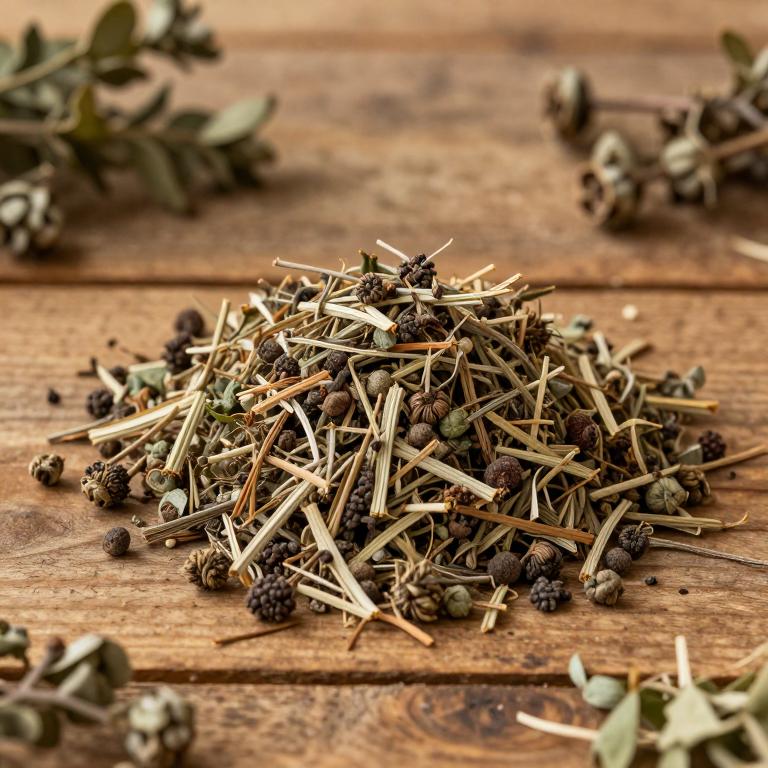
Names and Synonyms
Common Names
- Southern Boxthorn
Scientific Names
Accepted name
Lycium intricatumRegional and Traditional Names
German:
- Sparriger Bocksdorn
French:
- Lycium imbriqué
Sources: Wikidata, Catalogue of Life
Taxonomical Classification
This plant belongs to the kingdom Plantae and the phylum Streptophyta, falling under the class Equisetopsida and subclass Magnoliidae. It is further classified within the order Solanales and the family Solanaceae. Finally, its taxonomic identity is defined by the genus Lycium.
| Rank | Classification |
|---|---|
| Kingdom | Plantae |
| Phylum | Streptophyta |
| Class | Equisetopsida |
| Subclass | Magnoliidae |
| Order | Solanales |
| Family | Solanaceae |
| Genus | Lycium |
Sources: The World Checklist of Vascular Plants (WCVP)
Distribution
This plant is widely distributed across several distinct regions in the Mediterranean basin. In Southwestern Europe, its presence is noted in the Balearic Islands, Portugal, and Spain. Its range also extends significantly into Northern Africa. Within this African region, the species can be found growing in both Algeria and Morocco. Consequently, its habitat spans a diverse geographical area encompassing both European and African territories.
| Region | Area |
|---|---|
| Southwestern Europe | Baleares |
| Southwestern Europe | Portugal |
| Southwestern Europe | Spain |
| Northern Africa | Algeria |
| Northern Africa | Morocco |
| Northern Africa | Western Sahara |
| Macaronesia | Canary Is. |
| Macaronesia | Madeira |
| West Tropical Africa | Mauritania |
Sources: The World Checklist of Vascular Plants (WCVP)
Botanical Identification
Ecology
The ecology of Lycium intricatum is characterized by its adaptation to low-altitude environments, occupying an elevational range that spans from 0 m to a maximum of 500 m AMSL. Within these coastal or lowland habitats, the plant has evolved specific survival strategies to navigate its biological environment, notably through the implementation of active defense mechanisms. These defensive traits allow the species to persist against herbivory and environmental stressors common to its specific altitudinal niche.
- Defense :
- yes
- Elevational range max:
- 500 m AMSL
- Elevational range min:
- 0 m AMSL
Life history
The life history of Lycium intricatum is characterized by its status as a perennial plant, allowing it to persist through multiple growing seasons and maintain a stable presence in its ecological niche. In terms of its structural growth habits, the species exhibits a complex life form categorization; it can be classified as a phanerophyte due to its woody stem structure, yet it also demonstrates characteristics of a nanophanerophyte, reflecting its specific height and branching patterns. This dual classification highlights its ability to maintain persistent, visible shoot systems that contribute to its long-term survival and adaptation within its environment.
- Life form :
- nanophanerophyte
- Life form :
- phanerophyte
- Lifecycle :
- perennial
Morphology
The morphology of Lycium intricatum is characterized by a woody growth form, specifically classified as a shrub. This plant exhibits a self-supporting climbing habit, functioning as a liana or vine that can maintain its own structure. In terms of physical dimensions, the plant height typically ranges from a minimum of 0.3 meters to a maximum of 2 meters.
- Climber :
- self-supporting
- Growth form :
- shrub
- Plant height max:
- 2 m
- Plant height min:
- 0.3 m
- Woodiness :
- woody
Physiology
The physiology of Lycium intricatum is characterized by a C3 photosynthetic pathway, utilizing standard carbon fixation processes to support its metabolic needs. The plant exhibits specialized leaf morphology designed for water retention, featuring succulent leaves that aid in moisture storage. These leaves are arranged in an alternate pattern along the stem and possess an ovate form. In terms of dimensions, the leaf length typically ranges from a minimum of 0.5 cm to a maximum of 2.5 cm, while the leaf thickness is quite fine, fluctuating between a minimum of 0.1 mm and a maximum of 0.3 mm.
- Leaf arrangement :
- alternate
- Leaf form :
- ovate
- Leaf length max:
- 2.5 cm
- Leaf length min:
- 0.5 cm
- Leaf thickness max:
- 0.3 mm
- Leaf thickness min:
- 0.1 mm
- Photosynthetic pathway :
- C3
- Succulence :
- yes
Reproduction
The reproduction of Lycium intricatum is characterized by a flowering period that typically begins in January and extends through June, though the timing can be variable. During this cycle, the plant produces distinct violet flowers that facilitate pollination. Following fertilization, the plant develops fleshy, orange-colored fruits classified as berries. These berries are indehiscent and range in length from a minimum of 0.3 cm to a maximum of 0.7 cm. Within these fruits, the seeds are produced with a consistent volume of approximately 4.2 mm³, which serves as the mean, minimum, and maximum volume for the species.
- Dehiscence :
- indehiscent
- Flower colour :
- violet
- Flowering time :
- Jan
- Flowering time :
- Jun
- Fruit colour :
- orange
- Fruit dryness :
- fleshy
- Fruit length max:
- 0.7 cm
- Fruit length min:
- 0.3 cm
- Fruit type :
- berry
- Seed volume max:
- 4.2 mm³
Sources: Global Inventory of Floras and Traits (GIFT)
Chemicals
Lycium intricatum has 5 reported phytochemicals identified across 0 scientific publications and several other databases. The most consistently reported chemicals include Flavonoids, Gallic acid, TRANS-CINNAMIC ACID, ferulic acid, gentisic acid.
| Chemical | Supporting sources | Consensus |
|---|---|---|
| Flavonoids | 1 supporting sources | ★☆☆☆☆ |
| Gallic acid | 1 supporting sources | ★☆☆☆☆ |
| TRANS-CINNAMIC ACID | 1 supporting sources | ★☆☆☆☆ |
| ferulic acid | 1 supporting sources | ★☆☆☆☆ |
| gentisic acid | 1 supporting sources | ★☆☆☆☆ |
Flavonoids
- Plants (Basel, Switzerland)
Gallic acid
- Plants (Basel, Switzerland)
TRANS-CINNAMIC ACID
- Plants (Basel, Switzerland)
ferulic acid
- Plants (Basel, Switzerland)
gentisic acid
- Plants (Basel, Switzerland)
Conditions
Lycium intricatum has 1 reported investigations on conditions identified across 0 scientific publications and several other databases. The most consistently reported conditions include type-2 diabetes mellitus.
| Condition | Supporting sources | Consensus |
|---|---|---|
| Type-2 diabetes mellitus | 1 supporting sources | ★☆☆☆☆ |
Type-2 diabetes mellitus
- Plants (Basel, Switzerland)