Royal Lily
Lilium regale · Accepted scientific name
Scientific literature: Very Sparse (6 studies) · ★☆☆☆☆
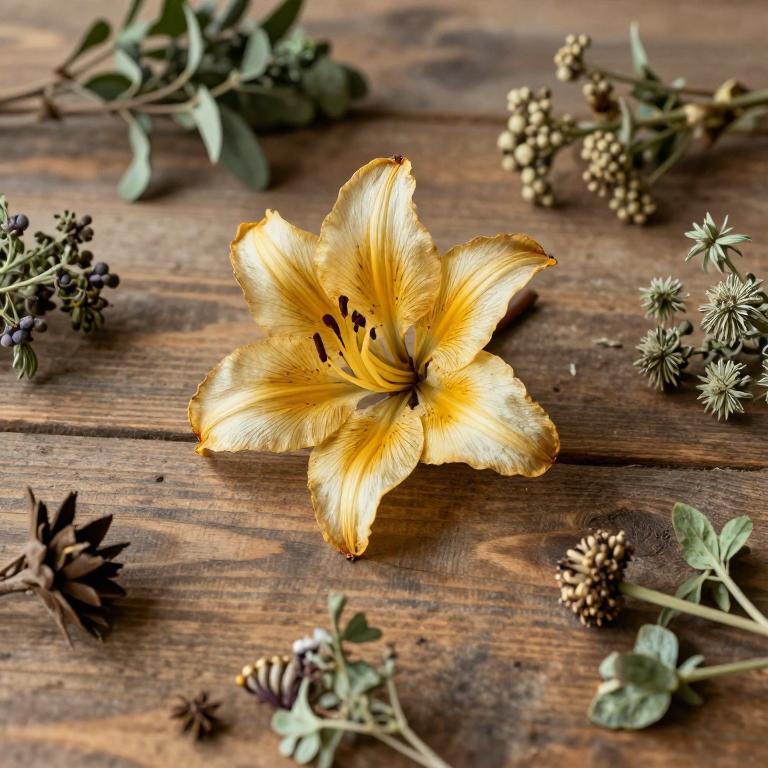
Royal Lily, scientifically known as Lilium regale, is a stunning perennial celebrated for its vibrant, trumpet-shaped blooms. Beyond its ornamental beauty, this species holds significant place in traditional herbal medicine. Renowned for its restorative properties, it is often utilized to support vitality and address various therapeutic needs in holistic wellness.
- Family
- Liliaceae
- Native range
- Europe
- Parts used
- Not available
- Common names
- Royal Lily · Regal Lily
- Scientific synonyms
- Not available
Names and Synonyms
Common Names
- Royal Lily
- regal lily
Scientific Names
Accepted name
Lilium regaleRegional and Traditional Names
Spanish:
- Lilium myriophyllum
German:
- Königs-Lilie
- Königslilie
- Königslilie
- Königs-Lilie
Sources: Wikidata, Catalogue of Life
Taxonomical Classification
This plant belongs to the kingdom Plantae and is classified under the phylum Streptophyta and class Equisetopsida. Within the subclass Magnoliidae and order Liliales, it is further organized into the family Liliaceae. Finally, it is identified by its specific genus, Lillium.
| Rank | Classification |
|---|---|
| Kingdom | Plantae |
| Phylum | Streptophyta |
| Class | Equisetopsida |
| Subclass | Magnoliidae |
| Order | Liliales |
| Family | Liliaceae |
| Genus | Lilium |
Sources: The World Checklist of Vascular Plants (WCVP)
Distribution
This plant exhibits a remarkably wide and fragmented geographical distribution across several continents. In Europe, its presence is noted within the borders of Bulgaria. Its range extends into Asia, specifically throughout South-Central China. Within the Southeastern United States, it can be found growing in both Alabama and Mississippi. Finally, the species reaches the Southern regions of Brazil in South America.
| Region | Area |
|---|---|
| Southeastern Europe | Bulgaria |
| China | China South-Central |
| Southeastern U.S.A. | Alabama |
| Southeastern U.S.A. | Mississippi |
| Brazil | Brazil South |
| Southern South America | Argentina Northeast |
Sources: The World Checklist of Vascular Plants (WCVP)
Botanical Identification
Ecology
The ecology of Lilium regale is closely tied to its specific altitudinal preferences within its natural habitat. This species is primarily found across a diverse vertical gradient, occupying various montane and subalpine zones. It exhibits a broad elevational range, with its distribution spanning from a minimum altitude of 800 m AMSL to a maximum of 2500 m AMSL. On average, the plant thrives at a mean elevation of 1650 m AMSL, a range that dictates the specific climatic conditions, such as temperature fluctuations and moisture availability, to which the species has adapted.
- Elevational range max:
- 2500 m AMSL
- Elevational range mean:
- 1650 m AMSL
- Elevational range min:
- 800 m AMSL
Life history
The life history of Lilium regale is characterized by its status as a perennial plant, meaning it persists through multiple growing seasons rather than completing its cycle in a single year. As a geophyte, it survives unfavorable environmental conditions by storing essential nutrients and energy within underground structures, such as bulbs, which allow it to remain dormant during periods of stress. This survival strategy is closely linked to its classification as a cryptophyte, indicating that its vital regenerative buds are located safely below the soil surface, protected from external elements and temperature fluctuations.
- Life form :
- geophyte
- Life form :
- cryptophyte
- Lifecycle :
- perennial
Morphology
The morphology of Lilium regale is characterized by its growth form as a non-woody herb, specifically classified as a forb. It is a terrestrial plant, functioning as an independent organism rather than a parasite or an epiphyte. The plant is self-supporting in its structure, lacking any climbing or vining tendencies. While it typically exhibits a mean height of approximately 0.05 m in certain developmental stages or specific environmental contexts, its physical architecture remains distinctly herbaceous and non-woody throughout its life cycle.
- Aquatic :
- terrestrial
- Climber :
- self-supporting
- Epiphyte :
- terrestrial
- Growth form :
- herb
- Growth form :
- forb
- Parasite :
- independent
- Plant height mean:
- 0.05 m
- Woodiness :
- non-woody
Physiology
The physiology of Lilium regale is characterized by a C3 photosynthetic pathway, which dictates its carbon fixation processes and metabolic efficiency in its natural habitat. The plant's vegetative structure is defined by specialized foliage with distinct morphological dimensions; the leaves typically exhibit a mean length of 7 cm, with individual leaf lengths ranging from a minimum of 6 cm to a maximum of 8 cm. In terms of lateral development, the leaf width is relatively narrow, fluctuating between a minimum of 0.2 cm and a maximum of 0.3 cm. These physiological parameters reflect the plant's adaptive strategy for light interception and gas exchange through its narrow, elongated leaf blades.
- Leaf length max:
- 8 cm
- Leaf length mean:
- 7 cm
- Leaf length min:
- 6 cm
- Leaf width max:
- 0.3 cm
- Leaf width min:
- 0.2 cm
- Photosynthetic pathway :
- C3
Sources: Global Inventory of Floras and Traits (GIFT)
Chemicals
Lilium regale has 6 reported phytochemicals identified across 0 scientific publications and several other databases. The most consistently reported chemicals include ETHEPHON, Flavonoids, Methyl jasmonate, Terpenoids, hydrogen peroxide.
| Chemical | Supporting sources | Consensus |
|---|---|---|
| ETHEPHON | 1 supporting sources | ★☆☆☆☆ |
| Flavonoids | 1 supporting sources | ★☆☆☆☆ |
| Methyl jasmonate | 1 supporting sources | ★☆☆☆☆ |
| Terpenoids | 1 supporting sources | ★☆☆☆☆ |
| hydrogen peroxide | 1 supporting sources | ★☆☆☆☆ |
| salicylic acid | 1 supporting sources | ★☆☆☆☆ |
ETHEPHON
- Phytopathology
Flavonoids
- Molecules (Basel, Switzerland)
Methyl jasmonate
- Phytopathology
Terpenoids
- Nature communications
hydrogen peroxide
- Phytopathology
salicylic acid
- Phytopathology