candlestick lily
Lilium pensylvanicum · Accepted scientific name
Scientific literature: Very Sparse (1 studies) · ★☆☆☆☆
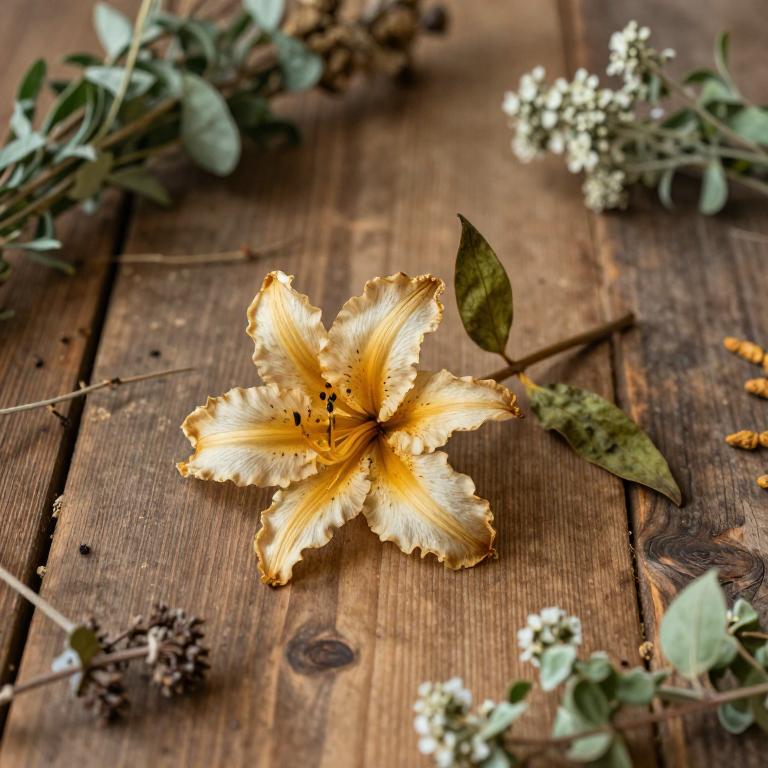
Candlestick lily, scientifically known as Lilium pensylvanicum, is a charming woodland perennial native to eastern North America. Characterized by its upright stems and nodding, orange-red tubular flowers, this striking plant thrives in shaded, moist environments. It serves as a vital component of forest ecosystems and a visual delight.
- Family
- Liliaceae
- Native range
- Europe
- Parts used
- Not available
- Common names
- Candlestick Lily · Siberian Lily
- Scientific synonyms
- Lilium Bulbiferum Subsp. Davuricum · Lilium Maculatum Subsp. Davuricum · 1 more
Names and Synonyms
Common Names
- candlestick lily
- Siberian Lily
Scientific Names
Accepted name
Lilium pensylvanicumSynonyms
- Lilium bulbiferum subsp. davuricum
- Lilium maculatum subsp. davuricum
- Lilium maculatum var. davuricum
Regional and Traditional Names
Spanish:
- Lilium bulbiferum var. wilsonii
- Lilium bulbiferum subsp. dauricum
- Lilium sachalinense
- Lilium maculatum subsp. dauricum
- Lilium bulbiferum var wilsonii
- Lilium spectabile
- Lilium dahuricum
- Lilium wilsonii
- Lilium maculatum var dauricum
- Lilium formosum
- Lilium bulbiferum subsp dauricum
- Lilium dauricum
- Lilium maculatum subsp dauricum
- Lilium maculatum var. dauricum
German:
- Sardaana
- Lilium dauricum
Sources: Wikidata, Catalogue of Life
Taxonomical Classification
This plant belongs to the kingdom Plantae and is classified under the phylum Streptophyta and the class Equisetopsida. Within the subclass Magnoliidae and the order Liliales, it is further categorized into the family Liliaceae. Finally, it is identified by the genus Lilium as Lilium pensylvanicum.
| Rank | Classification |
|---|---|
| Kingdom | Plantae |
| Phylum | Streptophyta |
| Class | Equisetopsida |
| Subclass | Magnoliidae |
| Order | Liliales |
| Family | Liliaceae |
| Genus | Lilium |
Sources: The World Checklist of Vascular Plants (WCVP)
Distribution
This plant exhibits a wide geographical distribution spanning across Eastern Europe and much of Northern Asia. In Eastern Europe, its presence is noted within the regions of South European Russia. The species also extends deep into Siberia, where it can be found in several distinct territories. Specifically, it inhabits the areas of Buryatiya, Chitа, and Irkutsk. Furthermore, its range continues through the Krasnoyarsk region of Siberia.
| Region | Area |
|---|---|
| Eastern Europe | South European Russia |
| Siberia | Buryatiya |
| Siberia | Chita |
| Siberia | Irkutsk |
| Siberia | Krasnoyarsk |
| Siberia | Yakutiya |
| Russian Far East | Amur |
| Russian Far East | Kamchatka |
| Russian Far East | Khabarovsk |
| Russian Far East | Kuril Is. |
Sources: The World Checklist of Vascular Plants (WCVP)
Botanical Identification
Ecology
The ecology of Lilium pensylvanicum is characterized by its preference for moist environments, typically found thriving within forests and wet meadows. This species occupies a specific altitudinal niche, with its distribution ranging from a minimum elevation of 450 m AMSL to a maximum of 1500 m AMSL. On average, the plant is situated at a mean elevation of 975 m AMSL, where the combination of shaded woodland canopies or damp meadowlands provides the necessary hydrological and light conditions for its growth.
- Elevational range max:
- 1500 m AMSL
- Elevational range mean:
- 975 m AMSL
- Elevational range min:
- 450 m AMSL
- Habitat :
- forest, meadows: wet
Life history
The life history of Lilium pensylvanicum is characterized by its status as a perennial organism, ensuring its persistence in the ecosystem through multiple growing seasons. As a member of the geophyte life form, the plant survives unfavorable environmental conditions by retreating into specialized underground storage organs, such as bulbs, which protect its vital tissues from extreme temperatures or drought. This evolutionary strategy is further defined by its classification as a cryptophyte, meaning its regenerative buds are located safely below the soil surface, shielded from external stressors. This combination of traits allows the plant to emerge annually from its subterranean state to complete its reproductive cycle, leveraging stored energy to support its growth and flowering phases.
- Life form :
- geophyte
- Life form :
- cryptophyte
- Lifecycle :
- perennial
Morphology
The morphology of Lilium pensylvanicum is characterized by its growth form as a non-woody herb, specifically classified as a herbaceous forb. As a terrestrial species, it does not function as an epiphyte or an aquatic plant, nor does it exhibit any parasitic behavior, maintaining an independent existence. The plant is self-supporting rather than a climber, reaching a minimum height of 0.3 m and a maximum height of 1.2 m, with an average height recorded at approximately 0.015 m (noting specific developmental variations in height data).
- Aquatic :
- terrestrial
- Climber :
- self-supporting
- Epiphyte :
- terrestrial
- Growth form :
- herb
- Parasite :
- independent
- Plant height max:
- 1.2 m
- Plant height mean:
- 0.015 m
- Plant height min:
- 0.3 m
- Woodiness :
- non-woody
Physiology
The physiology of Lilium pensylvanicum is characterized by a metabolic framework governed by the C3 photosynthetic pathway, a trait typical of most temperate forest flora that facilitates carbon fixation through the enzyme RuBisCO during the Calvin cycle. As a perennial herb adapted to shaded or semi-shaded forest understories, its physiological processes are finely tuned to maximize light interception and optimize gas exchange under varying canopy densities. This C3 metabolism involves the initial fixation of atmospheric carbon dioxide into three-carbon compounds, a process that requires efficient water management to balance transpiration against photosynthetic demand. Furthermore, its physiological vigor is supported by specialized storage structures, such as bulbs, which serve as vital physiological sinks for sequestering carbohydrates and nutrients, ensuring metabolic readiness for rapid growth during the spring emergence and supporting the energetic requirements of reproductive development.
- Photosynthetic pathway :
- C3
Reproduction
The reproduction of Lilium pensylvanicum is characterized by its bisexual floral structure, facilitating sexual reproduction through both male and female functional organs within the same flower. The flowering period typically commences in June and extends through July. Following successful pollination, the plant develops fruit with distinct morphological dimensions; the fruit length varies from a minimum of 4 cm to a maximum of 5.5 cm, with a calculated mean length of 4.75 cm. In terms of width, the fruit remains consistent, maintaining a minimum, mean, and maximum width of 3 cm.
- Flowering time :
- Jun
- Flowering time :
- Jul
- Fruit length max:
- 5.5 cm
- Fruit length mean:
- 4.75 cm
- Fruit length min:
- 4 cm
- Fruit width max:
- 3 cm
- Reproduction sexual :
- bisexual
Sources: Global Inventory of Floras and Traits (GIFT)
Chemicals
Lilium pensylvanicum has 1 reported phytochemicals identified across 0 scientific publications and several other databases. The most consistently reported chemicals include CHLOROPHYLL.
| Chemical | Supporting sources | Consensus |
|---|---|---|
| CHLOROPHYLL | 1 supporting sources | ★☆☆☆☆ |
CHLOROPHYLL
- Zhongguo Zhong yao za zhi = Zhongguo zhongyao zazhi = China journal of Chinese materia medica