lance-leaved tiger lily
Lilium lancifolium · Accepted scientific name
Scientific literature: Very Sparse (36 studies) · ★☆☆☆☆
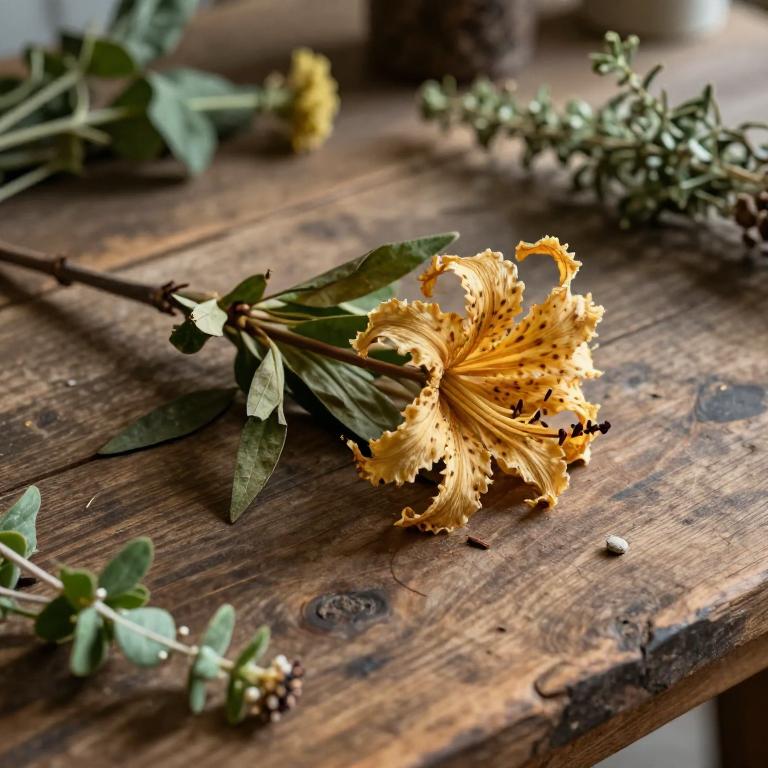
Lance-leaved tiger lily, scientifically known as Lilium lancifoliuom, is a striking perennial valued for its vibrant orange blooms and medicinal properties. Traditionally used in various herbal remedies, this plant is recognized for its potential therapeutic benefits, offering a unique intersection of ornamental beauty and significant ethnobotanical importance in traditional healing.
Names and Synonyms
Common Names
- lance-leaved tiger lily
- tiger lily
- Easter lily
- devil lily
- kentan
- martagon
Scientific Names
Accepted name
Lilium lancifoliumSynonyms
- Lilium lancifolium melpomene
- Lilium tigrinum fortunei
- Lilium tigrinum var. plenescens
- Lilium tigrinum var. splendens
- Lilium lishmannii
- Lilium lancifolium var. flaviflorum
- Lilium leopoldii
- Lilium tigrinum
- Lilium lancifolium var. splendens
- Lilium lancifolium var. fortunei
- Lilium lancifolium var. densum
- Lilium tigrinum var. erectum
Regional and Traditional Names
Spanish:
- lirio de tigre
German:
- Tiger-Lilie
- Tigerlilie
French:
- lis tigré
- lis élégant
Sources: Wikidata, Catalogue of Life
Taxonomical Classification
This plant belongs to the kingdom Plantae and is classified under the phylum Streptophyta and the class Equisetopsida. Within the subclass Magnoliidae and the order Liliales, it is further categorized into the family Liliaceae. Finally, it is identified by the genus Lilium, specifically as the species Lilium lancifolium.
| Rank | Classification |
|---|---|
| Kingdom | Plantae |
| Phylum | Streptophyta |
| Class | Equisetopsida |
| Subclass | Magnoliidae |
| Order | Liliales |
| Family | Liliaceae |
| Genus | Lilium |
Sources: The World Checklist of Vascular Plants (WCVP)
Distribution
This plant exhibits a broad presence across several distinct regions of the European continent. In Middle Europe, its range can be identified within the borders of Austria. Moving toward the southeast, the species is also documented throughout Bulgaria. The distribution extends significantly into Eastern Europe, where it inhabits Central European Russia. Finally, its geographical reach encompasses both East European Russia and South European Russia.
| Region | Area |
|---|---|
| Middle Europe | Austria |
| Southeastern Europe | Bulgaria |
| Eastern Europe | Central European Russia |
| Eastern Europe | East European Russia |
| Eastern Europe | South European Russia |
| Russian Far East | Amur |
| Russian Far East | Kuril Is. |
| Russian Far East | Primorye |
| Russian Far East | Sakhalin |
| China | China South-Central |
Sources: The World Checklist of Vascular Plants (WCVP)
Botanical Identification
Ecology
The ecology of Lilium lancifolium is characterized by its preference for lowland environments, where it thrives in well-drained, nutrient-rich soils. Within these low-lying regions, the species typically colonizes open areas such as forest edges, meadows, and sunny slopes, requiring significant exposure to sunlight to facilitate its growth and flowering cycles. It demonstrates a high degree of adaptability to temperate climates, often establishing itself in habitats that provide a balance of moisture and aeration to support its bulbous root system. The plant's distribution within these lowland ecosystems is influenced by its ability to compete for light and space, often flourishing in disturbed sites or transitional zones where soil organic matter is sufficient to sustain its vigorous perennial lifecycle.
- Habitat :
- Lowland
Life history
The life history of Lilium lancifolium is characterized by a perennial lifecycle, allowing the plant to persist through multiple growing seasons. As a geophyte, it survives unfavorable environmental conditions by storing nutrients and energy within specialized underground structures, such as bulbs, which remain protected beneath the soil surface. This survival strategy is further categorized under the life form of a cryptophyte, meaning its essential regenerative organs are concealed underground, ensuring its longevity and ability to re-emerge annually once favorable conditions return.
- Life form :
- geophyte
- Life form :
- cryptophyte
- Lifecycle :
- perennial
Morphology
The morphology of Lilium lancifolium is characterized by its growth form as a non-woody herb, specifically classified as a forb. This plant is a self-supporting species that does not function as a climber or a liana, and it grows as an independent organism rather than a parasite or an epiphyte, maintaining a terrestrial existence. In terms of stature, it exhibits a variable plant height ranging from a minimum of 0.01 m to a maximum of 1.2 m, with an average height of approximately 0.9 m.
- Aquatic :
- terrestrial
- Climber :
- self-supporting
- Epiphyte :
- terrestrial
- Growth form :
- herb
- Growth form :
- forb
- Parasite :
- independent
- Plant height max:
- 1.2 m
- Plant height mean:
- 0.9 m
- Plant height min:
- 0.01 m
- Woodiness :
- non-woody
Physiology
The physiological profile of Lilium lancifolium is characterized by a C3 photosynthetic pathway, which governs its carbon fixation processes and energy production. The foliage displays a highly specialized morphology, featuring oblanceolate leaf forms with entire margins and a complete absence of protective structures such as thorns or spines. The leaf dimensions are consistent and relatively narrow, maintaining a uniform width of 1.5 cm (ranging from a minimum to a maximum of 1.5 cm) and reaching a maximum length of 10.5 cm. This specific structural configuration and metabolic pathway support its growth and resource management within its ecological niche.
- Leaf form :
- oblanceolate
- Leaf length max:
- 10.5 cm
- Leaf margin :
- entire
- Leaf spines :
- no
- Leaf thorns :
- no
- Leaf width mean:
- 1.5 cm
- Photosynthetic pathway :
- C3
Reproduction
The reproduction of Lilium lancifolium involves both sexual and asexual mechanisms to ensure its survival and propagation. The flowering period, which facilitates sexual reproduction through pollination, typically begins in July and continues through September. In addition to this seasonal flowering cycle, the plant is capable of asexual reproduction, which allows for vegetative propagation and the establishment of new individuals without the necessity of seed production.
- Flowering time :
- Jul
- Flowering time :
- Sep
- Reproduction asexual :
- present
Sources: Global Inventory of Floras and Traits (GIFT)
Plant Parts
Lilium lancifolium has 1 reported plant parts identified across 1 scientific publications and several other databases that are studied for medicinal purposes. The most consistently reported plant part include leaf.
| Plant part | Supporting sources | Consensus |
|---|---|---|
| Leaf | 1 supporting sources | ★☆☆☆☆ |
Leaf
- Zhongguo Zhong yao za zhi = Zhongguo zhongyao zazhi = China journal of Chinese materia medica
Chemicals
Lilium lancifolium has 16 reported phytochemicals identified across 1 scientific publications and several other databases. The most consistently reported chemicals include Regaloside A, REGALOSIDE E, Regaloside C, colchicine, (25R)-spirost-5-ene-3beta-yl-O-alpha-L-rhamnopyranosyl-(1->2)-[beta-D-glucopyranosyl-(1->6)]-beta-D-glucopyranoside.
| Chemical | Supporting sources | Consensus |
|---|---|---|
| Regaloside A | 3 supporting sources | ★★☆☆☆ |
| REGALOSIDE E | 2 supporting sources | ★☆☆☆☆ |
| Regaloside C | 2 supporting sources | ★☆☆☆☆ |
| colchicine | 2 supporting sources | ★☆☆☆☆ |
| (25R)-spirost-5-ene-3beta-yl-O-alpha-L-rhamnopyranosyl-(1->2)-[beta-D-glucopyranosyl-(1->6)]-beta-D-glucopyranoside | 1 supporting sources | ★☆☆☆☆ |
| CHLOROPHYLL | 1 supporting sources | ★☆☆☆☆ |
| Daucosterol | 1 supporting sources | ★☆☆☆☆ |
| NAPHTHALENEACETIC ACID | 1 supporting sources | ★☆☆☆☆ |
| Regaloside B | 1 supporting sources | ★☆☆☆☆ |
| SE | 1 supporting sources | ★☆☆☆☆ |
Regaloside A
- Journal of pharmaceutical and biomedical analysis
- Zhongguo Zhong yao za zhi = Zhongguo zhongyao zazhi = China journal of Chinese materia medica
- Journal of the science of food and agriculture
REGALOSIDE E
- Journal of pharmaceutical and biomedical analysis
- Journal of the science of food and agriculture
Regaloside C
- Journal of pharmaceutical and biomedical analysis
- Zhongguo Zhong yao za zhi = Zhongguo zhongyao zazhi = China journal of Chinese materia medica
colchicine
- Molecules (Basel, Switzerland)
- Plants (Basel, Switzerland)
(25R)-spirost-5-ene-3beta-yl-O-alpha-L-rhamnopyranosyl-(1->2)-[beta-D-glucopyranosyl-(1->6)]-beta-D-glucopyranoside
- Zhongguo Zhong yao za zhi = Zhongguo zhongyao zazhi = China journal of Chinese materia medica
CHLOROPHYLL
- Zhongguo Zhong yao za zhi = Zhongguo zhongyao zazhi = China journal of Chinese materia medica
Daucosterol
- Zhongguo Zhong yao za zhi = Zhongguo zhongyao zazhi = China journal of Chinese materia medica
NAPHTHALENEACETIC ACID
- Plants (Basel, Switzerland)
Regaloside B
- Journal of pharmaceutical and biomedical analysis
SE
- Frontiers in plant science
Activities
Lilium lancifolium has 1 reported activities identified across 1 scientific publications and several other databases. The most consistently reported activities include Antioxidant.
| Activity | Supporting sources | Consensus |
|---|---|---|
| Antioxidant | 2 supporting sources | ★☆☆☆☆ |
Antioxidant
- Actas urologicas espanolas
- Journal of food biochemistry
Conditions
Lilium lancifolium has 3 reported investigations on conditions identified across 1 scientific publications and several other databases. The most consistently reported conditions include bronchitis, cancer, pneumonia.
| Condition | Supporting sources | Consensus |
|---|---|---|
| Bronchitis | 1 supporting sources | ★☆☆☆☆ |
| Cancer | 1 supporting sources | ★☆☆☆☆ |
| Pneumonia | 1 supporting sources | ★☆☆☆☆ |
Bronchitis
- Journal of food biochemistry
Cancer
- Journal of Cancer
Pneumonia
- Journal of food biochemistry
Preparations
Lilium lancifolium has 3 reported preparations identified across 1 scientific publications and several other databases. The most consistently reported preparations include bulbs, bulbs extract, fresh fleshy scaleleaf.
| Preparation | Supporting sources | Consensus |
|---|---|---|
| Bulbs | 1 supporting sources | ★☆☆☆☆ |
| Bulbs extract | 1 supporting sources | ★☆☆☆☆ |
| Fresh fleshy scaleleaf | 1 supporting sources | ★☆☆☆☆ |
Bulbs
- Frontiers in plant science
Bulbs extract
- Journal of food biochemistry
Fresh fleshy scaleleaf
- Zhongguo Zhong yao za zhi = Zhongguo zhongyao zazhi = China journal of Chinese materia medica