tickbush
Kunzea ambigua · Accepted scientific name
Scientific literature: Very Sparse (2 studies) · ★☆☆☆☆
Tickbush, scientifically known as Kunzea ambigua, is a versatile Australian shrub renowned for its dense, fine-textured foliage and delicate white blossoms. Highly valued in traditional medicine for its antimicrobial and anti-inflammatory properties, this hardy plant offers significant therapeutic potential for treating various skin conditions and supporting overall wellness.
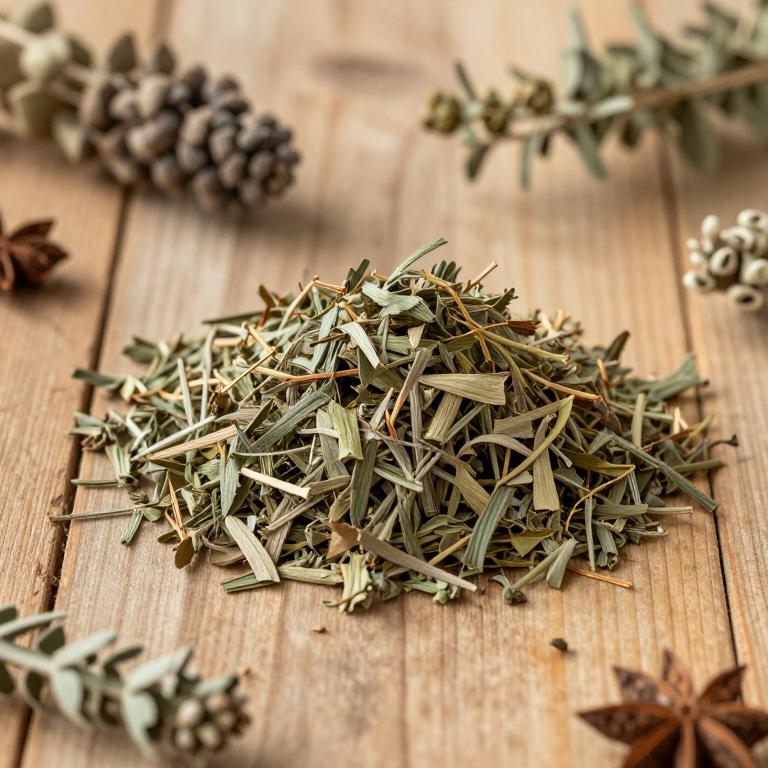
Names and Synonyms
Common Names
- tickbush
- white kunzea
- Butterfly Bush
Scientific Names
Accepted name
Kunzea ambiguaSynonyms
- Metrosideros corifolia
- Metrosideros abietina
- Callistemon corifolius
- Leptospermum ambiguum
- Stenospermum corifolium
- Kunzea corifolia
- Kunzea pelagia
Regional and Traditional Names
French:
- Kunzea blanche
Sources: Wikidata, Catalogue of Life
Taxonomical Classification
This plant belongs to the kingdom Plantae and is classified under the phylum Streptophyta and class Equisetopsida. Within the subclass Magnoliidae, it is placed in the order Myrtales and the family Myrtaceae. Finally, it is categorized under the genus Kunzea.
| Rank | Classification |
|---|---|
| Kingdom | Plantae |
| Phylum | Streptophyta |
| Class | Equisetopsida |
| Subclass | Magnoliidae |
| Order | Myrtales |
| Family | Myrtaceae |
| Genus | Kunzea |
Sources: The World Checklist of Vascular Plants (WCVP)
Distribution
This plant, known as Kunzea ambigua, exhibits a specific geographical distribution across several regions of Australia. It can be found growing naturally within the state of New South Wales. Additionally, its presence extends into the southern territories of South Australia. The species is also documented to inhabit various parts of Victoria. Finally, its range reaches further south into the island state of Tasmania.
| Region | Area |
|---|---|
| Australia | New South Wales |
| Australia | South Australia |
| Australia | Tasmania |
| Australia | Victoria |
Sources: The World Checklist of Vascular Plants (WCVP)
Botanical Identification
Life history
The life history of Kunzea ambigua is characterized by a perennial lifecycle, allowing the plant to persist through multiple growing seasons. In terms of its structural development and ecological positioning, it exhibits life forms that can be classified as both phanerophyte and nanophanerophyte, depending on the environmental conditions and the specific growth stage of the individual. This range in life form reflects its ability to maintain woody stems above the ground level, adapting its stature to suit its specific habitat.
- Life form :
- nanophanerophyte
- Life form :
- phanerophyte
- Lifecycle :
- perennial
Morphology
The morphology of Kunzea ambigua is characterized by its growth form as a woody shrub, which functions as a self-supporting structure rather than a climber, liana, or vine. This species is a terrestrial plant, not classified as aquatic, semiaquatic, or an epiphyte, and it operates as an independent organism without parasitic tendencies. In terms of physical dimensions, the plant exhibits a significant stature, with a height ranging from a minimum of 2 meters to a maximum of 4 meters.
- Aquatic :
- terrestrial
- Climber :
- self-supporting
- Epiphyte :
- terrestrial
- Growth form :
- shrub
- Parasite :
- independent
- Plant height max:
- 4 m
- Plant height min:
- 2 m
- Woodiness :
- woody
Physiology
The physiology of Kunzea ambigua is characterized by a C3 photosynthetic pathway, which dictates its carbon fixation processes and metabolic efficiency. The plant exhibits specific morphological adaptations in its foliage, maintaining a narrow leaf profile with a width ranging from a minimum of 0.1 cm to a maximum of 0.15 cm. The leaf length is similarly specialized, with measurements fluctuating between a minimum of 0.4 cm and a maximum of 1.2 cm.
- Leaf length max:
- 1.2 cm
- Leaf length min:
- 0.4 cm
- Leaf width max:
- 0.15 cm
- Leaf width min:
- 0.1 cm
- Photosynthetic pathway :
- C3
Reproduction
Reproduction in Kunzea ambigua is characterized by the production of specialized seeds that play a critical role in its life cycle and dispersal. The botanical data indicates a highly consistent seed morphology, with a measured seed mass of exactly 3e-05 g. This uniformity is reflected across all recorded parameters, as both the mean, maximum, and minimum seed mass values are identical at 3e-05 g. Such precise and consistent seed sizing suggests a standardized reproductive strategy designed to optimize the plant's ability to colonize suitable habitats through effective dispersal mechanisms.
- Seed mass mean:
- 3e-05 g
Sources: Global Inventory of Floras and Traits (GIFT)
Plant Parts
Kunzea ambigua has 1 reported plant parts identified across 1 scientific publications and several other databases that are studied for medicinal purposes. The most consistently reported plant part include leaf.
| Plant part | Supporting sources | Consensus |
|---|---|---|
| Leaf | 1 supporting sources | ★☆☆☆☆ |
Leaf
- Journal of natural products
Chemicals
Kunzea ambigua has 1 reported phytochemicals identified across 1 scientific publications and several other databases. The most consistently reported chemicals include Kunzeagin A.
| Chemical | Supporting sources | Consensus |
|---|---|---|
| Kunzeagin A | 1 supporting sources | ★☆☆☆☆ |
Kunzeagin A
- Journal of natural products
Preparations
Kunzea ambigua has 1 reported preparations identified across 1 scientific publications and several other databases. The most consistently reported preparations include leaf extract.
| Preparation | Supporting sources | Consensus |
|---|---|---|
| Leaf extract | 1 supporting sources | ★☆☆☆☆ |
Leaf extract
- Journal of natural products