Milky Widow's-Thrill
Kalanchoe laxiflora · Accepted scientific name
Scientific literature: Very Sparse (6 studies) · ★☆☆☆☆
Milky Widow's-Thrill, scientifically known as Kalanchoe laxiflora, is a striking succulent native to Madagascar. Renowned for its pendulous, bell-shaped flowers and fleshy leaves, this plant is cherished in ornamental gardening. Beyond its beauty, it holds traditional significance in various cultures for its perceived medicinal properties and unique resilience.
- Family
- Crassulaceae
- Native range
- Europe
- Parts used
- Leaf
- Common names
- Milky Widow'S-Thrill
- Scientific synonyms
- Kalanchoe Tieghemii · Bryophyllum Crenatum · 1 more
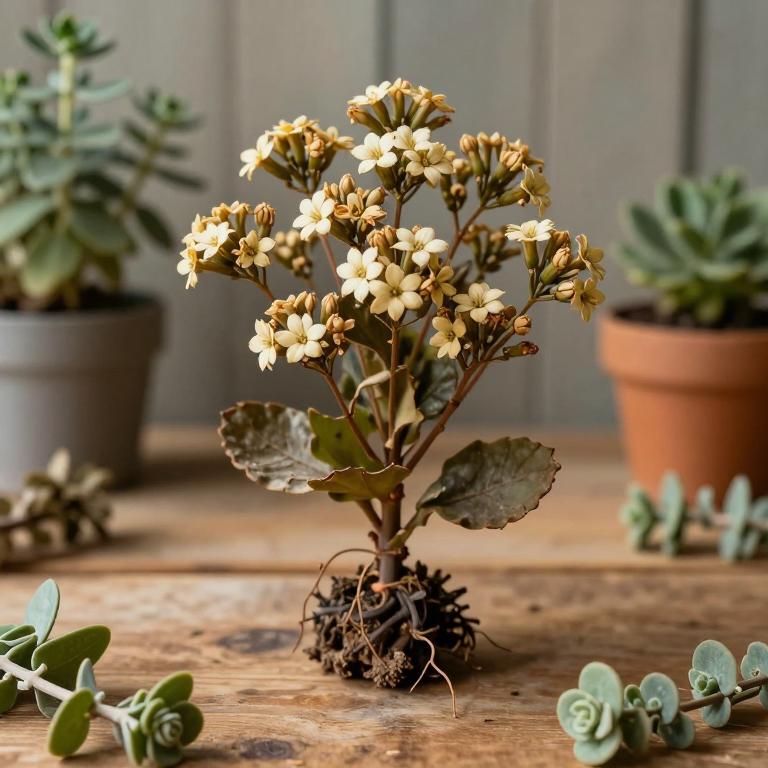
Names and Synonyms
Common Names
- Milky Widow's-Thrill
Scientific Names
Accepted name
Kalanchoe laxifloraSynonyms
- Kalanchoe tieghemii
- Bryophyllum crenatum
- Bryophyllum laxiflorum
Sources: Wikidata, Catalogue of Life
Taxonomical Classification
This plant belongs to the kingdom Plantae and is classified under the phylum Streptophyta within the class Equisetopsida. As a member of the subclass Magnoliidae and the order Saxifragales, it falls under the family Crassulaceae. Finally, its specific taxonomic designation is within the genus Kalanchoe.
| Rank | Classification |
|---|---|
| Kingdom | Plantae |
| Phylum | Streptophyta |
| Class | Equisetopsida |
| Subclass | Magnoliidae |
| Order | Saxifragales |
| Family | Crassulaceae |
| Genus | Kalanchoe |
Sources: The World Checklist of Vascular Plants (WCVP)
Distribution
This plant exhibits a diverse geographical range that spans across several continents and distinct climatic regions. In Southeastern Europe, it can be found growing within the territories of Italy and specifically on the island of Sicilia. Its distribution extends into Northern Africa, where populations are established in both Algeria and Morocco. Furthermore, the species reaches into South Tropical Africa, specifically within the borders of Zimbabwe. This wide-reaching presence demonstrates the plant's ability to adapt to various Mediterranean and subtropical environments.
| Region | Area |
|---|---|
| Southeastern Europe | Italy |
| Southeastern Europe | Sicilia |
| Northern Africa | Algeria |
| Northern Africa | Morocco |
| South Tropical Africa | Zimbabwe |
| Western Indian Ocean | Mauritius |
| Western Indian Ocean | Madagascar |
| Western Indian Ocean | Réunion |
| North-Central Pacific | Hawaii |
| Caribbean | Leeward Is. |
Sources: The World Checklist of Vascular Plants (WCVP)
Botanical Identification
Morphology
The morphology of Kalanchoe laxiflora is characterized by its growth form as a non-woody herb, functioning as a self-supporting plant that does not require climbing structures. It is categorized as a terrestrial species, existing independently without any parasitic or epiphytic tendencies, meaning it grows directly in the soil rather than as a holoepiphyte, hemiepiphyte, or facultative epiphyte. As a non-woody herb, its structural integrity is maintained without the development of true woody tissues, and it maintains a stable, independent life cycle within its terrestrial habitat.
- Aquatic :
- terrestrial
- Climber :
- self-supporting
- Epiphyte :
- terrestrial
- Growth form :
- herb
- Parasite :
- independent
- Woodiness :
- non-woody
Physiology
The physiology of Kalanchoe laxiflora is fundamentally defined by its specialized water-management strategies, most notably its pronounced succulence. As a succulent, the plant possesses thickened, fleshy tissues within its leaves and stems that serve as primary reservoirs for water storage, allowing it to maintain cellular turgidity and metabolic function during periods of prolonged drought. This morphological adaptation is closely linked to its specialized photosynthetic pathway, Crassulacean Acid Metabolism (CAM). In this physiological process, the plant minimizes transpirational water loss by keeping its stomata closed during the heat of the day and opening them only at night to collect carbon dioxide. This nocturnal CO2 uptake is subsequently stored as malic acid, which is then decarboxylated during the daylight hours to fuel the Calvin cycle. By decoupling gas exchange from solar radiation, Kalanchoe laxiflora exhibits high water-use efficiency, enabling it to thrive in arid or semi-arid environments where water availability is inconsistent.
- Succulence :
- yes
Sources: Global Inventory of Floras and Traits (GIFT)
Plant Parts
Kalanchoe laxiflora has 1 reported plant parts identified across 2 scientific publications and several other databases that are studied for medicinal purposes. The most consistently reported plant part include leaf.
| Plant part | Supporting sources | Consensus |
|---|---|---|
| Leaf | 2 supporting sources | ★☆☆☆☆ |
Leaf
- BMC complementary and alternative medicine
- Molecules (Basel, Switzerland)
Chemicals
Kalanchoe laxiflora has 3 reported phytochemicals identified across 2 scientific publications and several other databases. The most consistently reported chemicals include Sterols, Triterpenes, polyphenols.
| Chemical | Supporting sources | Consensus |
|---|---|---|
| Sterols | 1 supporting sources | ★☆☆☆☆ |
| Triterpenes | 1 supporting sources | ★☆☆☆☆ |
| polyphenols | 1 supporting sources | ★☆☆☆☆ |
Sterols
- BMC complementary and alternative medicine
Triterpenes
- BMC complementary and alternative medicine
polyphenols
- BMC complementary and alternative medicine
Activities
Kalanchoe laxiflora has 1 reported activities identified across 2 scientific publications and several other databases. The most consistently reported activities include Antihypertensive.
| Activity | Supporting sources | Consensus |
|---|---|---|
| Antihypertensive | 1 supporting sources | ★☆☆☆☆ |
Antihypertensive
- Molecules (Basel, Switzerland)
Preparations
Kalanchoe laxiflora has 2 reported preparations identified across 2 scientific publications and several other databases. The most consistently reported preparations include aqueous extract of the leaves, methanolic fraction.
| Preparation | Supporting sources | Consensus |
|---|---|---|
| Aqueous extract of the leaves | 1 supporting sources | ★☆☆☆☆ |
| Methanolic fraction | 1 supporting sources | ★☆☆☆☆ |
Aqueous extract of the leaves
- Molecules (Basel, Switzerland)
Methanolic fraction
- Indian journal of pharmacology