Kalanchoe crenodaigremontiana
Kalanchoe laetivirens · Accepted scientific name
Scientific literature: Very Sparse (3 studies) · ★☆☆☆☆
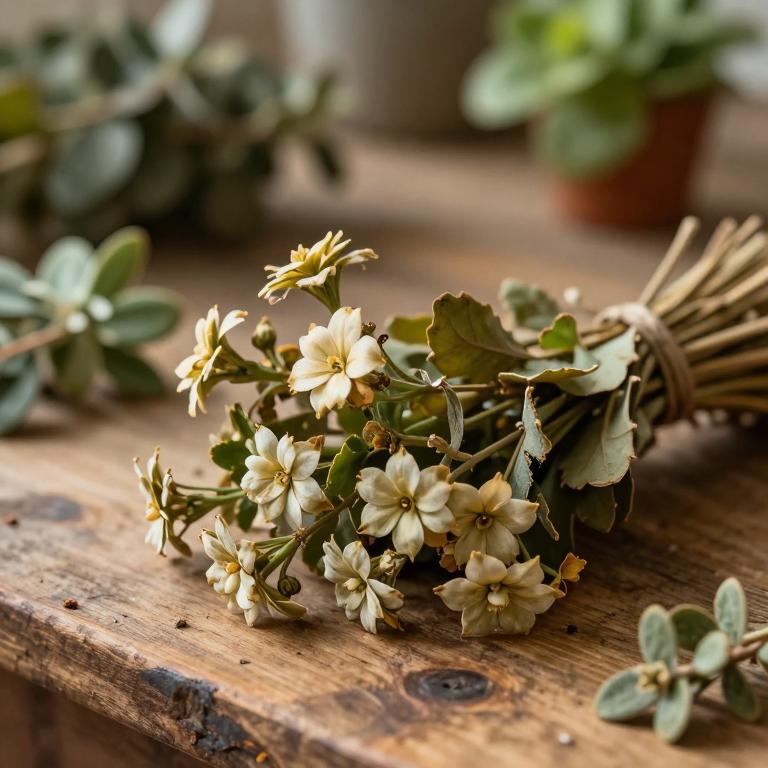
Kalanchoe crenodaigremontiana, scientifically known as Kalanchoe laetivirens, is a striking succulent celebrated for its vibrant, colorful foliage and medicinal potential. Often used in traditional practices to support wellness, this resilient plant features thick, decorative leaves that make it both a therapeutic resource and a stunning ornamental addition to gardens.
- Family
- Crassulaceae
- Native range
- Africa
- Parts used
- Leaf
- Common names
- Crenatodaigremontiana · Mother Of Thousands
- Scientific synonyms
- Bryophyllum Laetivirens
Names and Synonyms
Common Names
- Crenatodaigremontiana
- Mother of Thousands
Scientific Names
Accepted name
Kalanchoe laetivirensSynonyms
- Bryophyllum laetivirens
Regional and Traditional Names
Spanish:
- Madre de miles
- Mala Madre
Sources: Wikidata, Catalogue of Life
Taxonomical Classification
This plant, Kalanchoe laetivirens, belongs to the kingdom Plantae and the phylum Streptophyta. Within the class Equisetopsida and subclass Magnoliidae, it is further classified under the order Saxifragales. Finally, it is a member of the family Crassulaceae and the genus Kalanchoe.
| Rank | Classification |
|---|---|
| Kingdom | Plantae |
| Phylum | Streptophyta |
| Class | Equisetopsida |
| Subclass | Magnoliidae |
| Order | Saxifragales |
| Family | Crassulaceae |
| Genus | Kalanchoe |
Sources: The World Checklist of Vascular Plants (WCVP)
Distribution
This plant exhibits a diverse geographical distribution spanning several distinct global regions. In the Macaronesian islands, it can be found inhabiting the Canary Islands. Its presence extends to West Tropical Africa, specifically within the country of Senegal. Furthermore, it is established in the Western Indian Ocean, most notably on the island of Madagascar. Finally, the species reaches the Caribbean, where it is located in Cuba.
| Region | Area |
|---|---|
| Macaronesia | Canary Is. |
| West Tropical Africa | Senegal |
| Western Indian Ocean | Madagascar |
| Caribbean | Cuba |
Sources: The World Checklist of Vascular Plants (WCVP)
Botanical Identification
Morphology
The morphology of Kalanchoe laetivirens is characterized by its classification as a terrestrial organism, existing strictly in non-aquatic environments rather than as an aquatic or semiaquatic species. It exhibits a growth form consistent with a succulent herb, featuring fleshy, thickened structures designed for moisture retention. Furthermore, the plant is non-epiphytic, maintaining a terrestrial habit where it grows directly in soil rather than functioning as an obligatory or facultative epiphyte.
- Aquatic :
- terrestrial
- Epiphyte :
- terrestrial
- Growth form :
- herb
Physiology
The physiology of Kalanchoe laetivirgens is characterized by specialized adaptations for water conservation and metabolic efficiency, most notably through its pronounced succulence. As a succulent plant, it possesses thickened, fleshy leaves and stems that function as primary reservoirs for water storage, allowing the organism to maintain hydration during extended periods of drought. This morphological trait is inextricably linked to its Crassulacean Acid Metabolism (CAM), a physiological pathway wherein the plant opens its stomata at night to fix carbon dioxide, thereby minimizing transpirational water loss that would occur under direct sunlight. During the nocturnal phase, CO2 is converted into organic acids stored within the vacuoles of the succulent tissues; during the diurnal phase, these acids are decarboxylated to provide the carbon necessary for photosynthesis while the stomata remain closed. This highly efficient water-use strategy, combined with its ability to manage osmotic pressure within its specialized parenchyma cells, enables the plant to thrive in arid or semi-arid environments where water availability is inconsistent.
- Succulence :
- yes
Sources: Global Inventory of Floras and Traits (GIFT)
Plant Parts
Kalanchoe laetivirens has 1 reported plant parts identified across 1 scientific publications and several other databases that are studied for medicinal purposes. The most consistently reported plant part include leaf.
| Plant part | Supporting sources | Consensus |
|---|---|---|
| Leaf | 1 supporting sources | ★☆☆☆☆ |
Leaf
- Oncology reports
Chemicals
Kalanchoe laetivirens has 1 reported phytochemicals identified across 1 scientific publications and several other databases. The most consistently reported chemicals include F14.
| Chemical | Supporting sources | Consensus |
|---|---|---|
| F14 | 1 supporting sources | ★☆☆☆☆ |
F14
- Oncology reports
Activities
Kalanchoe laetivirens has 1 reported activities identified across 1 scientific publications and several other databases. The most consistently reported activities include Anticancer.
| Activity | Supporting sources | Consensus |
|---|---|---|
| Anticancer | 1 supporting sources | ★☆☆☆☆ |
Anticancer
- Oncology reports
Preparations
Kalanchoe laetivirens has 1 reported preparations identified across 1 scientific publications and several other databases. The most consistently reported preparations include B. laetivirens extract.
| Preparation | Supporting sources | Consensus |
|---|---|---|
| B. laetivirens extract | 1 supporting sources | ★☆☆☆☆ |
B. laetivirens extract
- Oncology reports