Kalanchoe glaucescens
Kalanchoe glaucescens · Accepted scientific name
Scientific literature: Very Sparse (2 studies) · ★☆☆☆☆
Kalanchoe glaucescens, scientifically known as Kalanchoe glaucescens, is a resilient succulent native to Madagascar. Renowned for its thick, glaucous leaves, this plant is valued in traditional medicine for its potential therapeutic properties. Its unique chemical composition offers intriguing possibilities for treating various ailments, making it a subject of botanical interest.
- Family
- Crassulaceae
- Native range
- Africa
- Parts used
- Not available
- Common names
- Not available
- Scientific synonyms
- Kalanchoe Holstii · Kalanchoe Flammea · 5 more
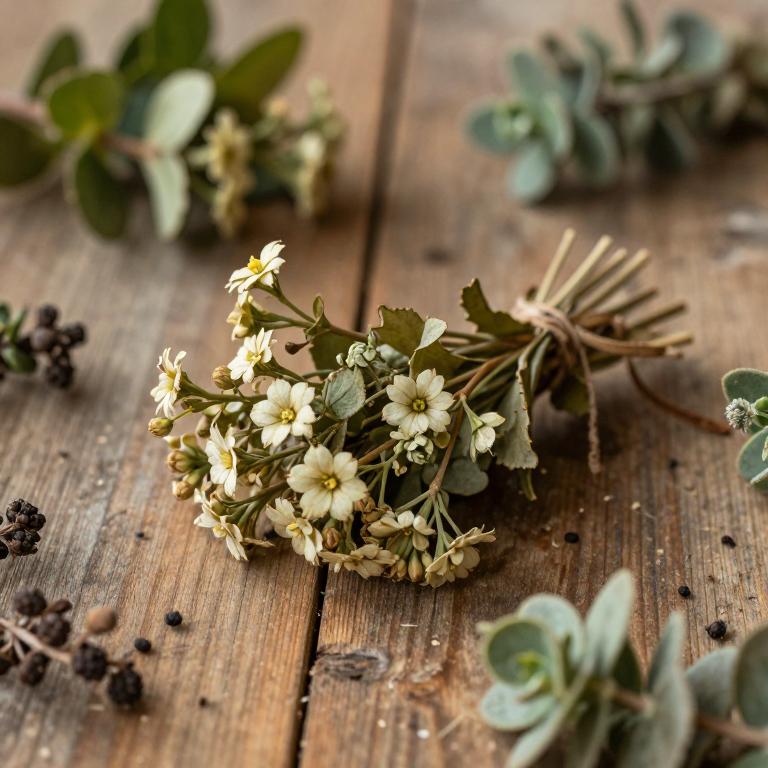
Names and Synonyms
Scientific Names
Accepted name
Kalanchoe glaucescensSynonyms
- Kalanchoe holstii
- Kalanchoe flammea
- Kalanchoe elliptica
- Kalanchoe magnidens
- Kalanchoe marinellii
- Kalanchoe ndorensis
- Kalanchoe beniensis
Sources: Wikidata, Catalogue of Life
Taxonomical Classification
This plant belongs to the kingdom Plantae and is classified under the phylum Streptophyta and the class Equisetopsida. Within the subclass Magnoliidae and the order Saxifragales, it is a member of the Crassulaceae family. Its taxonomic identity is further defined by its placement in the genus Kalanchoe.
| Rank | Classification |
|---|---|
| Kingdom | Plantae |
| Phylum | Streptophyta |
| Class | Equisetopsida |
| Subclass | Magnoliidae |
| Order | Saxifragales |
| Family | Crassulaceae |
| Genus | Kalanchoe |
Sources: The World Checklist of Vascular Plants (WCVP)
Distribution
This plant exhibits a diverse geographical distribution across several key regions of the African continent. In West-Central Tropical Africa, its presence is documented in both Rwanda and the Democratic Republic of the Congo. Moving toward the horn of Africa, the species is also found throughout Northeast Tropical Africa. Specifically, it inhabits the landscapes of Djibouti and Eritrea within this northeastern zone. Finally, its range extends into the highlands and territories of Ethiopia.
| Region | Area |
|---|---|
| West-Central Tropical Africa | Rwanda |
| West-Central Tropical Africa | DR Congo |
| Northeast Tropical Africa | Djibouti |
| Northeast Tropical Africa | Eritrea |
| Northeast Tropical Africa | Ethiopia |
| Northeast Tropical Africa | Somalia |
| Northeast Tropical Africa | Sudan-South Sudan |
| East Tropical Africa | Kenya |
| East Tropical Africa | Tanzania |
| East Tropical Africa | Uganda |
Sources: The World Checklist of Vascular Plants (WCVP)
Botanical Identification
Life history
The life history of Kalanchoe glaucescens is characterized by its status as a perennial plant, allowing it to persist through multiple growing seasons rather than completing its cycle within a single year. As a long-lived succulent, its developmental strategy focuses on resource accumulation and survival in arid or semi-arid environments, where it can endure extended periods of dormancy or slow growth depending on moisture availability. The plant typically undergoes a cycle of vegetative expansion, often aided by its ability to produce offsets or small plantlets, followed by periodic reproductive phases where it produces inflorescences to facilitate sexual reproduction via seeds. This perennial nature enables the species to establish stable populations that can withstand environmental fluctuations over many years.
- Lifecycle :
- perennial
Morphology
The morphology of Kalanchoe glaucescens is characterized by its herbaceous growth form, manifesting as a non-woody plant that lacks woody structural components. It typically reaches a plant height ranging from a minimum of 0.3 m to a maximum of 1.2 m. As a herb, its structure is primarily composed of soft, succulent tissues rather than rigid wood, contributing to its overall stature and developmental habit.
- Growth form :
- herb
- Plant height max:
- 1.2 m
- Plant height min:
- 0.3 m
- Woodiness :
- non-woody
Physiology
The physiology of Kalanchoe glaucescens is primarily defined by its specialized carbon fixation mechanism, specifically employing the Crassulacean Acid Metabolism (CAM) photosynthetic pathway. Unlike C3 or C4 plants, this species utilizes CAM to enhance water-use efficiency, a critical adaptation for survival in arid or semi-arid environments. During the nocturnal phase, the plant opens its stomata to absorb atmospheric carbon dioxide, which is then chemically fixed and stored as malic acid within the vacuoles of its succulent cells. As daylight occurs, the stomata remain closed to minimize transpirational water loss, and the stored malic acid is decarboxylated to release CO2 internally for the Calvin cycle. This temporal separation of CO2 uptake and fixation allows Kalanchoe glaucescens to maintain high photosynthetic productivity while significantly reducing its transpiration rates, reflecting a highly specialized physiological strategy for moisture conservation.
- Photosynthetic pathway :
- CAM
Reproduction
The reproduction of Kalanchoe glaucescens is characterized by the production of minute seeds that facilitate dispersal and colonization. These seeds exhibit a highly specific mass profile, with a calculated mean seed mass of 2.43e-05 g. The variation within the seed population is relatively narrow, ranging from a minimum seed mass of 2e-05 g to a maximum seed mass of 3e-05 g. This lightweight seed structure is typical of many species within its genus, allowing for efficient reproductive success through wind or water dispersal mechanisms.
- Seed mass max:
- 3e-05 g
- Seed mass mean:
- 2.43e-05 g
- Seed mass min:
- 2e-05 g
Sources: Global Inventory of Floras and Traits (GIFT)
Chemicals
Kalanchoe glaucescens has 2 reported phytochemicals identified across 0 scientific publications and several other databases. The most consistently reported chemicals include Coumaric Acid, palmitic acid.
| Chemical | Supporting sources | Consensus |
|---|---|---|
| Coumaric Acid | 1 supporting sources | ★☆☆☆☆ |
| palmitic acid | 1 supporting sources | ★☆☆☆☆ |
Coumaric Acid
- Journal of ethnopharmacology
palmitic acid
- Journal of ethnopharmacology