Kalanchoe farinacea
Kalanchoe farinacea · Accepted scientific name
Scientific literature: Very Sparse (0 studies) · ★☆☆☆☆
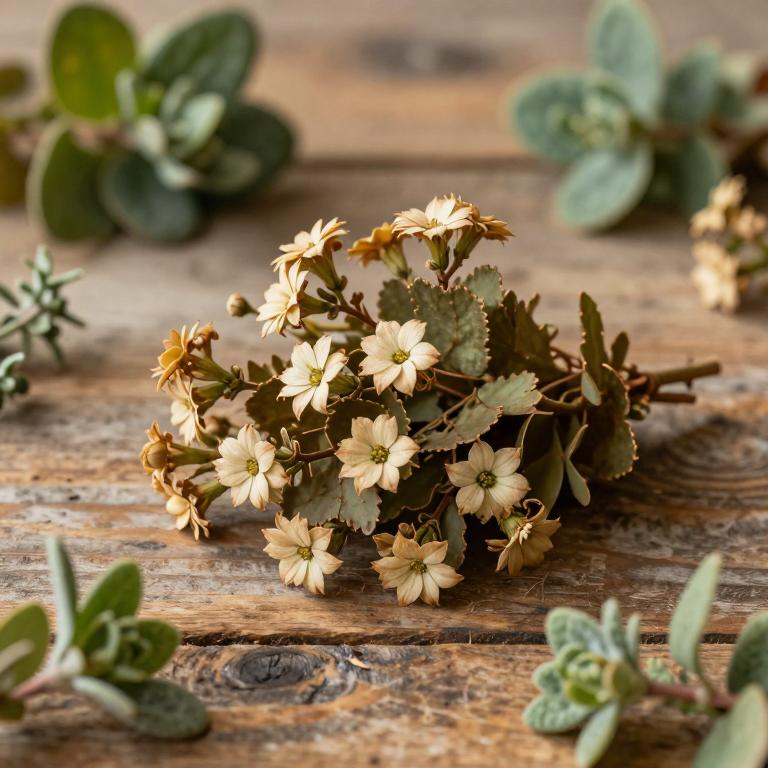
Kalanchoe farinacea is a succulent plant species recognized for its unique physiological properties and potential medicinal value. Recent scientific investigations have focused on the biological activities of its various chemical components. Specifically, researchers have utilized methanolic extracts to evaluate the plant's interaction with diverse microbial environments. These studies have demonstrated significant efficacy against Gram-Positive bacteria, highlighting the plant's antimicrobial potential. Consequently, the methanol extracts of Kalanchoe farinacea serve as a promising subject for further pharmacological development.
- Synonyms
- Not available
- Common names
- Not available
- Family
- Crassulaceae
- Distribution
- Not available
- Plant Parts
- Not available
Classification
Common Names
Kalanchoe farinacea is a distinctive succulent known by several different names depending on the region. In Finland, this plant is commonly referred to as jauhoitulehti. Those speaking Russian will recognize it by the name Каланхоэ мучнистое. Regardless of the language used, its unique appearance remains a defining characteristic. Understanding these common names can help gardeners identify the species more easily across different cultures.
Sources: Catalogue of Life (COL)
Taxonomy
Kalanchoe farinacea is a distinctive member of the kingdom Plantae. Within this vast biological realm, the species belongs to the class Equisetopsida. It is further categorized under the order Saxifragales to define its evolutionary lineage. This plant is a prominent representative of the genus Kalanchoe. Finally, it finds its specific botanical home within the family Crassulaceae.
| Rank | Classification |
|---|---|
| Kingdom | Plantae |
| Phylum | Streptophyta |
| Class | Equisetopsida |
| Subclass | Magnoliidae |
| Order | Saxifragales |
| Family | Crassulaceae |
| Genus | Kalanchoe |
Sources: The World Checklist of Vascular Plants (WCVP)
Distribution
Geographic Regions
Kalanchoe farinacea is a distinctive plant species with a specific geographic footprint. Its primary distribution is found throughout the diverse landscapes of Africa. Within the continent, it is particularly noted for its presence in Northeast Tropical Africa. The species also reaches the unique and isolated environment of Socotra. These regional connections highlight the plant's specialized ecological niche.
Sources: The World Checklist of Vascular Plants (WCVP)
Identification
Biological Activities
Compounds
Conditions
Kalanchoe farinacea demonstrates significant antimicrobial properties by effectively treating Gram-positive bacteria. Its methanolic extracts are also capable of treating multiresistant Staphylococcus strains. Furthermore, this plant shows potent inhibitory effects used to treat aminopeptidase N (APN) and angiotensin converting enzyme (ACE). The plant also exhibits notable anti-influenza virus type A activity in various testing systems. Together, these findings highlight the diverse medicinal potential of Kalanchoe farinacea.
Preparations
Kalanchoe farinacea is prepared as methanolic extracts to evaluate its various medicinal properties. These methanol extracts have been specifically tested for their ability to inhibit peptidases such as angiotensin converting enzyme, neutral endopeptidase, and aminopeptidase N. Furthermore, the plant is processed into methanolic extracts to demonstrate significant antibacterial activity against Gram-positive bacteria. Research also shows that Kalanchoe farinacea is prepared as methanol extracts to investigate its antiviral potential against the influenza virus. Through these different preparation methods, the efficacy of the plant's methanolic extracts is consistently highlighted across multiple pharmacological studies.