Mother of thousands
Kalanchoe daigremontiana · Accepted scientific name
Scientific literature: Very Sparse (27 studies) · ★☆☆☆☆
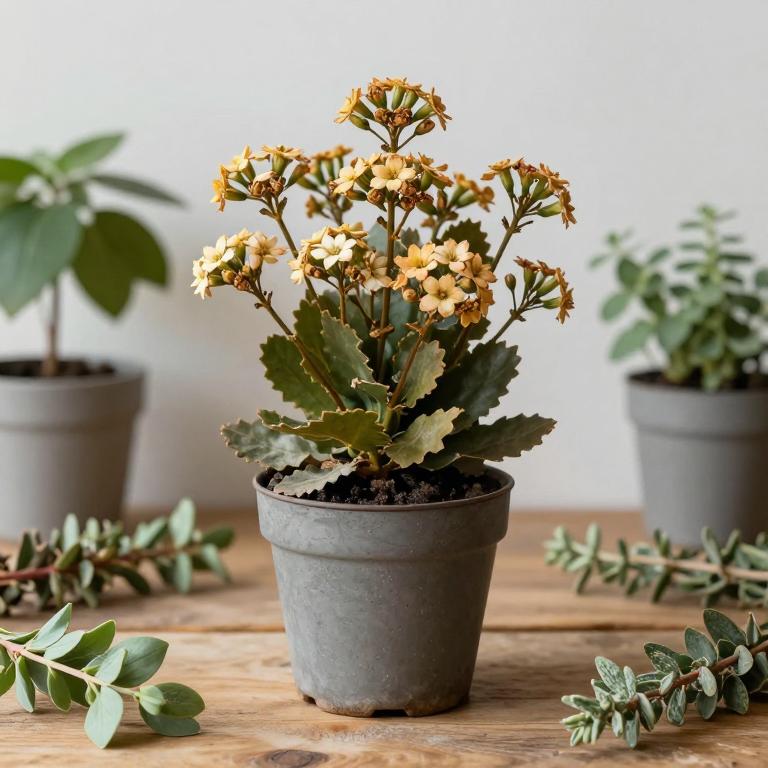
Mother of thousands, scientifically known as Kalanchoe daigremontiana, is a resilient succulent renowned for its rapid reproduction. Characterized by scalloped leaves and tiny plantlets along its edges, this hardy species is studied for its diverse phytochemical properties, offering potential therapeutic benefits in traditional medicine and modern pharmacological research.
- Family
- Crassulaceae
- Native range
- Europe
- Parts used
- Leaf
- Common names
- Mother-Of-Millions · Devil'S-Backbone · 3 more
- Scientific synonyms
- Bryophyllum Daigremontianum
Names and Synonyms
Common Names
- Mother-of-Millions
- devil's-backbone
- Alligator Plant
- Devil's Backbone
- Mother of Thousands
Scientific Names
Accepted name
Kalanchoe daigremontianaSynonyms
- Bryophyllum daigremontianum
Regional and Traditional Names
Spanish:
- Aranto
- Curalotodo
- Espinazo del diablo de Madagascar
- Planta lagarto de Madagascar
- Espinazo del diablo
German:
- Brutblatt
French:
- Kalanchoé de Daigremont
Sources: Wikidata, Catalogue of Life
Taxonomical Classification
This plant belongs to the kingdom Plantae within the phylum Streptophyta and is classified under the class Equisetopsida. As a member of the subclass Magnoliidae and the order Saxifragales, it is specifically situated within the family Crassulaceae. It is further identified by its genus, Kalanchoe, and its species name, Kalanchoe daigremontiana.
| Rank | Classification |
|---|---|
| Kingdom | Plantae |
| Phylum | Streptophyta |
| Class | Equisetopsida |
| Subclass | Magnoliidae |
| Order | Saxifragales |
| Family | Crassulaceae |
| Genus | Kalanchoe |
Sources: The World Checklist of Vascular Plants (WCVP)
Distribution
This plant exhibits a specific geographical distribution concentrated within the Mediterranean region of Southwestern Europe. It can be found growing naturally across various territories, including the islands of Baleares, Corse, and Sardegna. Furthermore, its presence extends to the mainland areas of both Portugal and Spain. These diverse locations highlight the plant's preference for the unique coastal and island environments of the southwest. Consequently, its range is defined by these specific European maritime locations.
| Region | Area |
|---|---|
| Southwestern Europe | Baleares |
| Southwestern Europe | Corse |
| Southwestern Europe | Portugal |
| Southwestern Europe | Sardegna |
| Southwestern Europe | Spain |
| Southeastern Europe | Italy |
| Southeastern Europe | Sicilia |
| Northern Africa | Algeria |
| Northern Africa | Morocco |
| Northern Africa | Tunisia |
Sources: The World Checklist of Vascular Plants (WCVP)
Botanical Identification
Ecology
The ecology of Kalanchoe daigremontiana is characterized by its adaptation to lowland environments, where it thrives in diverse ecological niches. This species typically maintains an elevational range with a mean altitude of approximately 1600 m AMSL, allowing it to occupy specific altitudinal belts within its native or naturalized territories. Its presence in these lowland habitats often involves a high degree of resilience to varying moisture levels, utilizing its specialized physiological traits to persist in environments where resource availability may fluctuate.
- Elevational range mean:
- 1600 m AMSL
- Habitat :
- Lowland
Life history
The life history of Kalanchoe daigremontiana is characterized by its classification as a perennial, allowing the plant to persist through multiple growing seasons. In terms of its growth habit and structural positioning, it is categorized as a chamaephyte, meaning its regenerative buds are located near or just above the soil surface, which contributes to its robust and spreading nature. This life form, characterized as both a chamaephyte and a perennial, enables the species to effectively colonize environments and maintain long-term stability within its ecological niche.
- Life form :
- chamaephyte
- Lifecycle :
- perennial
Morphology
The morphology of Kalanchoe daigremontiana is characterized by its growth form as a non-woody herb and forb. This terrestrial species, which functions independently as a non-parasitic plant, typically reaches a plant height ranging from a minimum of 0.3 m to a maximum of 1 m. The plant exhibits an ascending shoot orientation and is self-supporting rather than acting as a climber, liana, or vine. It is strictly a terrestrial organism, lacking any epiphytic or aquatic tendencies, and maintains a succulent, non-woody structure throughout its development.
- Aquatic :
- terrestrial
- Climber :
- self-supporting
- Epiphyte :
- terrestrial
- Growth form :
- herb
- Growth form :
- forb
- Parasite :
- independent
- Plant height max:
- 1 m
- Plant height min:
- 0.3 m
- Shoot orientation :
- ascending
- Woodiness :
- non-woody
Physiology
The physiology of Kalanchoe daigremontiana is characterized by highly specialized adaptations for water conservation and efficient resource management. As a succulent, the plant possesses thickened tissues designed for significant water storage, a trait essential for its survival in arid environments. This succulence is supported by a Crassulacean Acid Metabolism (CAM) photosynthetic pathway, which allows the plant to fix carbon dioxide at night to minimize transpirational water loss during the heat of the day. Morphologically, the plant features an opposite leaf arrangement, with elliptic leaf forms that vary significantly in size; individual leaves can range from a minimum length of 1 cm to a maximum of 18 cm, with widths ranging from a mean and minimum of 2.5 cm up to a maximum of 5 cm. Furthermore, the plant does not function as a nitrogen fixer, relying instead on the availability of nitrogen within the soil substrate to support its metabolic processes.
- Leaf arrangement :
- opposite
- Leaf form :
- elliptic
- Leaf length max:
- 18 cm
- Leaf length min:
- 1 cm
- Leaf width max:
- 5 cm
- Leaf width mean:
- 2.5 cm
- Nitrogen fixer :
- no
- Photosynthetic pathway :
- CAM
- Succulence :
- yes
Reproduction
The reproduction of Kalanchoe daigremontiana is characterized by a versatile strategy that includes the presence of asexual reproduction. The plant produces inflorescences in the form of a panicle, which bear flowers that typically exhibit a grey coloration. These flowers vary in size, with lengths ranging from a minimum of 1.8 cm to a maximum of 2.3 cm. The flowering period is quite extensive and variable, generally starting in December and concluding in May, though it can span across various months of the year. Regarding its seeds, the mass is extremely minute, with a mean, minimum, and maximum value all recorded at approximately 1e-05 g. The dispersal syndrome of the plant is classified as unspecialized, encompassing various methods such as anemochorous, zoochorous, autochorous, hydrochorous, and other unspecialized modes of movement.
- Dispersal syndrome :
- unspecialized
- Flower colour :
- grey
- Flower length max:
- 2.3 cm
- Flower length min:
- 1.8 cm
- Flowering time :
- Dec
- Flowering time :
- May
- Inflorescence :
- panicle
- Reproduction asexual :
- present
- Seed mass mean:
- 1e-05 g
Sources: Global Inventory of Floras and Traits (GIFT)
Plant Parts
Kalanchoe daigremontiana has 1 reported plant parts identified across 1 scientific publications and several other databases that are studied for medicinal purposes. The most consistently reported plant part include leaf.
| Plant part | Supporting sources | Consensus |
|---|---|---|
| Leaf | 1 supporting sources | ★☆☆☆☆ |
Leaf
- Chemistry & biodiversity
Chemicals
Kalanchoe daigremontiana has 18 reported phytochemicals identified across 1 scientific publications and several other databases. The most consistently reported chemicals include kaempferol, quercetin, 19-oxodesacetylcinobufagin, 4''-O-Acetylafzelin, 9,12,13-TriHOME.
| Chemical | Supporting sources | Consensus |
|---|---|---|
| kaempferol | 2 supporting sources | ★☆☆☆☆ |
| quercetin | 2 supporting sources | ★☆☆☆☆ |
| 19-oxodesacetylcinobufagin | 1 supporting sources | ★☆☆☆☆ |
| 4''-O-Acetylafzelin | 1 supporting sources | ★☆☆☆☆ |
| 9,12,13-TriHOME | 1 supporting sources | ★☆☆☆☆ |
| BERSALDEGENIN 1,3,5-ORTHOACETATE | 1 supporting sources | ★☆☆☆☆ |
| Blumenol C | 1 supporting sources | ★☆☆☆☆ |
| Corchorifatty acid F | 1 supporting sources | ★☆☆☆☆ |
| Fatty acids | 1 supporting sources | ★☆☆☆☆ |
| Flavonoids | 1 supporting sources | ★☆☆☆☆ |
kaempferol
- Journal of pharmaceutical and biomedical analysis
- Planta medica
quercetin
- Journal of pharmaceutical and biomedical analysis
- Planta medica
19-oxodesacetylcinobufagin
- Journal of pharmaceutical and biomedical analysis
4''-O-Acetylafzelin
- Journal of pharmaceutical and biomedical analysis
9,12,13-TriHOME
- Journal of pharmaceutical and biomedical analysis
BERSALDEGENIN 1,3,5-ORTHOACETATE
- Planta medica
Blumenol C
- Journal of pharmaceutical and biomedical analysis
Corchorifatty acid F
- Journal of pharmaceutical and biomedical analysis
Fatty acids
- Journal of pharmaceutical and biomedical analysis
Flavonoids
- Planta medica
Conditions
Kalanchoe daigremontiana has 6 reported investigations on conditions identified across 1 scientific publications and several other databases. The most consistently reported conditions include HSV-1, HSV-2, breast, drought, melanoma.
| Condition | Supporting sources | Consensus |
|---|---|---|
| Hsv-1 | 1 supporting sources | ★☆☆☆☆ |
| Hsv-2 | 1 supporting sources | ★☆☆☆☆ |
| Breast | 1 supporting sources | ★☆☆☆☆ |
| Drought | 1 supporting sources | ★☆☆☆☆ |
| Melanoma | 1 supporting sources | ★☆☆☆☆ |
| Wounds | 1 supporting sources | ★☆☆☆☆ |
Hsv-1
- Chemistry & biodiversity
Hsv-2
- Chemistry & biodiversity
Breast
- Planta medica
Drought
- Scientific reports
Melanoma
- Planta medica
Wounds
- Planta medica
Preparations
Kalanchoe daigremontiana has 4 reported preparations identified across 1 scientific publications and several other databases. The most consistently reported preparations include Kd-AC fraction, aqueous leaf extract, feed supplement, nanovesicle preparations.
| Preparation | Supporting sources | Consensus |
|---|---|---|
| Kd-ac fraction | 1 supporting sources | ★☆☆☆☆ |
| Aqueous leaf extract | 1 supporting sources | ★☆☆☆☆ |
| Feed supplement | 1 supporting sources | ★☆☆☆☆ |
| Nanovesicle preparations | 1 supporting sources | ★☆☆☆☆ |
Kd-ac fraction
- Chemistry & biodiversity
Aqueous leaf extract
- Chemistry & biodiversity
Feed supplement
- Biology
Nanovesicle preparations
- Plants (Basel, Switzerland)