Kalanchoe ceratophylla
Kalanchoe ceratophylla · Accepted scientific name
Scientific literature: Very Sparse (15 studies) · ★☆☆☆☆
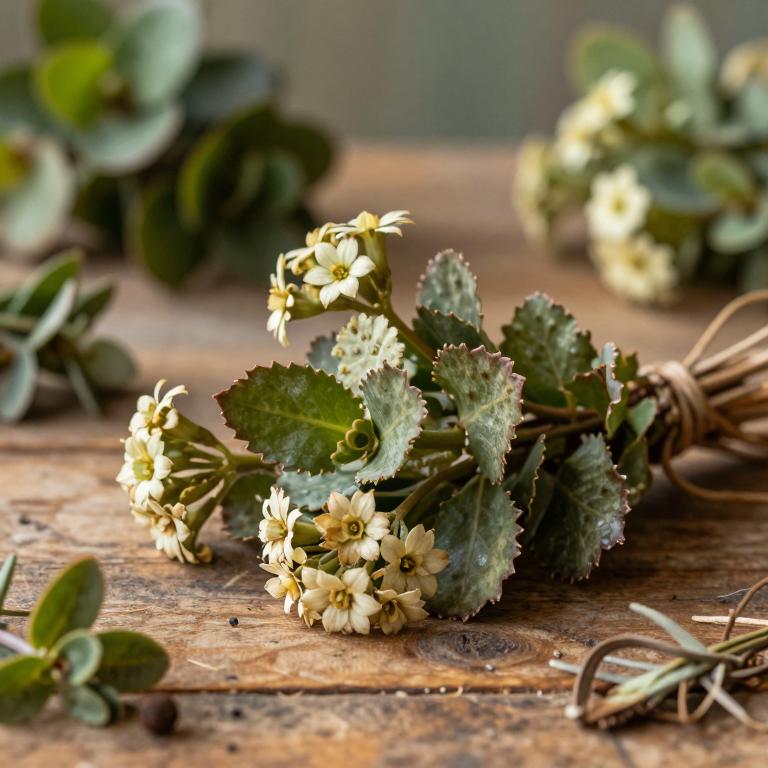
Kalanchoe ceratophylla, scientifically known as Kalanchoe ceratophylla, is a striking succulent native to Mexico. Renowned for its fleshy, horned leaves, this plant is valued in traditional medicine for its potential therapeutic properties. It serves as a fascinating subject for studying natural compounds and their diverse biological applications.
- Family
- Crassulaceae
- Native range
- Asia-Temperate
- Parts used
- Leaf · Stem
- Common names
- Not available
- Scientific synonyms
- Vereia Ceratophylla
Names and Synonyms
Scientific Names
Accepted name
Kalanchoe ceratophyllaSynonyms
- Vereia ceratophylla
Sources: Wikidata, Catalogue of Life
Taxonomical Classification
This plant belongs to the kingdom Plantae and is classified under the phylum Streptophyta and class Equisetopsida. Within the subclass Magnoliidae, it is organized under the order Saxifrages and the family Crassulaceae. Finally, it is identified by the genus Kalanchoe, specifically as the species Kalanchoe ceratophylla.
| Rank | Classification |
|---|---|
| Kingdom | Plantae |
| Phylum | Streptophyta |
| Class | Equisetopsida |
| Subclass | Magnoliidae |
| Order | Saxifragales |
| Family | Crassulaceae |
| Genus | Kalanchoe |
Sources: The World Checklist of Vascular Plants (WCVP)
Distribution
This plant exhibits a broad geographical distribution spanning several distinct regions across Asia. In China, it can be found throughout the South-Central and Southeast territories. Its presence extends further east to the island of Taiwan within Eastern Asia. Moving toward the Indian Subcontinent, the species is documented in the state of Assam. Additionally, the plant is known to grow within the borders of Bangladesh.
| Region | Area |
|---|---|
| China | China South-Central |
| China | China Southeast |
| Eastern Asia | Taiwan |
| Indian Subcontinent | Assam |
| Indian Subcontinent | Bangladesh |
| Indian Subcontinent | East Himalaya |
| Indian Subcontinent | India |
| Indian Subcontinent | West Himalaya |
| Indo-China | Cambodia |
| Indo-China | Laos |
Sources: The World Checklist of Vascular Plants (WCVP)
Plant Parts
Kalanchoe ceratophylla has 2 reported plant parts identified across 2 scientific publications and several other databases that are studied for medicinal purposes. The most consistently reported plant part include leaf, stem.
| Plant part | Supporting sources | Consensus |
|---|---|---|
| Leaf | 1 supporting sources | ★☆☆☆☆ |
| Stem | 1 supporting sources | ★☆☆☆☆ |
Leaf
- Scientifica
Stem
- Scientifica
Chemicals
Kalanchoe ceratophylla has 8 reported phytochemicals identified across 2 scientific publications and several other databases. The most consistently reported chemicals include Antioxidants, ERYTHRITOL, Flavonoids, Friedelan-3-one, GAMMA-SITOSTEROL.
| Chemical | Supporting sources | Consensus |
|---|---|---|
| Antioxidants | 1 supporting sources | ★☆☆☆☆ |
| ERYTHRITOL | 1 supporting sources | ★☆☆☆☆ |
| Flavonoids | 1 supporting sources | ★☆☆☆☆ |
| Friedelan-3-one | 1 supporting sources | ★☆☆☆☆ |
| GAMMA-SITOSTEROL | 1 supporting sources | ★☆☆☆☆ |
| NEOPHYTADIENE | 1 supporting sources | ★☆☆☆☆ |
| glutinol | 1 supporting sources | ★☆☆☆☆ |
| squalene | 1 supporting sources | ★☆☆☆☆ |
Antioxidants
- Scientifica
ERYTHRITOL
- Scientifica
Flavonoids
- Scientifica
Friedelan-3-one
- Scientifica
GAMMA-SITOSTEROL
- Scientifica
NEOPHYTADIENE
- Scientifica
glutinol
- Scientifica
squalene
- Scientifica
Activities
Kalanchoe ceratophylla has 2 reported activities identified across 2 scientific publications and several other databases. The most consistently reported activities include Anticancer, Antidiabetic.
| Activity | Supporting sources | Consensus |
|---|---|---|
| Anticancer | 1 supporting sources | ★☆☆☆☆ |
| Antidiabetic | 1 supporting sources | ★☆☆☆☆ |
Anticancer
- Scientifica
Antidiabetic
- Scientifica
Preparations
Kalanchoe ceratophylla has 2 reported preparations identified across 2 scientific publications and several other databases. The most consistently reported preparations include freeze drying (FD), hot air drying (HAD).
| Preparation | Supporting sources | Consensus |
|---|---|---|
| Freeze drying (fd) | 1 supporting sources | ★☆☆☆☆ |
| Hot air drying (had) | 1 supporting sources | ★☆☆☆☆ |
Freeze drying (fd)
- Scientifica
Hot air drying (had)
- Scientifica