Indian hasmine
Jasminum auriculatum · Accepted scientific name
Scientific literature: Very Sparse (4 studies) · ★☆☆☆☆
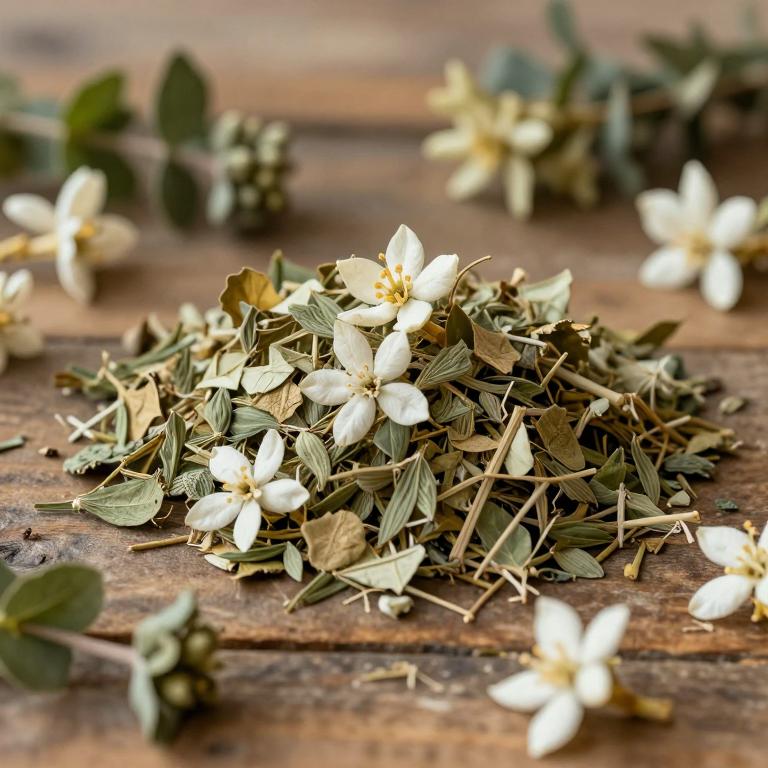
Indian jasmine, scientifically known as Jasminum auriculatum, is a fragrant, evergreen shrub prized for its intoxicatingly sweet white blossoms. Renowned in traditional medicine, it is widely utilized for its calming properties, skin-soothing benefits, and ability to alleviate stress, making it a vital botanical treasure in holistic wellness practices.
- Family
- Oleaceae
- Native range
- Asia-Tropical
- Parts used
- Not available
- Common names
- Indian Hasmine · Needle-Flower Jasmine
- Scientific synonyms
- Jasminum Auriculatum Var. Glabrior · Jasminum Ovalifolium · 1 more
Names and Synonyms
Common Names
- Indian hasmine
- needle-flower jasmine
Scientific Names
Accepted name
Jasminum auriculatumSynonyms
- Jasminum auriculatum var. glabrior
- Jasminum ovalifolium
- Mogorium trifoliatum
Regional and Traditional Names
Spanish:
- Mogorium trifoliatum
- Jasminum trifoliatum
- Jasminum affine
- Jasminum ovalifolium
- Jasminum auriculatum var. glabrior
- Jasminum mucronatum
Sources: Wikidata, Catalogue of Life
Taxonomical Classification
This plant belongs to the kingdom Plantae and is classified under the phylum Streptophyta within the class Equisetopsida. It is further categorized under the subclass Magnoliidae and the order Lamiales, falling into the family Oleaceae. Finally, its taxonomic identity is defined by the genus Jasminum.
| Rank | Classification |
|---|---|
| Kingdom | Plantae |
| Phylum | Streptophyta |
| Class | Equisetopsida |
| Subclass | Magnoliidae |
| Order | Lamiales |
| Family | Oleaceae |
| Genus | Jasminum |
Sources: The World Checklist of Vascular Plants (WCVP)
Distribution
This plant is widely distributed across the diverse landscapes of the Indian Subcontinent. It can be found growing naturally throughout the various regions of India. Its presence is also well-documented in the neighboring nations of Bangladesh and Nepal. Furthermore, the species thrives within the tropical environments of Sri Lanka. Finally, its range extends into the specific ecological zones of the West Himalaya.
| Region | Area |
|---|---|
| Indian Subcontinent | Bangladesh |
| Indian Subcontinent | India |
| Indian Subcontinent | Nepal |
| Indian Subcontinent | Sri Lanka |
| Indian Subcontinent | West Himalaya |
| Indo-China | Andaman Is. |
Sources: The World Checklist of Vascular Plants (WCVP)
Botanical Identification
Life history
The life history of Jasminum auriculatum is characterized by its nature as a perennial plant, allowing it to persist and thrive through multiple growing seasons. Throughout its existence, it maintains an evergreen habit, retaining its foliage continuously rather than shedding it seasonally.
- Deciduousness :
- evergreen
- Lifecycle :
- perennial
Morphology
The morphology of Jasminum auriculatum is characterized by its growth form as a woody shrub that exhibits climbing tendencies. While it primarily functions as a terrestrial plant rather than an aquatic or semiaquatic species, it acts as an obligatory climber to navigate its environment. As an independent organism, it does not function as a parasite or an epiphyte, maintaining a terrestrial existence. The plant's structural integrity is defined by its woody nature, providing the necessary support for its shrubby, climbing habit.
- Aquatic :
- terrestrial
- Climber :
- obligatory
- Epiphyte :
- terrestrial
- Growth form :
- shrub
- Parasite :
- independent
- Woodiness :
- woody
Physiology
The physiology of Jasminum auriculatum is characterized by its metabolic processes as a perennial woody shrub, primarily focusing on efficient photosynthesis and complex secondary metabolite production. As an angiosperm, it utilizes C3 photosynthetic pathways to convert solar energy into chemical energy, supporting the rapid development of its fragrant white flowers and dense foliage. The plant's vascular system is highly specialized for the transport of water and essential nutrients through xylem and phloem to sustain its sprawling growth habit. In terms of nutrient cycling and symbiotic relationships, Jasminum auriculatum is not a nitrogen fixer; it lacks the specialized root nodules containing nitrogen-fixing bacteria required to convert atmospheric nitrogen into ammonia, meaning it relies on the uptake of nitrates and ammonium from the soil. Its physiological resilience is further evidenced by its ability to regulate transpiration through stomatal control, allowing it to maintain turgor pressure and survive varying environmental moisture levels.
- Nitrogen fixer :
- no
Sources: Global Inventory of Floras and Traits (GIFT)
Activities
Jasminum auriculatum has 2 reported activities identified across 0 scientific publications and several other databases. The most consistently reported activities include Antimicrobial, Antioxidant.
| Activity | Supporting sources | Consensus |
|---|---|---|
| Antimicrobial | 1 supporting sources | ★☆☆☆☆ |
| Antioxidant | 1 supporting sources | ★☆☆☆☆ |
Antimicrobial
- Avicenna journal of phytomedicine
Antioxidant
- Avicenna journal of phytomedicine
Conditions
Jasminum auriculatum has 2 reported investigations on conditions identified across 0 scientific publications and several other databases. The most consistently reported conditions include skin diseases, wound.
| Condition | Supporting sources | Consensus |
|---|---|---|
| Skin diseases | 1 supporting sources | ★☆☆☆☆ |
| Wound | 1 supporting sources | ★☆☆☆☆ |
Skin diseases
- Avicenna journal of phytomedicine
Wound
- Avicenna journal of phytomedicine