Algerian Iris
Iris unguicularis · Accepted scientific name
Scientific literature: Very Sparse (5 studies) · ★☆☆☆☆
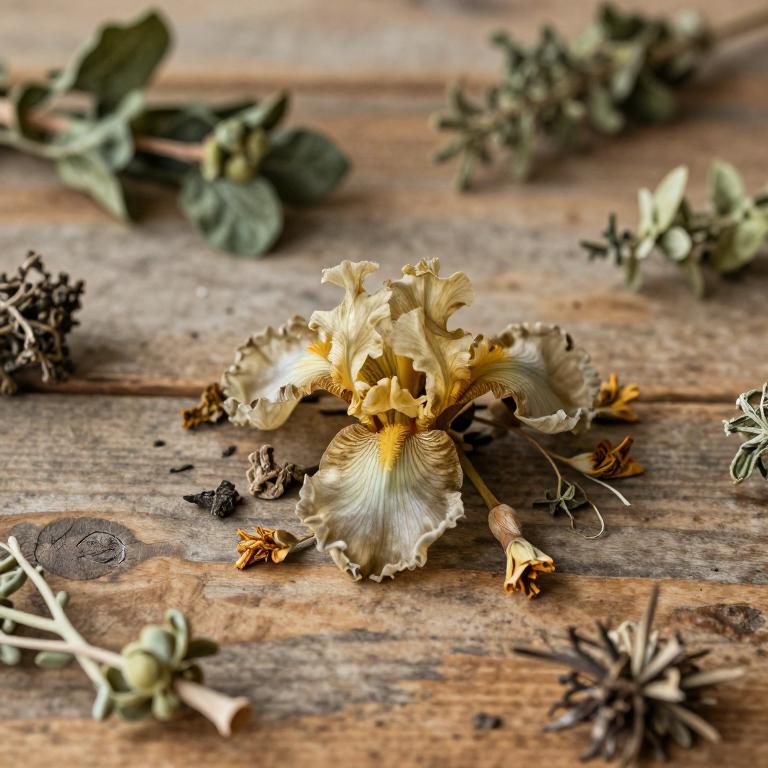
Algerian Iris, scientifically known as Iris unguicularis, is a charming, low-growing perennial celebrated for its striking, fragrant blooms. Native to North Africa, this hardy plant thrives in Mediterranean climates. While primarily used for ornamental beauty in rock gardens, its botanical significance lies in its resilience and unique floral elegance.
- Family
- Iridaceae
- Native range
- Europe
- Parts used
- Not available
- Common names
- Algerian Iris · Winter-Flowering Iris
- Scientific synonyms
- Siphonostylis Unguicularis
Names and Synonyms
Common Names
- Algerian Iris
- winter-flowering iris
Scientific Names
Accepted name
Iris unguicularisSynonyms
- Siphonostylis unguicularis
Regional and Traditional Names
Spanish:
- Siphonostylis unguicularis
- Iris stylosa var. angustifolia
- Siphonostylis cretensis subsp. carica
- Iris unguicularis var. carica
- Iris cretensis
- Iris humilis subsp. cretensis
- Siphonostylis cretensis
- Iris humilis
- Iris cretica
- Siphonostylis cretensis subsp. syriaca
- Iris stylosa
- Neubeckia stylosa
- Joniris stylosa
- Siphonostylis cretensis subsp carica
- Siphonostylis cretensis subsp syriaca
German:
- Kretische Schwertlilie
- Winter-Schwertlilie
French:
- Iris d'Alger
Sources: Wikidata, Catalogue of Life
Taxonomical Classification
This plant belongs to the kingdom Plantae and is classified under the phylum Streptophyta and class Equisetopsida. Within the subclass Magnoliidae, it is ordered under Asparagales and falls into the family Iridaceae. Finally, it is categorized under the genus Iris.
| Rank | Classification |
|---|---|
| Kingdom | Plantae |
| Phylum | Streptophyta |
| Class | Equisetopsida |
| Subclass | Magnoliidae |
| Order | Asparagales |
| Family | Iridaceae |
| Genus | Iris |
Sources: The World Checklist of Vascular Plants (WCVP)
Distribution
This plant exhibits a diverse geographical range across several regions of Europe. In Northern Europe, it can be specifically found within the borders of Great Britain. Its presence extends into Southwestern Europe, where it grows in Spain. Furthermore, the species is well-distributed throughout Southeastern Europe, including Italy and Greece. Finally, it can also be located on the island of Kriti within the Southeastern European region.
| Region | Area |
|---|---|
| Northern Europe | Great Britain |
| Southwestern Europe | Spain |
| Southeastern Europe | Greece |
| Southeastern Europe | Italy |
| Southeastern Europe | Kriti |
| Northern Africa | Algeria |
| Northern Africa | Morocco |
| Northern Africa | Tunisia |
| Western Asia | East Aegean Is. |
| Western Asia | Lebanon-Syria |
Sources: The World Checklist of Vascular Plants (WCVP)
Botanical Identification
Life history
The life history of Iris unguicularis is defined by its classification as a cryptophyte, specifically functioning as a geophyte. This life strategy involves the plant's ability to survive unfavorable environmental periods, such as extreme heat or drought, by retreating into specialized underground storage organs. As a geophyte, its vital parts are sequestered beneath the soil surface in the form of fleshy rhizomes, which allow it to remain dormant until seasonal conditions become optimal for growth. This subterranean existence protects the plant's energy reserves from surface-level stressors, enabling it to emerge annually to produce its characteristic foliage and flowers. By utilizing this underground survival mechanism, Iris unguicularis successfully navigates its ecological niche through cycles of dormancy and rapid seasonal development.
- Life form :
- geophyte
- Life form :
- cryptophyte
Morphology
The morphology of Iris unguicularis is characterized by a non-woody, herbaceous growth form, specifically classified as a herb and a forb. As a self-supporting plant, it does not function as a climber, liana, or vine, nor does it require external structures for support. It maintains an independent life cycle, functioning as an independent organism rather than a parasite, and is strictly terrestrial in its ecological habit, lacking any aquatic, semiaquatic, or epiphytic characteristics.
- Aquatic :
- terrestrial
- Climber :
- self-supporting
- Epiphyte :
- terrestrial
- Growth form :
- herb
- Parasite :
- independent
- Woodiness :
- non-woody
Reproduction
Reproduction in Iris unguicularis occurs primarily through the production of seeds following successful pollination, though the plant is also well-known for spreading via rhizomatous growth. The seeds produced are notably minute, characterized by a highly consistent seed mass. Quantitative analysis of the reproductive output shows that the seed mass is uniform across the sampled population, with a mean seed mass of 0.00393 g. This measurement is reflected in the maximum and minimum values, which both remain constant at 0.00393 g, indicating a lack of significant variance in the weight of individual seeds. This precision in seed size suggests a highly standardized reproductive strategy in terms of energy allocation per seed.
- Seed mass mean:
- 0.00393 g
Sources: Global Inventory of Floras and Traits (GIFT)
Chemicals
Iris unguicularis has 1 reported phytochemicals identified across 0 scientific publications and several other databases. The most consistently reported chemicals include Tectorigenin.
| Chemical | Supporting sources | Consensus |
|---|---|---|
| Tectorigenin | 1 supporting sources | ★☆☆☆☆ |
Tectorigenin
- Frontiers in pharmacology
Conditions
Iris unguicularis has 4 reported investigations on conditions identified across 0 scientific publications and several other databases. The most consistently reported conditions include Alzheimer's disease, Parkinson's disease, multiple sclerosis, neuroinflammatory disorders.
| Condition | Supporting sources | Consensus |
|---|---|---|
| Alzheimer's disease | 1 supporting sources | ★☆☆☆☆ |
| Parkinson's disease | 1 supporting sources | ★☆☆☆☆ |
| Multiple sclerosis | 1 supporting sources | ★☆☆☆☆ |
| Neuroinflammatory disorders | 1 supporting sources | ★☆☆☆☆ |
Alzheimer's disease
- Frontiers in pharmacology
Parkinson's disease
- Frontiers in pharmacology
Multiple sclerosis
- Frontiers in pharmacology
Neuroinflammatory disorders
- Frontiers in pharmacology