Blue Iris
Iris spuria · Accepted scientific name
Scientific literature: Very Sparse (4 studies) · ★☆☆☆☆
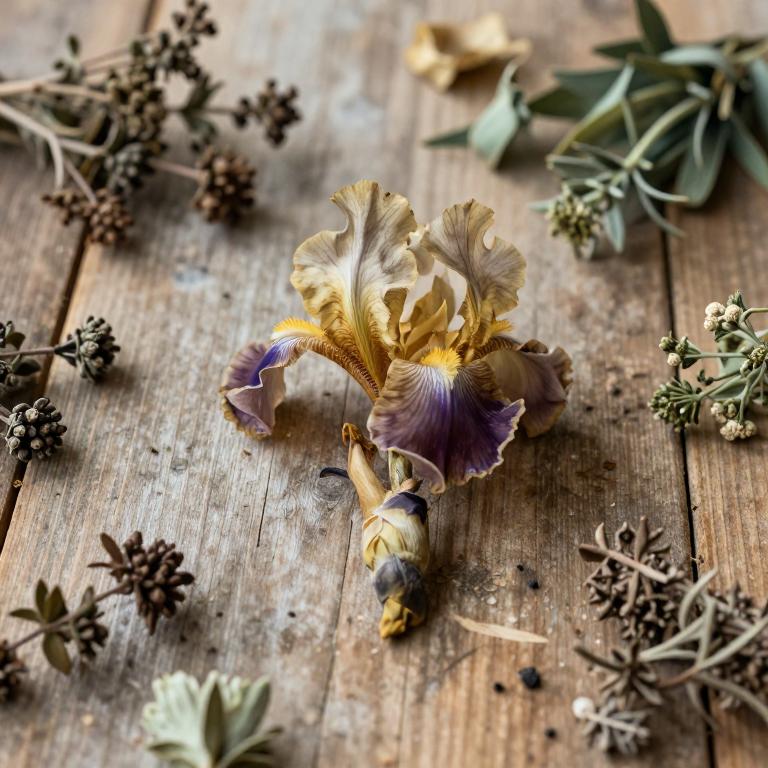
Blue Iris, scientifically known as Iris spuria, is a resilient perennial herb cherished for its striking blooms and medicinal potential. Historically utilized in traditional practices, it contains bioactive compounds valued for their therapeutic properties. This versatile plant offers a fascinating intersection of ornamental beauty and significant ethnobotanical importance.
- Family
- Iridaceae
- Native range
- Europe
- Parts used
- Rhizome
- Common names
- Blue Iris · Butterfly Iris
- Scientific synonyms
- Xiphion Spurium · Xyridion Spurium · 2 more
Names and Synonyms
Common Names
- Blue Iris
- Butterfly Iris
Scientific Names
Accepted name
Iris spuriaSynonyms
- Xiphion spurium
- Xyridion spurium
- Limniris spuria
- Chamaeiris spuria
Regional and Traditional Names
Spanish:
- Xyridion demetrii
- Iris spuria var. notha
- Xyridion musulmanicum
- Xyridion maritimum
- Iris klattii
- Xyridion spurium
- Xiphion nothum
- Xiphion spurium
- Iris spuria var. reichenbachiana
- Iris spuria var. hispanica
- Iris musulmanica
- Iris demetrii
- Iris spuria var. subbarbata
- Iris spathacea
- Spurio
- Xyridion carthaliniae
German:
- Bastard-Schwertlilie
- Steppen-Schwertlilie
- Salzwiesen-Schwertlilie
- Wiesen-Schwertlilie
- Steppen-Schwertlilie
- Wiesen-Schwertlilie
- Bastard-Schwertlilie
- Salzwiesen-Schwertlilie
French:
- iris des steppes
- Iris bâtard
Sources: Wikidata, Catalogue of Life
Taxonomical Classification
This plant belongs to the kingdom Plantae and the phylum Streptophyta, falling under the class Equisetopsida and subclass Magnoliidae. It is further classified within the order Asparagales and the family Iridaceae. Ultimately, it is identified by the genus Iris.
| Rank | Classification |
|---|---|
| Kingdom | Plantae |
| Phylum | Streptophyta |
| Class | Equisetopsida |
| Subclass | Magnoliidae |
| Order | Asparagales |
| Family | Iridaceae |
| Genus | Iris |
Sources: The World Checklist of Vascular Plants (WCVP)
Distribution
This plant exhibits a broad geographical distribution across several European regions. In Northern Europe, it can be found growing in Denmark, Great Britain, and Sweden. Its presence also extends into Middle Europe, where it inhabits parts of Austria. Additionally, the species is documented within the territories of Czechia and Slovakia. Together, these locations highlight the varied habitats where the plant thrives.
| Region | Area |
|---|---|
| Northern Europe | Denmark |
| Northern Europe | Great Britain |
| Northern Europe | Sweden |
| Middle Europe | Austria |
| Middle Europe | Czechia-Slovakia |
| Middle Europe | Germany |
| Middle Europe | Hungary |
| Southwestern Europe | France |
| Caucasus | North Caucasus |
| Caucasus | Transcaucasus |
Sources: The World Checklist of Vascular Plants (WCVP)
Botanical Identification
Ecology
The ecology of Iris spuria is primarily defined by its preference for lowland environments, where it establishes itself in diverse landscape formations. It thrives in open, sun-exposed areas such as meadows, pastures, and riparian zones, often colonizing moist to damp soils near seasonal watercourses or marshy depressions. As a resilient herbaceous perennial, it is well-adapted to disturbed habitats and transitional ecotones, where it can compete effectively within grassland communities. Its distribution is closely tied to these lowland alluvial or coastal plains, where the availability of moisture and consistent sunlight supports its vegetative spread via rhizomes and its reproductive success through seasonal flowering.
- Habitat :
- Lowland
Life history
The life history of Iris spuria is characterized by a perennial lifecycle, allowing the plant to persist through multiple growing seasons. It functions as a cryptophyte, specifically categorized as a geophyte, meaning it survives unfavorable periods using underground storage organs. In terms of its seasonal growth patterns, the plant is deciduous, shedding its foliage as it enters dormancy.
- Deciduousness :
- deciduous
- Life form :
- geophyte
- Life form :
- cryptophyte
- Lifecycle :
- perennial
Morphology
The morphology of Iris spuria is characterized by its growth form as a non-woody herb, specifically categorized as a forb. This plant is a self-supporting species that does not function as a climber, liana, or vine, and it grows independently without being a parasite or an epiphyte, maintaining a terrestrial habit. In terms of stature, it exhibits a moderate height, with individual plants typically ranging from a minimum of 0.3 m to a maximum of 0.9 m, maintaining an average plant height of approximately 0.6 m.
- Aquatic :
- terrestrial
- Climber :
- self-supporting
- Epiphyte :
- terrestrial
- Growth form :
- herb
- Growth form :
- forb
- Parasite :
- independent
- Plant height max:
- 0.9 m
- Plant height mean:
- 0.6 m
- Plant height min:
- 0.3 m
- Woodiness :
- non-woody
Physiology
The physiology of Iris spuria is characterized by a C3 photosynthetic pathway, which dictates its carbon fixation processes and metabolic efficiency under typical environmental conditions. Structurally, the plant exhibits highly consistent morphological dimensions in its foliage, maintaining a specialized leaf width that remains uniform throughout its development. Specifically, the leaf width displays no variance, with a mean, minimum, and maximum value all measured at exactly 1 cm. This narrow, consistent leaf architecture is closely tied to its physiological resource management and its ability to regulate transpiration and gas exchange within its specific ecological niche.
- Leaf width mean:
- 1 cm
- Photosynthetic pathway :
- C3
Reproduction
The reproduction of Iris spuria involves both sexual and asexual mechanisms. Asexual reproduction is present in this species, allowing for vegetative propagation. During its flowering season, the plant typically begins to bloom in June and concludes its flowering period in July. The seeds produced during the sexual phase are relatively small, with a minimum mass of 0.02423 g, a maximum mass of 0.02923 g, and a mean seed mass of approximately 0.0260383333333333 g. Regarding seed dissemination, the species exhibits a hydrochorous dispersal syndrome, meaning its seeds are primarily dispersed by water.
- Dispersal syndrome :
- hydrochorous
- Flowering time :
- Jun
- Flowering time :
- Jul
- Reproduction asexual :
- present
- Seed mass max:
- 0.02923 g
- Seed mass mean:
- 0.0260383333333333 g
- Seed mass min:
- 0.02423 g
Sources: Global Inventory of Floras and Traits (GIFT)
Plant Parts
Iris spuria has 1 reported plant parts identified across 1 scientific publications and several other databases that are studied for medicinal purposes. The most consistently reported plant part include rhizome.
| Plant part | Supporting sources | Consensus |
|---|---|---|
| Rhizome | 1 supporting sources | ★☆☆☆☆ |
Rhizome
- Phytomedicine : international journal of phytotherapy and phytopharmacology
Chemicals
Iris spuria has 3 reported phytochemicals identified across 1 scientific publications and several other databases. The most consistently reported chemicals include Iristectorigenin A, Isoflavonoids, Tectoridin.
| Chemical | Supporting sources | Consensus |
|---|---|---|
| Iristectorigenin A | 1 supporting sources | ★☆☆☆☆ |
| Isoflavonoids | 1 supporting sources | ★☆☆☆☆ |
| Tectoridin | 1 supporting sources | ★☆☆☆☆ |
Iristectorigenin A
- Phytomedicine : international journal of phytotherapy and phytopharmacology
Isoflavonoids
- Phytomedicine : international journal of phytotherapy and phytopharmacology
Tectoridin
- Phytomedicine : international journal of phytotherapy and phytopharmacology
Preparations
Iris spuria has 2 reported preparations identified across 1 scientific publications and several other databases. The most consistently reported preparations include methanolic extract, plant extract.
| Preparation | Supporting sources | Consensus |
|---|---|---|
| Methanolic extract | 1 supporting sources | ★☆☆☆☆ |
| Plant extract | 1 supporting sources | ★☆☆☆☆ |
Methanolic extract
- Phytomedicine : international journal of phytotherapy and phytopharmacology
Plant extract
- Phytomedicine : international journal of phytotherapy and phytopharmacology