yellow iris
Iris pseudacorus · Accepted scientific name
Scientific literature: Very Sparse (17 studies) · ★☆☆☆☆
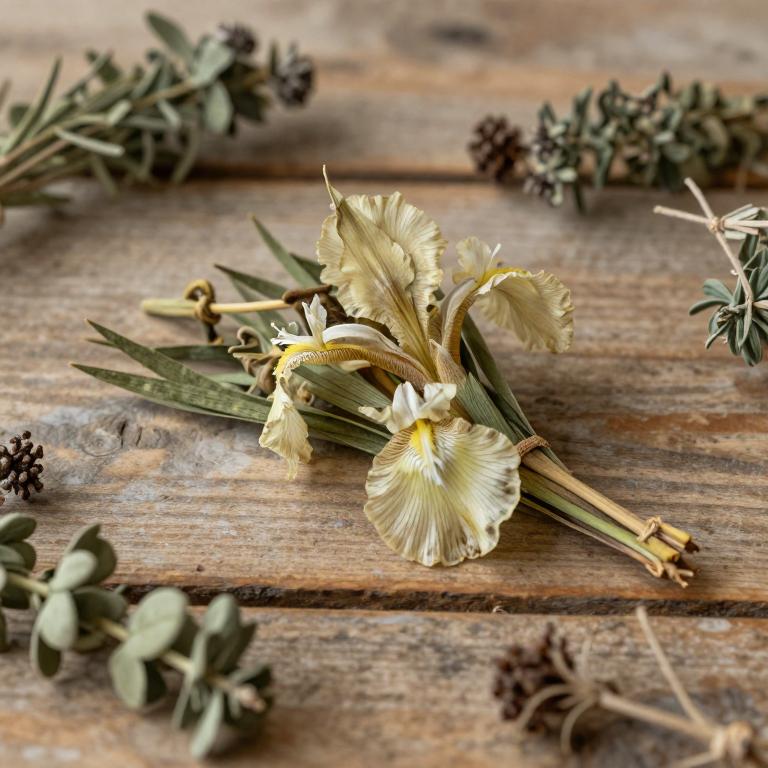
Yellow iris, scientifically known as Iris pseudacorus, is a striking perennial native to European wetlands. Renowned for its vibrant, lemon-yellow blooms, this moisture-loving plant thrives in marshes and stream banks. While aesthetically beautiful, it contains irritating substances, requiring careful handling when used in traditional medicinal or ornamental contexts.
Names and Synonyms
Common Names
- pale yellow iris
- yellow flag
- yellow iris
- yellow water iris
- Flag Iris
- common yellow iris
- pale-yellow iris
- water flag
- yellow flag iris
Scientific Names
Accepted name
Iris pseudacorusSynonyms
- Limniris pseudacorus
- Xyridion pseudacorus
- Xyridion acoroideum
- Iris pseudacorus var. acoriformis
- Iris pseudacorus var. parviflorum
- Iris pseudacorus f. submersa
- Iris pseudacorus var. citrina
- Iris pseudacorus var. ochroleuca
- Iris acoroides
- Iris pseudacorus f. albescens
- Iris pseudacorus var. parviflora
- Iris palustris var. pallida
- Iris paludosa
- Iris pseudacorus var. acoroides
- Iris pseudacorus var. bastardii
- Acorus adulterinus
- Iris pseudacorus var. acoriformis
- Iris lutea
- Iris pseudacorus f. nyaradyana
- Iris pseudacorus f. longiacuminata
- Iris pseudacorus subsp. bastardii
- Iris pseudacorus subvar. aurantiaca
- Iris pallidior
- Iris pseudacorus var. longifolia
- Iris pseudacorus subsp. acoriformis
- Iris sativa
- Limnirion pseudacorus
- Moraea candolleana
- Iris bastardii
- Iris flava
- Iris curtopetala
- Iris acoriformis
- Xiphion pseudacorus
- Xiphion acoroides
Regional and Traditional Names
Spanish:
- Gladiolo de agua
- Vieusseuxia iridioides
- Xiphion acoroides
- Lirio de la marisma
- Falso ácoro
- Lirio amarillo de lagunas
- Lirio borde
- Liris de la espadana de flor amarilla
- Xyridion pseudacorus
- Brimbio
- Ácoro bastardo
- Lirio espadañal amarillo
- Espadaña de flor amarilla
- Acoro acuático amarillo
- Iris palustris
- Colchicum falcifolium
- Pseudo-iris palustris
- Iris flava
- Lirios de campo
- Iris curtopetala
- Iris acoroides
- Raiz de lirio amarillo
- Acoro falso
- Iris sativa
- Espadana amarilla
- Limnirion pseudacorus
- Lirio pajizo
- Lirio amarillo de agua
- Lirio salvaje amarillo
- Ácoro palustre
- Lirio espadanal amarillo
- Acorus adulterinus
- Limniris pseudacorus
- Espadaña amarilla
- Acaro bastardo
- Espadanal
- Falso-acoro
- Espadana de flor amarilla
- Iris paludosa
- Iris bastardii
- Espadana fina
- Falso acoro
- Azucena amarilla
- Pseudo iris palustris
- Jarro de oro
- Pseudoacoro
- Iris acoriformis
- Iris amarillo
- Raíz de lirio amarillo
- Acoro palustre
- Acoro bastardo
- Iris lutea
- Moraea candolleana
- Alsusena
- Liris de la espadaña de flor amarilla
- Iris pallidior
- Acoro acuatico amarillo
- Xyridion acoroideum
- Xiphion pseudacorus
- Lirio amarillo
German:
- Sumpf-Schwertlilie
- Sumpfschwertlilie
- Wasserschwertlilie
- Gelbe Schwertlilie
- Wasser-Schwertlilie
- Iris des Marais
- iris jaune
- Sumpf-Schwertlilie
- Gelbe Schwertlilie
- Sumpfschwertlilie
- Wasserschwertlilie
French:
- Iris Des Marais
- Iris jaune
- Iris d'eau
- fleur-de-lis
- iris des marais
- iris faux-acore
- iris jaune
Sources: Wikidata, Catalogue of Life
Taxonomical Classification
This plant belongs to the kingdom Plantae and is classified under the phylum Streptophyta and the class Equisetopsida. Within the subclass Magnoliidae, it is further categorized under the order Asparagales and the family Iridaceae. Ultimately, its taxonomic identity is defined by its placement within the genus Iris.
| Rank | Classification |
|---|---|
| Kingdom | Plantae |
| Phylum | Streptophyta |
| Class | Equisetopsida |
| Subclass | Magnoliidae |
| Order | Asparagales |
| Family | Iridaceae |
| Genus | Iris |
Sources: The World Checklist of Vascular Plants (WCVP)
Distribution
This plant, known as Iris pseudacorus, exhibits a specific distribution pattern across several regions of Northern Europe. It can be found growing naturally in the landscapes of Denmark and Finland. Additionally, the species is present in the Faroe Islands, which are part of the North Atlantic region. Its range also extends to the British Isles, including Great Britain. Finally, the plant is well-established within the natural habitats of Ireland.
| Region | Area |
|---|---|
| Northern Europe | Denmark |
| Northern Europe | Finland |
| Northern Europe | Føroyar |
| Northern Europe | Great Britain |
| Northern Europe | Ireland |
| Northern Europe | Norway |
| Northern Europe | Sweden |
| Middle Europe | Austria |
| Middle Europe | Belgium |
| Middle Europe | Czechia-Slovakia |
Sources: The World Checklist of Vascular Plants (WCVP)
Botanical Identification
Ecology
The ecology of Iris pseudacorus is characterized by its preference for low-lying, saturated environments, thriving primarily in habitats such as lakes, rivers, shores, and swamps. It occupies a specific altitudinal niche, with an elevational range spanning from 0 to a maximum of 500 m AMSL. In terms of its symbiotic relationships, this species does not exhibit mycorrhizal associations, as indicated by its lack of mycorrhiza.
- Elevational range max:
- 500 m AMSL
- Elevational range min:
- 0 m AMSL
- Habitat :
- lakes, rivers, shores, swamps
- Mycorrhiza :
- no
Life history
The life history of Iris pseudacorus is characterized by its status as a perennial plant, allowing it to persist in its environment over multiple growing seasons. As a cryptophyte, it relies on underground structures to survive unfavorable conditions, and its specific life form is classified as a geophyte, utilizing specialized storage organs located beneath the soil surface. This species maintains an evergreen nature, retaining its foliage throughout much of its cycle, which facilitates continuous photosynthetic activity.
- Deciduousness :
- evergreen
- Life form :
- geophyte
- Life form :
- cryptophyte
- Lifecycle :
- perennial
Morphology
The morphology of Iris pseudacorus is characterized by its growth form as a non-woody herb, specifically categorized as a forb. As a self-supporting plant, it does not exhibit climbing tendencies such as a liana or vine, and it functions as an independent organism rather than a parasite. The plant is terrestrial in its ecological habit, avoiding epiphytic or aquatic lifestyles. In terms of stature, it displays significant variation in size, with a plant height ranging from a minimum of 0.4 m to a maximum of 1.6 m, maintaining an average height of approximately 0.625 m.
- Aquatic :
- terrestrial
- Climber :
- self-supporting
- Epiphyte :
- terrestrial
- Growth form :
- herb
- Growth form :
- forb
- Parasite :
- independent
- Plant height max:
- 1.6 m
- Plant height mean:
- 0.625 m
- Plant height min:
- 0.4 m
- Woodiness :
- non-woody
Physiology
The physiology of Iris pseudacorus is characterized by a C3 photosynthetic pathway, typical of many temperate wetland species, and it functions as a non-carnivorous organism that does not possess the ability to fix nitrogen. Its vegetative structure is defined by elongated, ensiform leaves that exhibit significant morphological variation, with leaf lengths ranging from a minimum of 70 cm to a maximum of 100 cm. These leaves are notably narrow, maintaining a mean width of 0.3 cm, though individual specimens can vary between a minimum width of 2 cm and a maximum width of 3 cm, resulting in a mean leaf size of approximately 208.7375 cm². Furthermore, the plant demonstrates a mean Specific Leaf Area (SLA) of 160.52 cm²/g, reflecting its leaf mass per area and its adaptation to its specific environmental niche.
- Carnivory :
- non-carnivorous
- Leaf length max:
- 100 cm
- Leaf length min:
- 70 cm
- Leaf size mean:
- 208.7375 cm²
- Leaf width max:
- 3 cm
- Leaf width mean:
- 0.3 cm
- Leaf width min:
- 2 cm
- Nitrogen fixer :
- no
- Photosynthetic pathway :
- C3
- Specific Leaf Area (SLA) mean:
- 160.52 cm²/g
Reproduction
The reproduction of Iris pseudacorus is primarily driven by sexual processes, as asexual reproduction is noted to be absent. The flowering period typically begins in May and concludes in July, during which the plant undergoes biotic pollination. Specifically, the pollination syndrome is characterized by insect activity, with bees serving as key pollinators. Interestingly, self-fertilization is absent in this species, necessitating cross-pollination to ensure genetic diversity. Following successful fertilization, the plant develops a dehiscent fruit categorized as a capsule. This fruit has an average length of 5 cm and an average width of 2 cm. Within these capsules, the seeds are produced with a highly consistent length of 7 mm (ranging from a minimum to a maximum of 7 mm) and a mean mass of approximately 0.04789225 g, with individual seed masses fluctuating between a minimum of 0.03797 g and a maximum of 0.056 g. Once mature, the seeds are dispersed via a hydrochorous syndrome, utilizing water as the primary medium for transport to new habitats.
- Dehiscence :
- dehiscent
- Dispersal syndrome :
- hydrochorous
- Flowering time :
- May
- Flowering time :
- Jul
- Fruit length mean:
- 5 cm
- Fruit type :
- capsule
- Fruit width mean:
- 2 cm
- Pollination syndrome :
- insect
- Pollination syndrome :
- bee
- Pollination syndrome :
- biotic
- Reproduction asexual :
- absent
- Seed length mean:
- 7 mm
- Seed mass max:
- 0.056 g
- Seed mass mean:
- 0.04789225 g
- Seed mass min:
- 0.03797 g
- Self fertilization :
- absent
Sources: Global Inventory of Floras and Traits (GIFT)
Plant Parts
Iris pseudacorus has 2 reported plant parts identified across 3 scientific publications and several other databases that are studied for medicinal purposes. The most consistently reported plant part include rhizome, leaf.
| Plant part | Supporting sources | Consensus |
|---|---|---|
| Rhizome | 2 supporting sources | ★☆☆☆☆ |
| Leaf | 1 supporting sources | ★☆☆☆☆ |
Rhizome
- Journal of pharmaceutical and biomedical analysis
- Fitoterapia
Leaf
- Fitoterapia
Chemicals
Iris pseudacorus has 5 reported phytochemicals identified across 3 scientific publications and several other databases. The most consistently reported chemicals include 5,7,4'-trihydroxy-6,3'-dimethoxy isoflavone, Gallocatechin, Liquiritigenin, SYRINGIC ACID, Tannin.
| Chemical | Supporting sources | Consensus |
|---|---|---|
| 5,7,4'-trihydroxy-6,3'-dimethoxy isoflavone | 1 supporting sources | ★☆☆☆☆ |
| Gallocatechin | 1 supporting sources | ★☆☆☆☆ |
| Liquiritigenin | 1 supporting sources | ★☆☆☆☆ |
| SYRINGIC ACID | 1 supporting sources | ★☆☆☆☆ |
| Tannin | 1 supporting sources | ★☆☆☆☆ |
5,7,4'-trihydroxy-6,3'-dimethoxy isoflavone
- Journal of pharmaceutical and biomedical analysis
Gallocatechin
- Journal of pharmaceutical and biomedical analysis
Liquiritigenin
- Fitoterapia
SYRINGIC ACID
- Fitoterapia
Tannin
- Journal of pharmaceutical and biomedical analysis
Activities
Iris pseudacorus has 3 reported activities identified across 3 scientific publications and several other databases. The most consistently reported activities include Antibacterial, Antimicrobial, Cytotoxic.
| Activity | Supporting sources | Consensus |
|---|---|---|
| Antibacterial | 1 supporting sources | ★☆☆☆☆ |
| Antimicrobial | 1 supporting sources | ★☆☆☆☆ |
| Cytotoxic | 1 supporting sources | ★☆☆☆☆ |
Antibacterial
- Journal of pharmaceutical and biomedical analysis
Antimicrobial
- Fitoterapia
Cytotoxic
- Journal of pharmaceutical and biomedical analysis
Conditions
Iris pseudacorus has 4 reported investigations on conditions identified across 3 scientific publications and several other databases. The most consistently reported conditions include Enterococcus faecalis, Klebsiella pneumoniae, Pseudomonas aeruginosa, Staphylococcus aureus.
| Condition | Supporting sources | Consensus |
|---|---|---|
| Enterococcus faecalis | 1 supporting sources | ★☆☆☆☆ |
| Klebsiella pneumoniae | 1 supporting sources | ★☆☆☆☆ |
| Pseudomonas aeruginosa | 1 supporting sources | ★☆☆☆☆ |
| Staphylococcus aureus | 1 supporting sources | ★☆☆☆☆ |
Enterococcus faecalis
- Journal of pharmaceutical and biomedical analysis
Klebsiella pneumoniae
- Journal of pharmaceutical and biomedical analysis
Pseudomonas aeruginosa
- Journal of pharmaceutical and biomedical analysis
Staphylococcus aureus
- Journal of pharmaceutical and biomedical analysis
Preparations
Iris pseudacorus has 2 reported preparations identified across 3 scientific publications and several other databases. The most consistently reported preparations include Methanol extracts from leaves and rhizomes, Methanolic extracts.
| Preparation | Supporting sources | Consensus |
|---|---|---|
| Methanol extracts from leaves and rhizomes | 1 supporting sources | ★☆☆☆☆ |
| Methanolic extracts | 1 supporting sources | ★☆☆☆☆ |
Methanol extracts from leaves and rhizomes
- Fitoterapia
Methanolic extracts
- Journal of pharmaceutical and biomedical analysis