Iris kashmiriana
Iris kashmiriana · Accepted scientific name
Scientific literature: Very Sparse (13 studies) · ★☆☆☆☆
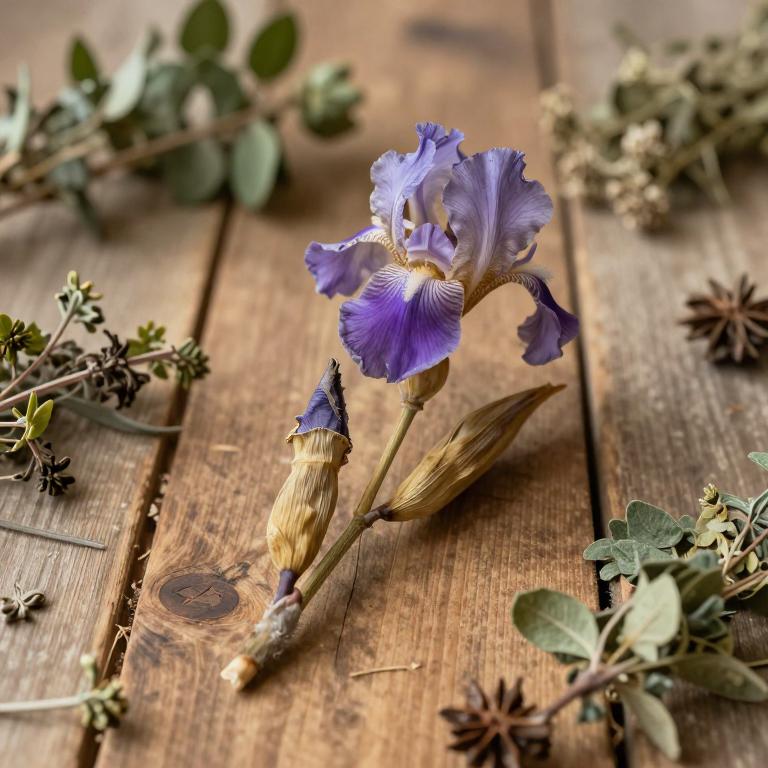
scientifically known as Iris kashmiriana, is a resilient perennial herb native to the high-altitude regions of the Himalayas. Renowned for its striking blooms, this plant holds significant ethnobotanical value. It is traditionally utilized in various medicinal practices for its bioactive properties, offering potential therapeutic benefits in holistic healing.
- Family
- Iridaceae
- Native range
- Asia-Temperate
- Parts used
- Flower
- Common names
- Not available
- Scientific synonyms
- Iris Bartonii
Names and Synonyms
Scientific Names
Accepted name
Iris kashmirianaSynonyms
- Iris bartonii
Sources: Wikidata, Catalogue of Life
Taxonomical Classification
This plant belongs to the kingdom Plantae and the phylum Streptophyta, falling under the class Equisetopsida and subclass Magnoliidae. It is classified within the order Asparagales and the family Iridaceae. Finally, it is identified by the genus Iris, specifically as the species Iris kashmiriana.
| Rank | Classification |
|---|---|
| Kingdom | Plantae |
| Phylum | Streptophyta |
| Class | Equisetopsida |
| Subclass | Magnoliidae |
| Order | Asparagales |
| Family | Iridaceae |
| Genus | Iris |
Sources: The World Checklist of Vascular Plants (WCVP)
Distribution
This plant exhibits a specific geographical distribution spanning across parts of Western Asia and the Indian Subcontinent. Within Western Asia, its presence is documented in the countries of Afghanistan and Iran. Moving into the Indian Subcontinent, the species is found growing in Pakistan. Additionally, it inhabits the mountainous regions of the West Himalaya. Together, these locations define the natural range where Iris kashmiriana can be located.
| Region | Area |
|---|---|
| Western Asia | Afghanistan |
| Western Asia | Iran |
| Indian Subcontinent | Pakistan |
| Indian Subcontinent | West Himalaya |
Sources: The World Checklist of Vascular Plants (WCVP)
Botanical Identification
Ecology
The ecology of Iris kashmiriana is characterized by its specific distribution within montane environments, where it thrives across a defined vertical gradient. This species is typically found inhabiting high-altitude terrains, occupying an elevational range that begins at a minimum of 1000 m AMSL and extends up to a maximum of 1800 m AMSL. Within this altitudinal belt, the plant adapts to the unique climatic conditions and soil compositions prevalent in these sub-alpine or montane zones, playing a role in the localized biodiversity of its specialized mountain habitat.
- Elevational range max:
- 1800 m AMSL
- Elevational range min:
- 1000 m AMSL
Life history
The life history of Iris kashmiriana is characterized by a perennial lifecycle, allowing the plant to persist through multiple growing seasons. It functions as a cryptophyte, ensuring its survival by keeping its perennuating buds protected below the soil surface or at the soil level during unfavorable conditions. Specifically, its biological structure is classified as a geophyte, meaning it relies on underground storage organs, such as rhizomes, to endure dormant periods and facilitate regrowth in its natural habitat.
- Life form :
- geophyte
- Life form :
- cryptophyte
- Lifecycle :
- perennial
Morphology
The morphology of Iris kashmiriana is characterized by its classification as a herb, exhibiting a non-woody structure throughout its vegetative parts. As a terrestrial plant, it grows directly in the soil rather than as an epiphyte, maintaining an independent life cycle without relying on a host, thus functioning as an independent organism. In terms of its structural habit, it does not possess climbing tendencies, instead maintaining a self-supporting growth form that allows it to stand upright within its natural habitat.
- Climber :
- self-supporting
- Epiphyte :
- terrestrial
- Growth form :
- herb
- Parasite :
- independent
- Woodiness :
- non-woody
Reproduction
The reproduction of Iris kashmiriana is primarily characterized by its seasonal flowering cycle, which is a critical component of its life cycle. The flowering period for this species is relatively concentrated, typically commencing in May and reaching its conclusion by June. While the exact timing can be subject to environmental variables, the onset of the reproductive phase is most consistently observed during the month of May, with the blooming process concluding in June. This specific temporal window facilitates the pollination necessary for the plant's continued propagation and genetic diversity.
- Flowering time :
- May
- Flowering time :
- Jun
Sources: Global Inventory of Floras and Traits (GIFT)
Plant Parts
Iris kashmiriana has 1 reported plant parts identified across 1 scientific publications and several other databases that are studied for medicinal purposes. The most consistently reported plant part include flower.
| Plant part | Supporting sources | Consensus |
|---|---|---|
| Flower | 1 supporting sources | ★☆☆☆☆ |
Flower
- Scientific reports
Chemicals
Iris kashmiriana has 9 reported phytochemicals identified across 1 scientific publications and several other databases. The most consistently reported chemicals include CHLOROGENIC ACID, Epicatechin, Flavonoid, RUTIN, SINAPIC ACID.
| Chemical | Supporting sources | Consensus |
|---|---|---|
| CHLOROGENIC ACID | 1 supporting sources | ★☆☆☆☆ |
| Epicatechin | 1 supporting sources | ★☆☆☆☆ |
| Flavonoid | 1 supporting sources | ★☆☆☆☆ |
| RUTIN | 1 supporting sources | ★☆☆☆☆ |
| SINAPIC ACID | 1 supporting sources | ★☆☆☆☆ |
| Vanillic acid | 1 supporting sources | ★☆☆☆☆ |
| caffeic acid | 1 supporting sources | ★☆☆☆☆ |
| ellagic acid | 1 supporting sources | ★☆☆☆☆ |
| quercetin | 1 supporting sources | ★☆☆☆☆ |
CHLOROGENIC ACID
- Scientific reports
Epicatechin
- Scientific reports
Flavonoid
- Scientific reports
RUTIN
- Scientific reports
SINAPIC ACID
- Scientific reports
Vanillic acid
- Scientific reports
caffeic acid
- Scientific reports
ellagic acid
- Scientific reports
quercetin
- Scientific reports
Activities
Iris kashmiriana has 3 reported activities identified across 1 scientific publications and several other databases. The most consistently reported activities include Antibacterial, Antioxidant, Cytotoxic.
| Activity | Supporting sources | Consensus |
|---|---|---|
| Antibacterial | 1 supporting sources | ★☆☆☆☆ |
| Antioxidant | 1 supporting sources | ★☆☆☆☆ |
| Cytotoxic | 1 supporting sources | ★☆☆☆☆ |
Antibacterial
- Scientific reports
Antioxidant
- Scientific reports
Cytotoxic
- Scientific reports
Preparations
Iris kashmiriana has 2 reported preparations identified across 1 scientific publications and several other databases. The most consistently reported preparations include ethyl acetate (IRK-ETH) extracts, methanol (IRK-MTH) extracts.
| Preparation | Supporting sources | Consensus |
|---|---|---|
| Ethyl acetate (irk-eth) extracts | 1 supporting sources | ★☆☆☆☆ |
| Methanol (irk-mth) extracts | 1 supporting sources | ★☆☆☆☆ |
Ethyl acetate (irk-eth) extracts
- Scientific reports
Methanol (irk-mth) extracts
- Scientific reports