Himalayan indigo
Indigofera heterantha · Accepted scientific name
Scientific literature: Very Sparse (9 studies) · ★☆☆☆☆
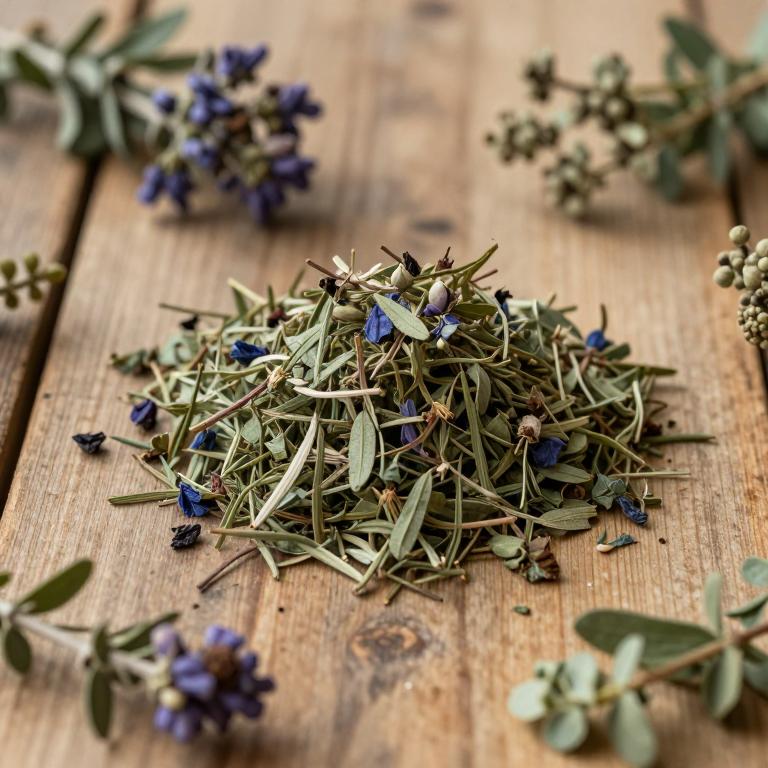
Himalayan indigo, scientifically known as Indigofera heterantha, is a perennial shrub native to the high-altitude regions of the Himalayas. Renowned for its deep blue pigment, this plant holds significant ethnobotanical value. It is traditionally utilized in various medicinal practices for its potent antioxidant and antimicrobial properties in herbal formulations.
Names and Synonyms
Common Names
- Himalayan indigo
- Edgeworth
- Yern
Scientific Names
Accepted name
Indigofera heteranthaSynonyms
- Indigofera gerardiana var. heterantha
- Indigofera himalayensis var. retusa
- Indigofera macrostachya
- Indigofera roylei
- Indigofera rubroviolacea
- Anil macrostachya
Regional and Traditional Names
German:
- Himalaya-Indigostrauch
Sources: Wikidata, Catalogue of Life
Taxonomical Classification
This plant belongs to the kingdom Plantae and the phylum Streptophyta, falling under the class Equisetopsida and subclass Magnoliidae. Within the order Fabales, it is a member of the family Fabaceae. It is specifically classified under the genus Indigofera as the species Indigofera heterantha.
| Rank | Classification |
|---|---|
| Kingdom | Plantae |
| Phylum | Streptophyta |
| Class | Equisetopsida |
| Subclass | Magnoliidae |
| Order | Fabales |
| Family | Fabaceae |
| Genus | Indigofera |
Sources: The World Checklist of Vascular Plants (WCVP)
Distribution
This plant exhibits a diverse geographical distribution across several distinct regions. In Western Asia, it can be found growing within the borders of Afghanistan. Its range extends into China, specifically localized to the Tibet region. Within the Indian Subcontinent, the species is present in Assam and throughout the East Himalaya. Additionally, the plant is commonly distributed across the mountainous terrain of Nepal.
| Region | Area |
|---|---|
| Western Asia | Afghanistan |
| China | Tibet |
| Indian Subcontinent | Assam |
| Indian Subcontinent | East Himalaya |
| Indian Subcontinent | Nepal |
| Indian Subcontinent | Pakistan |
| Indian Subcontinent | West Himalaya |
| Indo-China | Myanmar |
Sources: The World Checklist of Vascular Plants (WCVP)
Botanical Identification
Ecology
The ecology of Indigofera heterantha is characterized by its specific adaptation to montane environments, where it thrives within a distinct altitudinal gradient. This species is primarily distributed across mid-to-high altitude zones, occupying a specialized ecological niche that spans an elevational range from a minimum of 1400 m AMSL to a maximum of 3000 m AMSL. Within this vertical distribution, the plant is subject to varying environmental pressures, including shifts in temperature, atmospheric pressure, and moisture availability associated with increasing elevation. Its ability to persist across this 1600-meter span suggests a level of physiological plasticity that allows it to colonize diverse mountain microhabitats ranging from sub-montane slopes to higher alpine-adjacent terrains.
- Elevational range max:
- 3000 m AMSL
- Elevational range min:
- 1400 m AMSL
Life history
The life history of Indigofera heterantha is characterized by its status as a perennial species, allowing it to persist in its environment over multiple growing seasons. As a perennial, the plant maintains its physiological presence through successive years, which often contributes to its ability to establish stable populations within its specific ecological niche. This long-term life cycle supports a continuous presence in the landscape, enabling the plant to undergo seasonal cycles of vegetative growth and reproductive phases. Through this perennial strategy, the species can endure fluctuations in environmental conditions, leveraging its established root systems and biological structures to sustain itself across extended periods compared to annual or biennial counterparts.
- Lifecycle :
- perennial
Morphology
The morphology of Indigofera heterantha is characterized by a woody growth form, primarily manifesting as a shrub. While it exhibits climbing tendencies, it functions as a self-supporting plant, categorized as a self-supporting liana or vine rather than an obligatory climber. The species is an independent organism, meaning it does not function as a parasite, and it maintains a terrestrial lifestyle rather than being an epiphyte.
- Climber :
- self-supporting
- Epiphyte :
- terrestrial
- Growth form :
- shrub
- Parasite :
- independent
- Woodiness :
- woody
Reproduction
The reproduction of Indigofera heterantha is characterized by a specific seasonal flowering pattern that dictates its reproductive cycle. The flowering period for this species is relatively concentrated, typically commencing in June. Following this onset, the blooming phase continues through the month of July, marking the window during which the plant engages in its reproductive processes.
- Flowering time :
- Jun
- Flowering time :
- Jul
Sources: Global Inventory of Floras and Traits (GIFT)
Activities
Indigofera heterantha has 3 reported activities identified across 0 scientific publications and several other databases. The most consistently reported activities include Anthelmintic, Antibacterial, Antifungal.
| Activity | Supporting sources | Consensus |
|---|---|---|
| Anthelmintic | 1 supporting sources | ★☆☆☆☆ |
| Antibacterial | 1 supporting sources | ★☆☆☆☆ |
| Antifungal | 1 supporting sources | ★☆☆☆☆ |
Anthelmintic
- Journal of pharmaceutical health care and sciences
Antibacterial
- Journal of pharmaceutical health care and sciences
Antifungal
- Journal of pharmaceutical health care and sciences
Conditions
Indigofera heterantha has 6 reported investigations on conditions identified across 0 scientific publications and several other databases. The most consistently reported conditions include Acinetobacter baumannii, Enterobacteriaceae, Enterococcus faecium, Pseudomonas aeruginosa, S. cerevisiae.
| Condition | Supporting sources | Consensus |
|---|---|---|
| Acinetobacter baumannii | 1 supporting sources | ★☆☆☆☆ |
| Enterobacteriaceae | 1 supporting sources | ★☆☆☆☆ |
| Enterococcus faecium | 1 supporting sources | ★☆☆☆☆ |
| Pseudomonas aeruginosa | 1 supporting sources | ★☆☆☆☆ |
| S. cerevisiae | 1 supporting sources | ★☆☆☆☆ |
| Staphylococcus aureus | 1 supporting sources | ★☆☆☆☆ |
Acinetobacter baumannii
- Journal of pharmaceutical health care and sciences
Enterobacteriaceae
- Journal of pharmaceutical health care and sciences
Enterococcus faecium
- Journal of pharmaceutical health care and sciences
Pseudomonas aeruginosa
- Journal of pharmaceutical health care and sciences
S. cerevisiae
- Journal of pharmaceutical health care and sciences
Staphylococcus aureus
- Journal of pharmaceutical health care and sciences