Himalayan star anise
Illicium griffithii · Accepted scientific name
Scientific literature: Very Sparse (5 studies) · ★☆☆☆☆
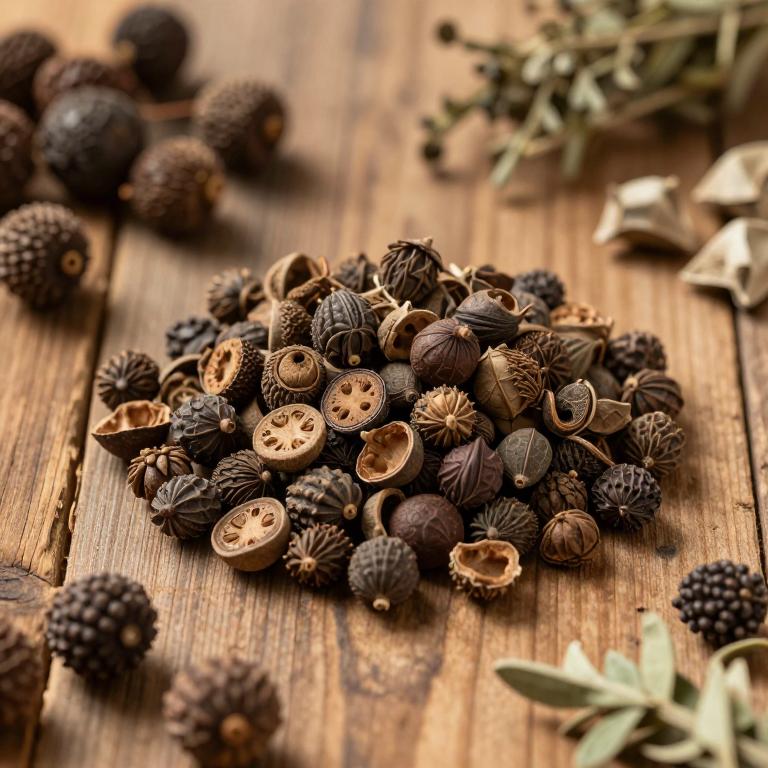
Himalayan star anise, scientifically known as Illicium griffithii, is a remarkable medicinal plant native to the eastern Himalayas. Renowned for its aromatic star-shaped fruit, it contains potent essential oils used in traditional medicine to treat digestive ailments, respiratory issues, and infections, offering a unique blend of fragrance and healing.
- Family
- Schisandraceae
- Native range
- Asia-Tropical
- Parts used
- Fruit
- Common names
- Himalayan Star Anise
- Scientific synonyms
- Badianifera Griffithii
Names and Synonyms
Common Names
- Himalayan star anise
Scientific Names
Accepted name
Illicium griffithiiSynonyms
- Badianifera griffithii
Sources: Wikidata, Catalogue of Life
Taxonomical Classification
This plant belongs to the kingdom Plantae within the phylum Streptophyta and the class Equisetopsida. It is further classified under the subclass Magnoliidae and the order Austrobaileyales. Finally, it resides in the family Schisandraceae and is identified by the genus Illicium.
| Rank | Classification |
|---|---|
| Kingdom | Plantae |
| Phylum | Streptophyta |
| Class | Equisetopsida |
| Subclass | Magnoliidae |
| Order | Austrobaileyales |
| Family | Schisandraceae |
| Genus | Illicium |
Sources: The World Checklist of Vascular Plants (WCVP)
Distribution
This plant is primarily distributed across several key regions within the Asian continent. In the Indian Subcontinent, its presence is noted specifically in Assam and throughout the East Himalaya. Its range extends further into Indo-China, where it can be found in Cambodia and Vietnam. Additionally, the species is located within the Malesia region, specifically in Malaya. These diverse locations highlight the broad ecological footprint of this medicinal species.
| Region | Area |
|---|---|
| Indian Subcontinent | Assam |
| Indian Subcontinent | East Himalaya |
| Indo-China | Cambodia |
| Indo-China | Vietnam |
| Malesia | Malaya |
Sources: The World Checklist of Vascular Plants (WCVP)
Botanical Identification
Ecology
The ecology of Illicium griffithii is defined by its preference for high-altitude montane environments, where it thrives within a specific vertical niche. This species is specialized to inhabit montane forest ecosystems, maintaining a precise elevational range that begins at 1800 m AMSL and extends up to a maximum of 2500 m AMSL. Within this altitudinal belt, the plant is adapted to the cooler temperatures, increased moisture levels, and distinct atmospheric conditions characteristic of high-elevation tropical or subtropical mountain ranges. Its distribution is closely tied to these specific topographical constraints, occupying stable ecological niches that support its growth and medicinal potency.
- Elevational range max:
- 2500 m AMSL
- Elevational range min:
- 1800 m AMSL
Morphology
The morphology of Illicium griffithii is characterized by its distinct growth form and structural habit. It presents as a woody shrub that exhibits a self-supporting climbing habit, functioning as a climber without the strict necessity of external support. In terms of its ecological placement and growth strategy, the plant is strictly terrestrial rather than epiphytic, maintaining its root system within the soil to support its woody, perennial structure.
- Climber :
- self-supporting
- Epiphyte :
- terrestrial
- Growth form :
- shrub
- Woodiness :
- woody
Physiology
The physiology of Illicium griffithii is characterized by a C3 photosynthetic pathway, a mechanism common among many woody angiosperms where carbon fixation occurs through the Calvin cycle within the mesophyll cells. This pathway involves the initial fixation of atmospheric carbon dioxide by the enzyme RuBisCO to form a three-carbon compound, which is a process highly dependent on efficient stomatal conductance and water availability to maintain optimal gas exchange. As a C3 plant, its metabolic efficiency is closely tied to environmental variables such as light intensity, temperature, and moisture levels, as it lacks the specialized concentrating mechanisms found in C4 or CAM species. The plant's energy assimilation is driven by the conversion of light energy into chemical energy through the light-dependent reactions of photosynthesis, subsequently fueling the synthesis of complex organic molecules required for growth, secondary metabolite production, and structural maintenance.
- Photosynthetic pathway :
- C3
Sources: Global Inventory of Floras and Traits (GIFT)
Plant Parts
Illicium griffithii has 1 reported plant parts identified across 1 scientific publications and several other databases that are studied for medicinal purposes. The most consistently reported plant part include fruit.
| Plant part | Supporting sources | Consensus |
|---|---|---|
| Fruit | 1 supporting sources | ★☆☆☆☆ |
Fruit
- Scientific reports
Chemicals
Illicium griffithii has 3 reported phytochemicals identified across 1 scientific publications and several other databases. The most consistently reported chemicals include CATECHIN, Gallic acid, p-Hydroxybenzoic acid.
| Chemical | Supporting sources | Consensus |
|---|---|---|
| CATECHIN | 1 supporting sources | ★☆☆☆☆ |
| Gallic acid | 1 supporting sources | ★☆☆☆☆ |
| p-Hydroxybenzoic acid | 1 supporting sources | ★☆☆☆☆ |
CATECHIN
- Scientific reports
Gallic acid
- Scientific reports
p-Hydroxybenzoic acid
- Scientific reports
Activities
Illicium griffithii has 1 reported activities identified across 1 scientific publications and several other databases. The most consistently reported activities include Anticancer.
| Activity | Supporting sources | Consensus |
|---|---|---|
| Anticancer | 1 supporting sources | ★☆☆☆☆ |
Anticancer
- Turkish journal of chemistry
Preparations
Illicium griffithii has 1 reported preparations identified across 1 scientific publications and several other databases. The most consistently reported preparations include traditional dyeing of clothes and food items.
| Preparation | Supporting sources | Consensus |
|---|---|---|
| Traditional dyeing of clothes and food items | 1 supporting sources | ★☆☆☆☆ |
Traditional dyeing of clothes and food items
- Journal of ethnobiology and ethnomedicine