knobweed
Hyptis capitata · Accepted scientific name
Scientific literature: Moderate (102 studies) · ★★★☆☆
Knobweed, scientifically known as Hyptis capitata, is a versatile medicinal herb native to various tropical regions. Renowned for its distinctive flowering heads, this plant is traditionally utilized in folk medicine to treat skin ailments, inflammation, and digestive issues. Its unique phytochemical profile offers promising potential for modern therapeutic applications.
- Family
- Lamiaceae
- Native range
- Asia-Temperate
- Parts used
- Leaf
- Common names
- Knobweed · False Ironwort
- Scientific synonyms
- Clinopodium Capitatum · Mesosphaerum Capitatum · 10 more
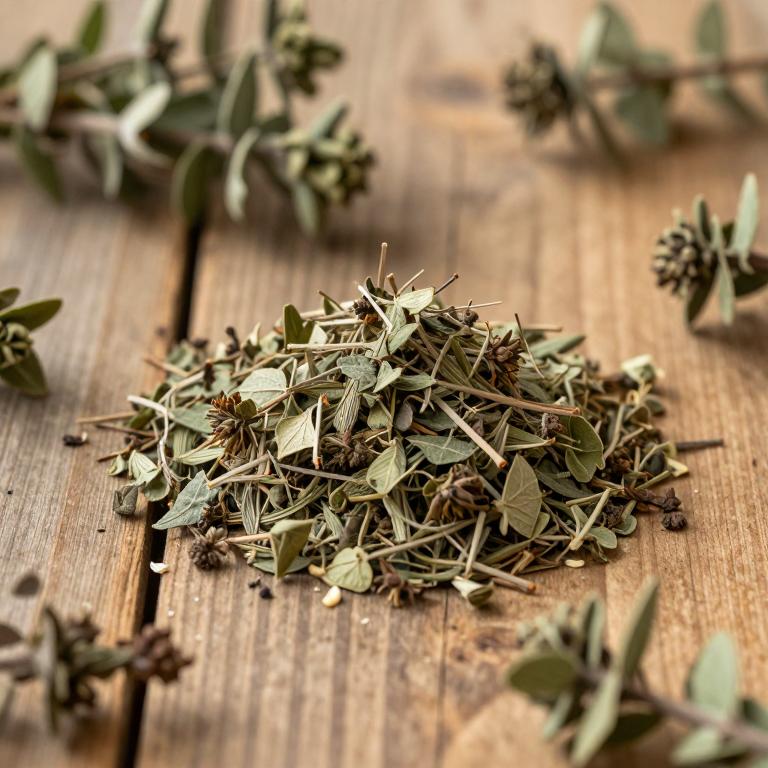
Names and Synonyms
Common Names
- knobweed
- false ironwort
Scientific Names
Accepted name
Hyptis capitataSynonyms
- Clinopodium capitatum
- Mesosphaerum capitatum
- Hyptis mariannarum
- Mesosphaerum rhombodeum
- Hyptis pittieri
- Mesosphaerum pittieri
- Hyptis rhomboidea
- Hyptis decurrens
- Hyptis capitata var. mariannarum
- Hyptis capitata var. mexicana
- Hyptis capitata var. vulgaris
- Pycnanthemum decurrens
Regional and Traditional Names
Spanish:
- Biojo
- Botoncillo
Sources: Wikidata, Catalogue of Life
Taxonomical Classification
This plant belongs to the kingdom Plantae and the phylum Streptophyta, falling under the class Equisetopsida and subclass Magnoliidae. Within the order Lamiales and family Lamiaceae, it is classified under the genus Hyptis. Specifically, this medicinal species is identified by its scientific name, Hyptis capitata.
| Rank | Classification |
|---|---|
| Kingdom | Plantae |
| Phylum | Streptophyta |
| Class | Equisetopsida |
| Subclass | Magnoliidae |
| Order | Lamiales |
| Family | Lamiaceae |
| Genus | Hyptis |
Sources: The World Checklist of Vascular Plants (WCVP)
Distribution
This plant exhibits a diverse geographical range spanning several distinct regions across Asia. In Eastern Asia, its presence is specifically noted within the Nansei-shoto islands. Moving toward the Indian Subcontinent, it can be found in both Assam and Bangladesh. The species also extends into the Indo-China region, encompassing the Andaman Islands. Finally, its distribution reaches into the mainland area of Cambodia.
| Region | Area |
|---|---|
| Eastern Asia | Nansei-shoto |
| Indian Subcontinent | Assam |
| Indian Subcontinent | Bangladesh |
| Indo-China | Andaman Is. |
| Indo-China | Cambodia |
| Indo-China | Nicobar Is. |
| Indo-China | Thailand |
| Indo-China | Vietnam |
| Malesia | Borneo |
| Malesia | Jawa |
Sources: The World Checklist of Vascular Plants (WCVP)
Botanical Identification
Ecology
The ecology of Hyptis capitata is characterized by its ability to thrive across a broad altitudinal gradient, ranging from sea level (0 m AMSL) up to an elevation of 2000 m AMSL. This species demonstrates significant adaptability to diverse environmental conditions, frequently colonizing both natural and modified landscapes. Specifically, it is commonly found in anthropogenic areas (Área Antrópica), where human activity has altered the landscape, as well as in floodplain meadows (Campo de Várzea), suggesting a tolerance for seasonally moist or periodically inundated soil conditions.
- Elevational range max:
- 2000 m AMSL
- Elevational range min:
- 0 m AMSL
- Habitat :
- Área Antrópica, Campo de Várzea
Life history
The life history of Hyptis capitata is characterized by a lifecycle categorized as annual, meaning it completes its entire developmental process from germination to seed production within a single growing season. In terms of its structural growth strategies and survival mechanisms, the species exhibits diverse life form classifications, functioning as a therophyte, which indicates that it survives unfavorable seasons as ephemeral seeds. Additionally, it displays characteristics of a hemicryptophyte, a life form where the perennating buds are located at the soil surface, protected by accumulated leaf litter or organic matter, though its primary seasonal strategy remains driven by its annual developmental cycle.
- Life form :
- hemicryptophyte
- Life form :
- therophyte
- Lifecycle :
- annual
Morphology
The morphology of Hyptis capitata is characterized by its growth form as a non-woody herb or forb. As a terrestrial plant, it grows independently without functioning as a parasite or an epiphyte. The plant exhibits an erect shoot orientation and is strictly self-supporting rather than acting as a climber, vine, or liana. In terms of stature, it reaches a minimum height of 0.5 m, with a mean height of approximately 1 m, and can attain a maximum height of up to 2.5 m.
- Aquatic :
- terrestrial
- Climber :
- self-supporting
- Epiphyte :
- terrestrial
- Growth form :
- herb
- Growth form :
- forb
- Parasite :
- independent
- Plant height max:
- 2.5 m
- Plant height mean:
- 1 m
- Plant height min:
- 0.5 m
- Shoot orientation :
- erect
- Woodiness :
- non-woody
Physiology
The physiology of Hyptis capitata is characterized by specific morphological dimensions and metabolic processes related to nutrient acquisition. The plant's foliar structure exhibits significant variability in size, with leaf lengths ranging from a minimum of 5 cm to a maximum of 12 cm. Correspondingly, the leaf width fluctuates between a minimum of 2 cm and a maximum of 6 cm, reflecting a dynamic growth pattern in its vegetative tissue. In terms of nutrient cycling and metabolic efficiency, the plant does not function as a nitrogen fixer, meaning it lacks the symbiotic relationship with diazotrophic bacteria required to convert atmospheric nitrogen into bioavailable forms, relying instead on the uptake of nitrogen from the surrounding soil medium.
- Leaf length max:
- 12 cm
- Leaf length min:
- 5 cm
- Leaf width max:
- 6 cm
- Leaf width min:
- 2 cm
- Nitrogen fixer :
- no
Reproduction
The reproduction of Hyptis capitata is characterized by its distinct flowering structures and specialized seed traits. The plant produces inflorescences that typically range in length from a minimum of 0.025 m (25 mm) to a maximum of 0.04 m. These inflorescences bear flowers that are specifically characterized by a violet colour. Following pollination, the plant produces small seeds with a length varying between 1 mm and 1.2 mm and a width ranging from 0.7 mm to 0.8 mm. The mass of these seeds is quite minute, with a minimum recorded value of 0.00029 g, a mean mass of 0.0004 g (4e-04 g), and a maximum mass of 0.0005 g (5e-04 g). Regarding the movement of its offspring, the plant exhibits a complex dispersal syndrome that is primarily zoochorous, though it also incorporates anemochorous, autochorous, hydrochorous, and unspecialized mechanisms to ensure its spread.
- Dispersal syndrome :
- zoochorous
- Flower colour :
- violet
- Inflorescence length max:
- 0.04 m
- Inflorescence length min:
- 25 m
- Seed length max:
- 1.2 mm
- Seed length min:
- 1 mm
- Seed mass max:
- 5e-04 g
- Seed mass mean:
- 4e-04 g
- Seed mass min:
- 0.00029 g
- Seed width max:
- 0.8 mm
- Seed width min:
- 0.7 mm
Sources: Global Inventory of Floras and Traits (GIFT)
Plant Parts
Hyptis capitata has 1 reported plant parts identified across 1 scientific publications and several other databases that are studied for medicinal purposes. The most consistently reported plant part include leaf.
| Plant part | Supporting sources | Consensus |
|---|---|---|
| Leaf | 1 supporting sources | ★☆☆☆☆ |
Leaf
- Journal of experimental pharmacology
Chemicals
Hyptis capitata has 14 reported phytochemicals identified across 1 scientific publications and several other databases. The most consistently reported chemicals include Pomolic acid, 1-OCTEN-3-OL, 2alpha-Hydroxyursolic acid, CAMPESTEROL, Germacrene D.
| Chemical | Supporting sources | Consensus |
|---|---|---|
| Pomolic acid | 2 supporting sources | ★☆☆☆☆ |
| 1-OCTEN-3-OL | 1 supporting sources | ★☆☆☆☆ |
| 2alpha-Hydroxyursolic acid | 1 supporting sources | ★☆☆☆☆ |
| CAMPESTEROL | 1 supporting sources | ★☆☆☆☆ |
| Germacrene D | 1 supporting sources | ★☆☆☆☆ |
| Linalool | 1 supporting sources | ★☆☆☆☆ |
| METHYL LINOLEATE | 1 supporting sources | ★☆☆☆☆ |
| OLEANOLIC ACID | 1 supporting sources | ★☆☆☆☆ |
| Tormentic acid | 1 supporting sources | ★☆☆☆☆ |
| Ursolic acid | 1 supporting sources | ★☆☆☆☆ |
Pomolic acid
- Dr. Duke
- Journal of natural products
1-OCTEN-3-OL
- Journal of experimental pharmacology
2alpha-Hydroxyursolic acid
- Dr. Duke
CAMPESTEROL
- Molecules (Basel, Switzerland)
Germacrene D
- Journal of experimental pharmacology
Linalool
- Journal of experimental pharmacology
METHYL LINOLEATE
- Journal of experimental pharmacology
OLEANOLIC ACID
- Journal of natural products
Tormentic acid
- Dr. Duke
Ursolic acid
- Dr. Duke
Activities
Hyptis capitata has 80 reported activities identified across 1 scientific publications and several other databases. The most consistently reported activities include Antioxidant, Analgesic, AntiEBV, AntiHIV, AntiTGF-beta.
| Activity | Supporting sources | Consensus |
|---|---|---|
| Antioxidant | 2 supporting sources | ★☆☆☆☆ |
| Analgesic | 1 supporting sources | ★☆☆☆☆ |
| AntiEBV | 1 supporting sources | ★☆☆☆☆ |
| AntiHIV | 1 supporting sources | ★☆☆☆☆ |
| AntiTGF-beta | 1 supporting sources | ★☆☆☆☆ |
| Antialzheimeran | 1 supporting sources | ★☆☆☆☆ |
| Antiarrhythmic | 1 supporting sources | ★☆☆☆☆ |
| Antiarthritic | 1 supporting sources | ★☆☆☆☆ |
| Antibacterial | 1 supporting sources | ★☆☆☆☆ |
| Anticancer | 1 supporting sources | ★☆☆☆☆ |
Antioxidant
- Dr. Duke
- Journal of experimental pharmacology
Analgesic
- Dr. Duke
AntiEBV
- Dr. Duke
AntiHIV
- Dr. Duke
AntiTGF-beta
- Dr. Duke
Antialzheimeran
- Dr. Duke
Antiarrhythmic
- Dr. Duke
Antiarthritic
- Dr. Duke
Antibacterial
- Dr. Duke
Anticancer
- Dr. Duke
Conditions
Hyptis capitata has 3 reported investigations on conditions identified across 1 scientific publications and several other databases. The most consistently reported conditions include HIV, HIV-1, Malaria.
| Condition | Supporting sources | Consensus |
|---|---|---|
| Hiv | 1 supporting sources | ★☆☆☆☆ |
| Hiv-1 | 1 supporting sources | ★☆☆☆☆ |
| Malaria | 1 supporting sources | ★☆☆☆☆ |
Hiv
- Journal of natural products
Hiv-1
- Journal of natural products
Malaria
- Journal of experimental pharmacology
Preparations
Hyptis capitata has 5 reported preparations identified across 1 scientific publications and several other databases. The most consistently reported preparations include 95% ethanol extract, essential oils, inflorescence oil, leaf oil, whole plant.
| Preparation | Supporting sources | Consensus |
|---|---|---|
| 95% ethanol extract | 1 supporting sources | ★☆☆☆☆ |
| Essential oils | 1 supporting sources | ★☆☆☆☆ |
| Inflorescence oil | 1 supporting sources | ★☆☆☆☆ |
| Leaf oil | 1 supporting sources | ★☆☆☆☆ |
| Whole plant | 1 supporting sources | ★☆☆☆☆ |
95% ethanol extract
- Molecules (Basel, Switzerland)
Essential oils
- Journal of experimental pharmacology
Inflorescence oil
- Journal of experimental pharmacology
Leaf oil
- Journal of experimental pharmacology
Whole plant
- Journal of natural products