Hofariqun
Hypericum · Accepted scientific name
Scientific literature: Very Sparse (38 studies) · ★☆☆☆☆
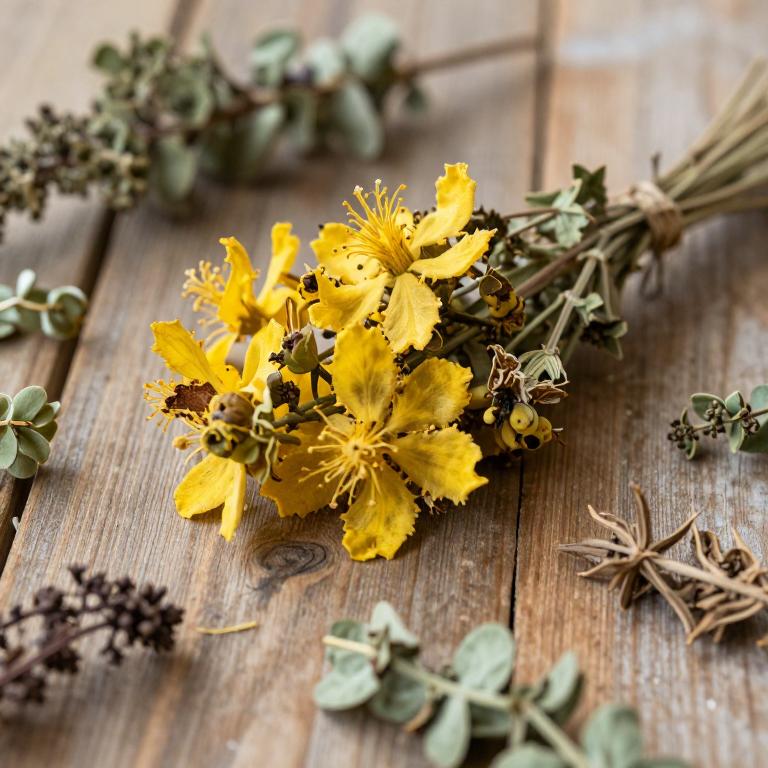
Hofariqun, scientifically known as Hypericum, is a versatile genus of flowering plants renowned for its medicinal properties. Most famous for St. John's Wort, this herb is widely utilized in herbal medicine to support emotional well-being, alleviate mild depression, and promote wound healing through its potent, bioactive phytochemical compounds.
Names and Synonyms
Common Names
- St. John's-wort
- Saint John's Worts
- St. John's-worts
- St. Johnsworts
- St John's-wort
Scientific Names
Accepted name
HypericumSynonyms
- Takasagoya
- Roscyna
- Streptalon
- Tridia
- Brathys
- Spachelodes
- Psorophytum
- Ascyrum
- Campylosporus
- Eremanthe
- Brathydium
- Drosanthe
- Campylopus
- Receveura
- Drosocarpium
- Elodes
- Crookea
- Santomasia
- Sarothra
- Petalanisia
- Pleurenodon
- Tripentas
- Sanidophyllum
- Olympia
- Holosepalum
- Hypericoides
- Eremosporus
- Episiphis
- Androsaemum
- Adenotrias
- Adenosepalum
- Thornea
- Triadenum
- Lianthus
- Komana
- Myriandra
- Knifa
- Norysca
- Pancalum
Regional and Traditional Names
Spanish:
- Ascyrum
- Sanidophyllum
- Androsemum
- Sarothra
- Triadenia
- Androsaemum
- Takasagoya
- Adenotrias
- Lianthus
- Hierbas de San Juan
German:
- Johanniskräuter
- Johanniskraut
- Johanneskraut
- Johanneskräuter
- Hartheu
- Johanneskräuter
- Johanniskräuter
French:
- millepertuis
- Millepertuis
- millepertuis
Sources: Wikidata, Catalogue of Life
Taxonomical Classification
This plant belongs to the kingdom Plantae and is classified under the phylum Streptophyta and the class Equisetopsida. Within the subclass Magnoliidae, it follows the order Malpighiales and is a member of the family Hypericaceae. Finally, it is identified under the genus Hypericum.
| Rank | Classification |
|---|---|
| Kingdom | Plantae |
| Phylum | Streptophyta |
| Class | Equisetopsida |
| Subclass | Magnoliidae |
| Order | Malpighiales |
| Family | Hypericaceae |
| Genus | Hypericum |
Sources: The World Checklist of Vascular Plants (WCVP)
Distribution
This plant exhibits a specific geographical distribution concentrated within the regions of Northern Europe. It can be found growing across the landscapes of Denmark and Finland. Additionally, its presence extends to the islands of Føroyar. The species is also well-documented throughout the territory of Great Britain. Finally, its range reaches into the coastal areas of Ireland.
| Region | Area |
|---|---|
| Northern Europe | Denmark |
| Northern Europe | Finland |
| Northern Europe | Føroyar |
| Northern Europe | Great Britain |
| Northern Europe | Ireland |
| Northern Europe | Norway |
| Northern Europe | Sweden |
| Middle Europe | Austria |
| Middle Europe | Belgium |
| Middle Europe | Czechia-Slovakia |
Sources: The World Checklist of Vascular Plants (WCVP)
Plant Parts
Hypericum has 1 reported plant parts identified across 1 scientific publications and several other databases that are studied for medicinal purposes. The most consistently reported plant part include leaf.
| Plant part | Supporting sources | Consensus |
|---|---|---|
| Leaf | 1 supporting sources | ★☆☆☆☆ |
Leaf
- Phytochemical analysis : PCA
Chemicals
Hypericum has 11 reported phytochemicals identified across 1 scientific publications and several other databases. The most consistently reported chemicals include hypericin, Flavonoids, hyperforin, Amentoflavone, CHLOROGENIC ACID.
| Chemical | Supporting sources | Consensus |
|---|---|---|
| hypericin | 3 supporting sources | ★★☆☆☆ |
| Flavonoids | 2 supporting sources | ★☆☆☆☆ |
| hyperforin | 2 supporting sources | ★☆☆☆☆ |
| Amentoflavone | 1 supporting sources | ★☆☆☆☆ |
| CHLOROGENIC ACID | 1 supporting sources | ★☆☆☆☆ |
| Hypericum Extract | 1 supporting sources | ★☆☆☆☆ |
| Protohypericin | 1 supporting sources | ★☆☆☆☆ |
| Terpenoids | 1 supporting sources | ★☆☆☆☆ |
| XANTHONE | 1 supporting sources | ★☆☆☆☆ |
| pseudohypericin | 1 supporting sources | ★☆☆☆☆ |
hypericin
- Journal of geriatric psychiatry and neurology
- International journal of pharmaceutics
- Chinese journal of natural medicines
Flavonoids
- Journal of ethnopharmacology
- Frontiers in plant science
hyperforin
- Wiener medizinische Wochenschrift (1946)
- Pharmacopsychiatry
Amentoflavone
- Frontiers in plant science
CHLOROGENIC ACID
- Frontiers in plant science
Hypericum Extract
- Journal of geriatric psychiatry and neurology
Protohypericin
- International journal of pharmaceutics
Terpenoids
- Journal of ethnopharmacology
XANTHONE
- The Plant journal : for cell and molecular biology
pseudohypericin
- Journal of geriatric psychiatry and neurology
Activities
Hypericum has 9 reported activities identified across 1 scientific publications and several other databases. The most consistently reported activities include Antiviral, Cytotoxic, Antibacterial, Anticancer, Antidepressant.
| Activity | Supporting sources | Consensus |
|---|---|---|
| Antiviral | 2 supporting sources | ★☆☆☆☆ |
| Cytotoxic | 2 supporting sources | ★☆☆☆☆ |
| Antibacterial | 1 supporting sources | ★☆☆☆☆ |
| Anticancer | 1 supporting sources | ★☆☆☆☆ |
| Antidepressant | 1 supporting sources | ★☆☆☆☆ |
| Antifungal | 1 supporting sources | ★☆☆☆☆ |
| Antimicrobial | 1 supporting sources | ★☆☆☆☆ |
| Antioxidant | 1 supporting sources | ★☆☆☆☆ |
| Antiprotozoal | 1 supporting sources | ★☆☆☆☆ |
Antiviral
- Journal of ethnopharmacology
- Chinese journal of natural medicines
Cytotoxic
- Current medicinal chemistry
- Journal of ethnopharmacology
Antibacterial
- Current medicinal chemistry
Anticancer
- Journal of ethnopharmacology
Antidepressant
- Pharmacopsychiatry
Antifungal
- Journal of ethnopharmacology
Antimicrobial
- Journal of ethnopharmacology
Antioxidant
- Journal of ethnopharmacology
Antiprotozoal
- Molecules (Basel, Switzerland)
Conditions
Hypericum has 9 reported investigations on conditions identified across 1 scientific publications and several other databases. The most consistently reported conditions include antiviral, atopic dermatitis, bruises, hepatitis, injuries.
| Condition | Supporting sources | Consensus |
|---|---|---|
| Antiviral | 1 supporting sources | ★☆☆☆☆ |
| Atopic dermatitis | 1 supporting sources | ★☆☆☆☆ |
| Bruises | 1 supporting sources | ★☆☆☆☆ |
| Hepatitis | 1 supporting sources | ★☆☆☆☆ |
| Injuries | 1 supporting sources | ★☆☆☆☆ |
| Irregular menstruation | 1 supporting sources | ★☆☆☆☆ |
| Malaria | 1 supporting sources | ★☆☆☆☆ |
| Slow wave sleep | 1 supporting sources | ★☆☆☆☆ |
| Wounds | 1 supporting sources | ★☆☆☆☆ |
Antiviral
- Chinese journal of natural medicines
Atopic dermatitis
- American journal of clinical dermatology
Bruises
- Journal of ethnopharmacology
Hepatitis
- Journal of ethnopharmacology
Injuries
- Molecules (Basel, Switzerland)
Irregular menstruation
- Journal of ethnopharmacology
Malaria
- Journal of ethnopharmacology
Slow wave sleep
- Praxis
Wounds
- Journal of ethnopharmacology
Preparations
Hypericum has 43 reported preparations identified across 1 scientific publications and several other databases. The most consistently reported preparations include extracts, hypericum extract, hypericum extracts, Hypericum extract, extract.
| Preparation | Supporting sources | Consensus |
|---|---|---|
| Extracts | 6 supporting sources | ★★★☆☆ |
| Hypericum extract | 6 supporting sources | ★★★☆☆ |
| Hypericum extracts | 6 supporting sources | ★★★☆☆ |
| Hypericum extract | 5 supporting sources | ★★★☆☆ |
| Extract | 3 supporting sources | ★★☆☆☆ |
| Hypericum extracts | 2 supporting sources | ★☆☆☆☆ |
| Blackmore's hyperiforte | 1 supporting sources | ★☆☆☆☆ |
| Co2 hypericum extract (hpco2) | 1 supporting sources | ★☆☆☆☆ |
| Co2 extract | 1 supporting sources | ★☆☆☆☆ |
| Hpco2 | 1 supporting sources | ★☆☆☆☆ |
Extracts
- Psychiatria polska
- Molecules (Basel, Switzerland)
- Pharmacopsychiatry
- Biofizika
- BMJ (Clinical research ed.)
View 1 additional sources
- Pharmaceuticals (Basel, Switzerland)
Hypericum extract
- Journal of geriatric psychiatry and neurology
- Wiener medizinische Wochenschrift (1946)
- Pharmacopsychiatry
- BJOG : an international journal of obstetrics and gynaecology
- Nederlands tijdschrift voor geneeskunde
View 1 additional sources
- Praxis
Hypericum extracts
- Pharmacopsychiatry
- Proceedings of the National Academy of Sciences of the United States of America
- Wiener medizinische Wochenschrift (1946)
- Praxis
- Journal of geriatric psychiatry and neurology
View 1 additional sources
- International journal of clinical pharmacology and therapeutics
Hypericum extract
- Psychopharmacology
- Brain research
- The British journal of dermatology
- International journal of pharmaceutics
- Molecular psychiatry
Extract
- Journal of ethnopharmacology
- Biologia futura
- Photochemistry and photobiology
Hypericum extracts
- The Annals of pharmacotherapy
- Forschende Komplementarmedizin (2006)
Blackmore's hyperiforte
- Behavioural pharmacology
Co2 hypericum extract (hpco2)
- Alcohol and alcoholism (Oxford, Oxfordshire)
Co2 extract
- Pharmacopsychiatry
Hpco2
- Alcohol and alcoholism (Oxford, Oxfordshire)