Wavy St John's-wort
Hypericum undulatum · Accepted scientific name
Scientific literature: Very Sparse (4 studies) · ★☆☆☆☆
Wavy St John's-wort, scientifically known as Hypericum undulatum, is a perennial herb native to East Asia. Distinguished by its characteristic undulating leaf margins, this plant belongs to the Hypericaceae family. It is valued in traditional herbalism and botanical studies for its unique morphological features and diverse phytochemical properties.
- Family
- Hypericaceae
- Native range
- Europe
- Parts used
- Not available
- Common names
- Wavy St John'S-Wort · Wavy St. John'S-Wort
- Scientific synonyms
- Hypericum Acutum Proles Undulatum · Hypericum Tetrapterum Subsp. Undulatum · 8 more
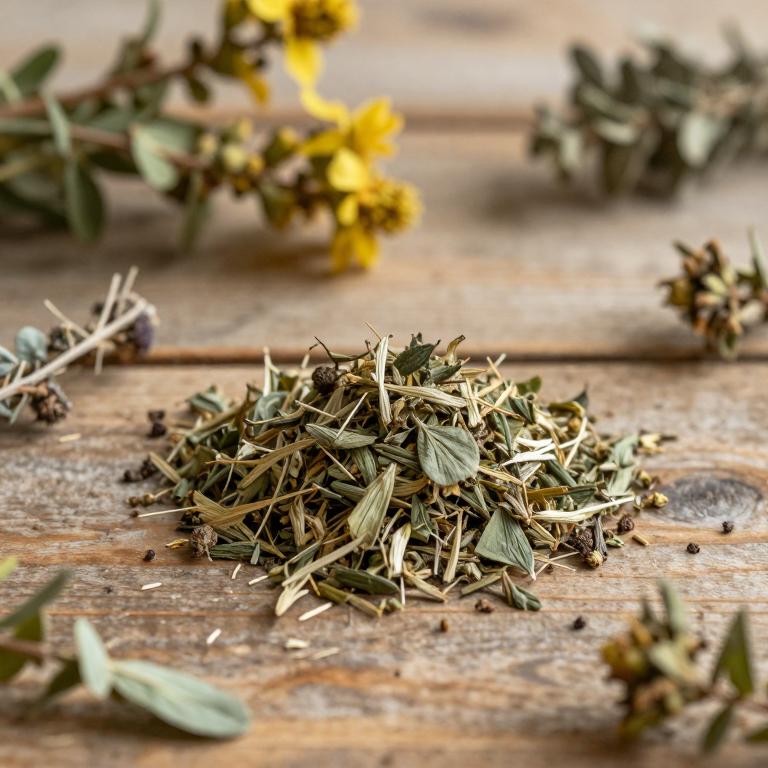
Names and Synonyms
Common Names
- Wavy St John's-wort
- Wavy St. John's-Wort
Scientific Names
Accepted name
Hypericum undulatumSynonyms
- Hypericum acutum proles undulatum
- Hypericum tetrapterum subsp. undulatum
- Hypericum quadrangulum subsp. undulatum
- Hypericum tetrapterum var. undulatum
- Hypericum quadrangulum var. undulatum
- Hypericum quadrangulum f. undulatum
- Hypericum quadrangulum subsp. undulatum
- Hypericum acutum subsp. undulatum
- Hypericum acutum var. undulatum
- Hypericum maculatum subsp. undulatum
Regional and Traditional Names
French:
- Millepertuis ondulé
Sources: Wikidata, Catalogue of Life
Taxonomical Classification
This plant belongs to the kingdom Plantae and the phylum Streptophyta, falling under the class Equisetopsida and subclass Magnoliidae. Within the order Malpighiales, it is classified under the family Hypericaceae. Finally, its specific taxonomic placement is within the genus Hypericum.
| Rank | Classification |
|---|---|
| Kingdom | Plantae |
| Phylum | Streptophyta |
| Class | Equisetopsida |
| Subclass | Magnoliidae |
| Order | Malpighiales |
| Family | Hypericaceae |
| Genus | Hypericum |
Sources: The World Checklist of Vascular Plants (WCVP)
Distribution
This plant exhibits a wide geographical distribution across several distinct regions of the continent. In Northern Europe, its presence can be specifically noted within Great Britain. Moving towards Southwestern Europe, the species is found inhabiting the landscapes of France. It also grows throughout the Iberian Peninsula, covering both Portugal and Spain. Finally, its range extends into Northern Africa, where it is documented in Algeria.
| Region | Area |
|---|---|
| Northern Europe | Great Britain |
| Southwestern Europe | France |
| Southwestern Europe | Portugal |
| Southwestern Europe | Spain |
| Northern Africa | Algeria |
| Northern Africa | Morocco |
| Macaronesia | Azores |
| Macaronesia | Madeira |
Sources: The World Checklist of Vascular Plants (WCVP)
Botanical Identification
Life history
The life history of Hypericum undulatum is characterized by its existence as a perennial plant, meaning it persists through multiple growing seasons. In terms of its structural growth strategy, it is classified as a hemicryptophyte, a life form where the perennating buds are located at the soil surface, often protected by leaf litter or surface debris. This developmental habit allows the species to endure seasonal variations and regenerate its vegetative structures annually from these near-surface buds, ensuring its long-term survival within its ecological niche.
- Life form :
- hemicryptophyte
- Lifecycle :
- perennial
Morphology
The morphology of Hypericum undulatum is characterized by its growth as a non-woody herb, exhibiting a self-supporting habit that does not require external structures for climbing. It functions as an independent organism, lacking any parasitic tendencies. In terms of stature, the plant maintains a relatively low profile with an average height of approximately 0.362 m, though individuals may reach a maximum height of up to 0.5 m.
- Climber :
- self-supporting
- Growth form :
- herb
- Parasite :
- independent
- Plant height max:
- 0.5 m
- Plant height mean:
- 0.362 m
- Woodiness :
- non-woody
Physiology
The physiology of Hypericum undulatum is characterized by its metabolic efficiency and adaptive structural mechanisms, most notably its use of the C3 photosynthetic pathway. As a C3 plant, it fixes atmospheric carbon dioxide directly through the Calvin cycle using the enzyme Rubisco, a process that is highly effective in the temperate and moist environments where the species typically thrives. This metabolic strategy dictates its water-use efficiency and transpiration rates, as the plant relies on open stomata for gas exchange, necessitating a balance between carbon assimilation and moisture retention. Furthermore, its physiological processes include specialized secondary metabolism, involving the synthesis of various bioactive compounds that serve defensive roles against herbivory and environmental stressors. The plant's overall physiological vigor is supported by a robust vascular system and efficient nutrient uptake, which facilitates its growth and the production of its characteristic chemical constituents.
- Photosynthetic pathway :
- C3
Reproduction
The reproduction of Hypericum undulatum is characterized by a sexual process involving bisexual flowers, which facilitate genetic diversity through biotic pollination. The plant relies on an insect-based pollination syndrome, utilizing biological agents to transfer pollen, and notably, self-fertilization is absent, suggesting a dependence on cross-pollination. The reproductive output is prolific, with each fruit containing a high density of seeds, specifically exceeding 1,000 seeds per fruit. These seeds are remarkably small and lightweight, maintaining a consistent seed mass with a mean, minimum, and maximum value of approximately 3.0e-05 g. Once produced, the seeds are distributed via a hydrochorous dispersal syndrome, utilizing water as the primary medium to transport them to new locations for colonization.
- Dispersal syndrome :
- hydrochorous
- Pollination syndrome :
- insect
- Pollination syndrome :
- biotic
- Reproduction sexual :
- bisexual
- Seed mass max:
- 3e-05 g
- Seed mass mean:
- 3.3e-05 g
- Seeds_per_fruit :
- >1000
- Self fertilization :
- absent
Sources: Global Inventory of Floras and Traits (GIFT)
Chemicals
Hypericum undulatum has 3 reported phytochemicals identified across 0 scientific publications and several other databases. The most consistently reported chemicals include Antioxidant Activity, RUTIN, quercetin.
| Chemical | Supporting sources | Consensus |
|---|---|---|
| Antioxidant Activity | 1 supporting sources | ★☆☆☆☆ |
| RUTIN | 1 supporting sources | ★☆☆☆☆ |
| quercetin | 1 supporting sources | ★☆☆☆☆ |
Antioxidant Activity
- Journal of ethnopharmacology
RUTIN
- Food and chemical toxicology : an international journal published for the British Industrial Biological Research Association
quercetin
- Food and chemical toxicology : an international journal published for the British Industrial Biological Research Association
Conditions
Hypericum undulatum has 1 reported investigations on conditions identified across 0 scientific publications and several other databases. The most consistently reported conditions include oxidative DNA damage.
| Condition | Supporting sources | Consensus |
|---|---|---|
| Oxidative dna damage | 1 supporting sources | ★☆☆☆☆ |
Oxidative dna damage
- Food and chemical toxicology : an international journal published for the British Industrial Biological Research Association
Preparations
Hypericum undulatum has 4 reported preparations identified across 0 scientific publications and several other databases. The most consistently reported preparations include Essential oil, decoction, ethanolic extract, water extracts.
| Preparation | Supporting sources | Consensus |
|---|---|---|
| Essential oil | 1 supporting sources | ★☆☆☆☆ |
| Decoction | 1 supporting sources | ★☆☆☆☆ |
| Ethanolic extract | 1 supporting sources | ★☆☆☆☆ |
| Water extracts | 1 supporting sources | ★☆☆☆☆ |
Essential oil
- Journal of ethnopharmacology
Decoction
- Journal of ethnopharmacology
Ethanolic extract
- Journal of ethnopharmacology
Water extracts
- Food and chemical toxicology : an international journal published for the British Industrial Biological Research Association