tangled hypericum
Hypericum triquetrifolium · Accepted scientific name
Scientific literature: Very Sparse (38 studies) · ★☆☆☆☆
Tangled hypericum, scientifically known as Hypericum triquetrifolium, is a charming perennial herb native to the Mediterranean region. Characterized by its distinctive three-angled stems and bright yellow blossoms, this species belongs to the hypericaceous family. It is valued in traditional herbalism for its unique botanical properties and ecological significance.
- Family
- Hypericaceae
- Native range
- Europe
- Parts used
- Not available
- Common names
- Tangled Hypericum · Pyramidal St. John'S Wort · 1 more
- Scientific synonyms
- Hypericum Patentissimum · Hypericum Crispum
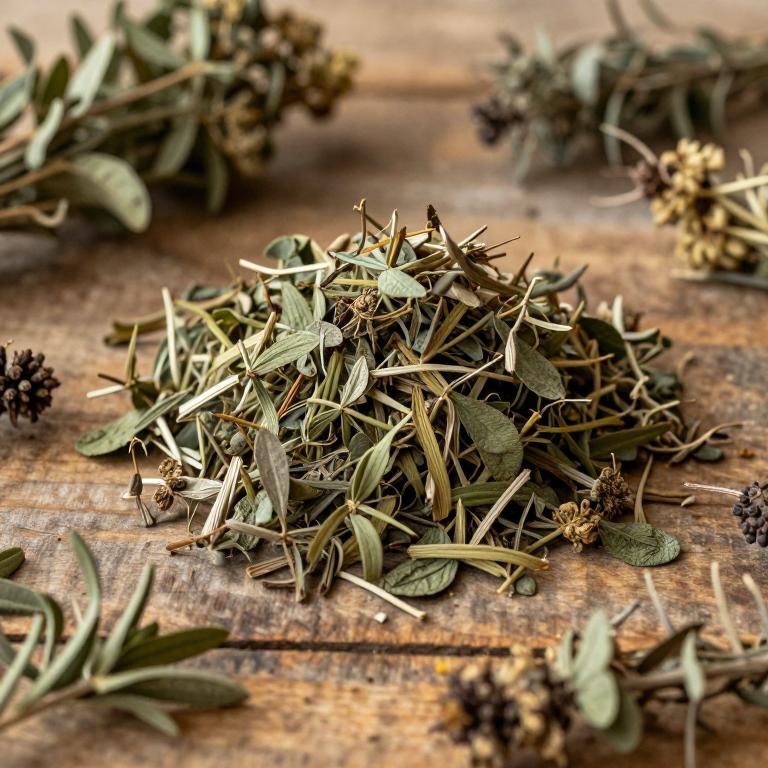
Names and Synonyms
Common Names
- tangled hypericum
- Pyramidal St. John's Wort
- Curled-leaved St. John's-wort
Scientific Names
Accepted name
Hypericum triquetrifoliumSynonyms
- Hypericum patentissimum
- Hypericum crispum
Sources: Wikidata, Catalogue of Life
Taxonomical Classification
This plant belongs to the kingdom Plantae and the phylum Streptophyta, falling under the class Equisetopsida and subclass Magnoliidae. Within the order Malpighiales, it is classified under the family Hypericaceae. Finally, it is identified by its genus, Hypericum.
| Rank | Classification |
|---|---|
| Kingdom | Plantae |
| Phylum | Streptophyta |
| Class | Equisetopsida |
| Subclass | Magnoliidae |
| Order | Malpighiales |
| Family | Hypericaceae |
| Genus | Hypericum |
Sources: The World Checklist of Vascular Plants (WCVP)
Distribution
This plant exhibits a specific distribution pattern focused primarily within the Mediterranean region. In Southwestern Europe, its presence is documented across Spain, France, and the Balearic Islands. Moving eastward, the species is also found throughout parts of Southeastern Europe. Specifically, its range extends into the territories of Albania and Greece. This distribution highlights a preference for the unique climates found along the southern European coastline.
| Region | Area |
|---|---|
| Southwestern Europe | Baleares |
| Southwestern Europe | France |
| Southwestern Europe | Spain |
| Southeastern Europe | Albania |
| Southeastern Europe | Greece |
| Southeastern Europe | Italy |
| Southeastern Europe | Kriti |
| Southeastern Europe | Sicilia |
| Southeastern Europe | Türkiye-in-Europe |
| Southeastern Europe | NW. Balkan Pen. |
Sources: The World Checklist of Vascular Plants (WCVP)
Botanical Identification
Life history
The life history of Hypericum triquetrifolium is characterized by a perennial lifecycle, allowing the plant to persist through multiple growing seasons. In terms of its structural growth strategy, it is classified as a geophyte, indicating that it survives unfavorable periods through underground storage organs. Furthermore, its developmental habit is defined as a cryptophyte, a classification that highlights its ability to protect its regenerative buds beneath the soil surface to endure environmental stressors.
- Life form :
- geophyte
- Life form :
- cryptophyte
- Lifecycle :
- perennial
Morphology
The morphology of Hypericum triquetrifolium is characterized by its growth form as a non-woody herb, specifically categorized as a forb. This plant exhibits a self-supporting habit, functioning as a self-supporting climber rather than an obligatory vine or liana. In terms of its ecological positioning and habitat, it displays a versatile range of moisture preferences, being described as aquatic, semiaquatic, or terrestrial, and it functions as a terrestrial organism rather than an epiphyte. As an independent species, it does not exhibit parasitic behavior. Morphologically, the plant maintains a relatively modest stature, reaching a maximum plant height of 0.5 m.
- Aquatic :
- terrestrial
- Climber :
- self-supporting
- Epiphyte :
- terrestrial
- Growth form :
- herb
- Parasite :
- independent
- Plant height max:
- 0.5 m
- Woodiness :
- non-woody
Reproduction
The reproduction of Hypericum triquetrifolium is characterized by the production of minute seeds that exhibit specific variability in their physical dimensions. The seed mass of this species is notably small, with a recorded mean mass of 0.0008575 g. Within the population, there is a measurable range of seed sizes, with the individual seed mass fluctuating between a minimum value of 0.00055 g and a maximum value of 0.0016 g. This variation in mass suggests a degree of morphological diversity in the reproductive output of the plant.
- Seed mass max:
- 0.0016 g
- Seed mass mean:
- 0.0008575 g
- Seed mass min:
- 0.00055 g
Sources: Global Inventory of Floras and Traits (GIFT)
Chemicals
Hypericum triquetrifolium has 13 reported phytochemicals identified across 0 scientific publications and several other databases. The most consistently reported chemicals include hypericin, (E)-gamma-Bisabolene, ALPHA-PINENE, Bicyclogermacrene, Caryophyllene oxide.
| Chemical | Supporting sources | Consensus |
|---|---|---|
| hypericin | 3 supporting sources | ★★☆☆☆ |
| (E)-gamma-Bisabolene | 1 supporting sources | ★☆☆☆☆ |
| ALPHA-PINENE | 1 supporting sources | ★☆☆☆☆ |
| Bicyclogermacrene | 1 supporting sources | ★☆☆☆☆ |
| Caryophyllene oxide | 1 supporting sources | ★☆☆☆☆ |
| DELTA-CADINENE | 1 supporting sources | ★☆☆☆☆ |
| Eremophilene | 1 supporting sources | ★☆☆☆☆ |
| RUTIN | 1 supporting sources | ★☆☆☆☆ |
| alpha-Humulene | 1 supporting sources | ★☆☆☆☆ |
| cis-Calamenene | 1 supporting sources | ★☆☆☆☆ |
hypericin
- Molecules (Basel, Switzerland)
- Drug design, development and therapy
- Natural product research
(E)-gamma-Bisabolene
- The Italian journal of biochemistry
ALPHA-PINENE
- The Italian journal of biochemistry
Bicyclogermacrene
- The Italian journal of biochemistry
Caryophyllene oxide
- The Italian journal of biochemistry
DELTA-CADINENE
- The Italian journal of biochemistry
Eremophilene
- The Italian journal of biochemistry
RUTIN
- Molecules (Basel, Switzerland)
alpha-Humulene
- The Italian journal of biochemistry
cis-Calamenene
- The Italian journal of biochemistry
Activities
Hypericum triquetrifolium has 5 reported activities identified across 0 scientific publications and several other databases. The most consistently reported activities include Antimicrobial, Anticholinergic, Antidepressant, Antihyperglycemic, Antioxidant.
| Activity | Supporting sources | Consensus |
|---|---|---|
| Antimicrobial | 2 supporting sources | ★☆☆☆☆ |
| Anticholinergic | 1 supporting sources | ★☆☆☆☆ |
| Antidepressant | 1 supporting sources | ★☆☆☆☆ |
| Antihyperglycemic | 1 supporting sources | ★☆☆☆☆ |
| Antioxidant | 1 supporting sources | ★☆☆☆☆ |
Antimicrobial
- Molecules (Basel, Switzerland)
- Turkish journal of pharmaceutical sciences
Anticholinergic
- Molecules (Basel, Switzerland)
Antidepressant
- Drug design, development and therapy
Antihyperglycemic
- Molecules (Basel, Switzerland)
Antioxidant
- Molecules (Basel, Switzerland)
Conditions
Hypericum triquetrifolium has 5 reported investigations on conditions identified across 0 scientific publications and several other databases. The most consistently reported conditions include Bacillus subtilis, Candida albicans, Escherichia coli, Pseudomonas aeruginosa, Staphylococcus aureus.
| Condition | Supporting sources | Consensus |
|---|---|---|
| Bacillus subtilis | 1 supporting sources | ★☆☆☆☆ |
| Candida albicans | 1 supporting sources | ★☆☆☆☆ |
| Escherichia coli | 1 supporting sources | ★☆☆☆☆ |
| Pseudomonas aeruginosa | 1 supporting sources | ★☆☆☆☆ |
| Staphylococcus aureus | 1 supporting sources | ★☆☆☆☆ |
Bacillus subtilis
- Journal of microbiological methods
Candida albicans
- Turkish journal of pharmaceutical sciences
Escherichia coli
- Journal of microbiological methods
Pseudomonas aeruginosa
- Journal of microbiological methods
Staphylococcus aureus
- Journal of microbiological methods
Preparations
Hypericum triquetrifolium has 1 reported preparations identified across 0 scientific publications and several other databases. The most consistently reported preparations include plant extracts.
| Preparation | Supporting sources | Consensus |
|---|---|---|
| Plant extracts | 1 supporting sources | ★☆☆☆☆ |
Plant extracts
- Journal of microbiological methods