four-winged St. John's-wort
Hypericum tetrapterum · Accepted scientific name
Scientific literature: Very Sparse (9 studies) · ★☆☆☆☆
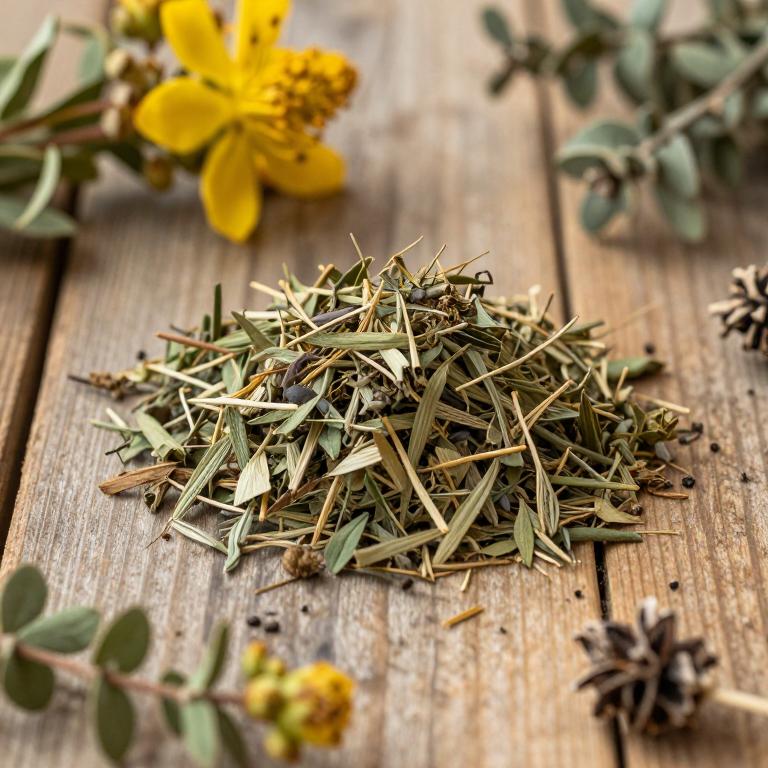
four-winged St. John's-wort, scientifically known as Hypericum tetrapterum, is a distinctive perennial herb native to Europe and Asia. Characterized by its unique four-winged seed capsules, this plant belongs to the Hypericaceae family. Often found in moist habitats, it shares traditional medicinal properties with its well-known relative, Hypericum perforatum.
Names and Synonyms
Common Names
- four-winged St. John's-wort
- square-stalked St. John's-wort
- Square St. John's Wort
- Square-stalked St John's-wort
- St. Peter's-wort
- square-stalk St. John's-wort
- Square Stemmed Saint John's Wort
Scientific Names
Accepted name
Hypericum tetrapterumSynonyms
- Hypericum acutum subsp. tetrapterum
- Hypericum quadrangulum subsp. tetrapterum
- Hypericum quadrangulum var. tetrapterum
Regional and Traditional Names
Spanish:
- Hypericum acutum
- Hypericum acutum subsp. tetrapterum
- Peterwort
- Hypericum quadrangulum
German:
- Geflügeltes Johanniskraut
- Flügel-Johanniskraut
- Flügel-Hartheu
- Flügel-Johanneskraut
- Scharfkantiges Johanniskraut
- geflügeltes Johanniskraut
- Flügel-Johanniskraut
- Vierfluegeliges Johanniskraut
French:
- millepertuis à quatre ailes
- Millepertuis à quatre angles
- millepertuis à quatre ailes
- Millepertuis quadrangule
- Millepertuis à quatre angles
Sources: Wikidata, Catalogue of Life
Taxonomical Classification
This plant belongs to the kingdom Plantae and is classified under the phylum Streptophyta within the class Equisetopsida. Following the subclass Magnoliidae, it is organized under the order Malpighiales and the family Hypericaceae. Finally, it is identified by the genus Hypericum, specifically as the species Hypericum tetrapterum.
| Rank | Classification |
|---|---|
| Kingdom | Plantae |
| Phylum | Streptophyta |
| Class | Equisetopsida |
| Subclass | Magnoliidae |
| Order | Malpighiales |
| Family | Hypericaceae |
| Genus | Hypericum |
Sources: The World Checklist of Vascular Plants (WCVP)
Distribution
This plant exhibits a broad distribution across several regions of the European continent. In Northern Europe, its presence is documented in Denmark, Great Britain, and Ireland. It can also be found further north within the borders of Sweden. Moving toward the center of the continent, the species is present in Middle Europe. Specifically, its range extends into the country of Austria.
| Region | Area |
|---|---|
| Northern Europe | Denmark |
| Northern Europe | Great Britain |
| Northern Europe | Ireland |
| Northern Europe | Sweden |
| Middle Europe | Austria |
| Middle Europe | Belgium |
| Middle Europe | Czechia-Slovakia |
| Middle Europe | Germany |
| Middle Europe | Netherlands |
| Middle Europe | Poland |
Sources: The World Checklist of Vascular Plants (WCVP)
Botanical Identification
Ecology
The ecology of Hypericum tetrapterum is characterized by its ability to colonize a diverse range of environments, demonstrating significant adaptability across varying terrains. It is commonly found inhabiting forested areas and mountainous regions, where it can integrate into the understory or rocky slopes. Furthermore, the species exhibits a notable preference for moist and saturated conditions, frequently occurring in swamps and along shores. This ability to thrive in both high-altitude ecosystems and water-proximate habitats allows it to occupy distinct ecological niches ranging from shaded woodlands to open, damp landscapes.
- Habitat :
- forest, mountains, shores, swamps
Life history
The life history of Hypericum tetrapterum is characterized by its classification as a perennial plant, allowing it to persist through multiple growing seasons. Functioning as a hemicryptophyte, its perennating buds are located at the soil surface, protected by leaf litter or the upper layers of the substrate. This species exhibits an evergreen nature, maintaining its foliage to support continuous physiological processes. Through its hemicryptophytic life form, the plant effectively navigates its environment, utilizing its perennial lifecycle to establish long-term presence in its habitat.
- Deciduousness :
- evergreen
- Life form :
- hemicryptophyte
- Lifecycle :
- perennial
Morphology
The morphology of Hypericum tetrapterum is characterized by its growth form as a non-woody herb, existing as both a herb and a forb. The plant typically exhibits an erect shoot orientation and is a self-supporting species rather than a climber or liana. In terms of its life habit, it is an independent organism that does not function as a parasite or an epiphyte, maintaining a terrestrial existence. The plant's stature varies, with a minimum height of 0.25 m, a maximum height of 1 m, and an average height of approximately 0.454 m.
- Aquatic :
- terrestrial
- Climber :
- self-supporting
- Epiphyte :
- terrestrial
- Growth form :
- herb
- Parasite :
- independent
- Plant height max:
- 1 m
- Plant height mean:
- 0.454 m
- Plant height min:
- 0.25 m
- Shoot orientation :
- erect
- Woodiness :
- non-woody
Physiology
The physiology of Hypericum tetrapterum is characterized by a C3 photosynthetic pathway, which dictates its carbon fixation processes and metabolic efficiency. As a non-carnivorous species, it relies entirely on soil-derived nutrients rather than the capture of prey, and it does not function as a nitrogen fixer, meaning it lacks the biological mechanisms to convert atmospheric nitrogen into usable forms. The plant's vegetative morphology includes leaves with a maximum length of 2.3 cm and a mean leaf size of 2.23 cm², reflecting its structural adaptations for light interception. Furthermore, its physiological efficiency regarding leaf mass per area is indicated by a mean Specific Leaf Area (SLA) of 361 cm²/g, a metric that describes the allocation of biomass to leaf surface area and influences its resource acquisition strategies within its habitat.
- Carnivory :
- non-carnivorous
- Leaf length max:
- 2.3 cm
- Leaf size mean:
- 2.23 cm²
- Nitrogen fixer :
- no
- Photosynthetic pathway :
- C3
- Specific Leaf Area (SLA) mean:
- 361 cm²/g
Reproduction
The reproduction of Hypericum tetrapterum is characterized by a sexual reproductive cycle that lacks any recorded asexual reproduction methods. The flowering period typically commences in July and extends through August. During this time, the plant utilizes biotic pollination syndromes, specifically relying on insects, with bees being a notable pollinator. While the process involves these biotic interactions, self-fertilization is also present, ensuring reproductive success. Following successful pollination, the plant produces fruit in the form of a capsule, which reaches an average length of 0.8 cm. These fruits are dehiscent, meaning they split open at maturity to release the seeds. The seeds themselves are quite small, with a mean mass of 4.6e-05 g, ranging from a minimum of 3e-05 g to a maximum of 1e-04 g. Once released, the seeds are dispersed via an anemochorous syndrome, utilizing wind as the primary mechanism for movement and colonization.
- Dehiscence :
- dehiscent
- Dispersal syndrome :
- anemochorous
- Flowering time :
- Jul
- Flowering time :
- Aug
- Fruit length mean:
- 0.8 cm
- Fruit type :
- capsule
- Pollination syndrome :
- insect
- Pollination syndrome :
- bee
- Pollination syndrome :
- biotic
- Reproduction asexual :
- absent
- Seed mass max:
- 1e-04 g
- Seed mass mean:
- 4.6e-05 g
- Seed mass min:
- 3e-05 g
- Self fertilization :
- present
Sources: Global Inventory of Floras and Traits (GIFT)
Chemicals
Hypericum tetrapterum has 5 reported phytochemicals identified across 0 scientific publications and several other databases. The most consistently reported chemicals include Flavonoids, RUTIN, hyperforin, hypericin, quercetin.
| Chemical | Supporting sources | Consensus |
|---|---|---|
| Flavonoids | 1 supporting sources | ★☆☆☆☆ |
| RUTIN | 1 supporting sources | ★☆☆☆☆ |
| hyperforin | 1 supporting sources | ★☆☆☆☆ |
| hypericin | 1 supporting sources | ★☆☆☆☆ |
| quercetin | 1 supporting sources | ★☆☆☆☆ |
Flavonoids
- Molecules (Basel, Switzerland)
RUTIN
- Molecules (Basel, Switzerland)
hyperforin
- Molecules (Basel, Switzerland)
hypericin
- Molecules (Basel, Switzerland)
quercetin
- Molecules (Basel, Switzerland)
Activities
Hypericum tetrapterum has 4 reported activities identified across 0 scientific publications and several other databases. The most consistently reported activities include Anticholinergic, Antihyperglycemic, Antimicrobial, Antioxidant.
| Activity | Supporting sources | Consensus |
|---|---|---|
| Anticholinergic | 1 supporting sources | ★☆☆☆☆ |
| Antihyperglycemic | 1 supporting sources | ★☆☆☆☆ |
| Antimicrobial | 1 supporting sources | ★☆☆☆☆ |
| Antioxidant | 1 supporting sources | ★☆☆☆☆ |
Anticholinergic
- Molecules (Basel, Switzerland)
Antihyperglycemic
- Molecules (Basel, Switzerland)
Antimicrobial
- Molecules (Basel, Switzerland)
Antioxidant
- Molecules (Basel, Switzerland)