Hypericum scabrum
Hypericum scabrum · Accepted scientific name
Scientific literature: Very Sparse (40 studies) · ★☆☆☆☆
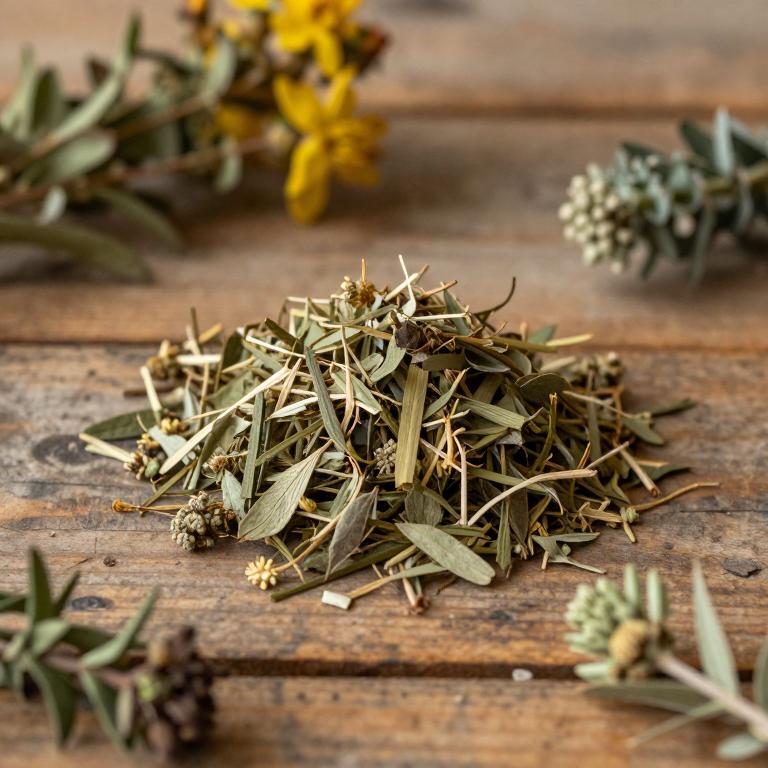
, scientifically known as Hypericum scabrum, is a perennial herb belonging to the Hypericaceae family. Commonly found in rocky, mountainous terrains, this plant is distinguished by its yellow flowers and distinctive leaf structure. While less studied than its relatives, it holds significant potential in traditional and modern medicinal applications.
- Family
- Hypericaceae
- Native range
- Asia-Temperate
- Parts used
- Flower · Root
- Common names
- Not available
- Scientific synonyms
- Hypericum Asperum · Hypericum Scabrum Var. Asperum · 11 more
Names and Synonyms
Scientific Names
Accepted name
Hypericum scabrumSynonyms
- Hypericum asperum
- Hypericum scabrum var. asperum
- Hypericum scabrum var. glabrum
- Hypericum scabrum var. hyssopifolium
- Hypericum scabrum var. laeve
- Hypericum scabrum var. laevicaule
- Hypericum scabrum var. leiocalyx
- Hypericum scabrum var. micranthum
- Hypericum scabrum subsp. sublaeve
- Hypericum cymosum
- Hypericum galiiforme
- Drosanthe scabra
- Drosanthe hyssopifolia
Sources: Wikidata, Catalogue of Life
Taxonomical Classification
This plant, known as Hypericum scabrum, belongs to the kingdom Plantae and the phylum Streptophyta. It is classified under the class Equisetopsida and the subclass Magnoliidae within the order Malpighiales. Finally, it is a member of the family Hypericaceae and the genus Hypericum.
| Rank | Classification |
|---|---|
| Kingdom | Plantae |
| Phylum | Streptophyta |
| Class | Equisetopsida |
| Subclass | Magnoliidae |
| Order | Malpighiales |
| Family | Hypericaceae |
| Genus | Hypericum |
Sources: The World Checklist of Vascular Plants (WCVP)
Distribution
This plant is primarily distributed across the vast landscapes of Central Asia. It can be found growing within the borders of Kazakhstan. Additionally, its natural habitat extends into the territory of Kirgizstan. The species is also documented to exist in Turkmenistan and Tadzhikistan. Finally, its geographical range includes the country of Uzbekistan.
| Region | Area |
|---|---|
| Central Asia | Kazakhstan |
| Central Asia | Kirgizstan |
| Central Asia | Turkmenistan |
| Central Asia | Tadzhikistan |
| Central Asia | Uzbekistan |
| Caucasus | Transcaucasus |
| Western Asia | Afghanistan |
| Western Asia | Iran |
| Western Asia | Iraq |
| Western Asia | Lebanon-Syria |
Sources: The World Checklist of Vascular Plants (WCVP)
Botanical Identification
Ecology
The ecology of Hypericum scabrum is characterized by its ability to thrive in diverse and rugged landscapes, ranging from mountainous terrains to expansive steppes. This species is commonly found inhabiting stony places, shrubberies, and areas near rivers, demonstrating a versatility in its preferred environments. In terms of altitudinal distribution, the plant occupies a significant vertical range, with a mean elevation of 1100 m AMSL and a minimum elevation of 1100 m AMSL. However, its ecological niche extends much higher into montane zones, reaching a maximum elevational limit of 3100 m AMSL.
- Elevational range max:
- 3100 m AMSL
- Elevational range mean:
- 1100 m AMSL
- Habitat :
- mountains, rivers, shrubberies, steppe, stony places
Life history
The life history of Hypericum scabrum is characterized by its status as a perennial plant, meaning it survives through multiple growing seasons rather than completing its cycle in a single year. Architecturally, the species is classified as a hemicryptophyte, a life form in which the perennating buds are located at or just below the soil surface, protected by leaf litter or other organic matter during unfavorable periods. This hemicryptophytic growth habit allows the plant to persist and regrow annually from its base, ensuring long-term survival in its natural habitat.
- Life form :
- hemicryptophyte
- Lifecycle :
- perennial
Morphology
The morphology of Hypericum scabrum is characterized by its growth form as a subshrub or herb, exhibiting a variable degree of woodiness. This species is a self-supporting plant that does not function as a climber or a parasite, maintaining an independent lifestyle. In terms of stature, it is a relatively low-growing species with a plant height that typically ranges from a minimum of 0.17 m to a maximum of 0.4 m, with an average height of approximately 0.3 m. Furthermore, this plant is strictly terrestrial in its habitat preference.
- Aquatic :
- terrestrial
- Climber :
- self-supporting
- Growth form :
- herb
- Growth form :
- subshrub
- Parasite :
- independent
- Plant height max:
- 0.4 m
- Plant height mean:
- 0.3 m
- Plant height min:
- 0.17 m
- Woodiness :
- variable
Reproduction
The reproduction of Hypericum scabrum is characterized by a specific seasonal flowering cycle and the production of small, uniform fruit and seeds. The flowering period typically commences in May and extends through July, though the timing can be variable. Following pollination, the plant develops fruits that exhibit consistent dimensions, with a mean length of 0.5 cm and a mean width of 0.35 cm; notably, the minimum and maximum values for both length (0.5 cm) and width (0.35 cm) align with these averages, indicating a highly standardized fruit size. The resulting seeds are quite minute, possessing a mean mass of 0.000715 g. Individual seed mass varies within a narrow range, with a minimum recorded at 0.00049 g and a maximum reaching 0.00114 g.
- Flowering time :
- May
- Flowering time :
- Jul
- Fruit length max:
- 0.5 cm
- Fruit width max:
- 0.35 cm
- Seed mass max:
- 0.00114 g
- Seed mass mean:
- 0.000715 g
- Seed mass min:
- 0.00049 g
Sources: Global Inventory of Floras and Traits (GIFT)
Plant Parts
Hypericum scabrum has 3 reported plant parts identified across 3 scientific publications and several other databases that are studied for medicinal purposes. The most consistently reported plant part include flower, root, stem.
| Plant part | Supporting sources | Consensus |
|---|---|---|
| Flower | 1 supporting sources | ★☆☆☆☆ |
| Root | 1 supporting sources | ★☆☆☆☆ |
| Stem | 1 supporting sources | ★☆☆☆☆ |
Flower
- AMB Express
Root
- BMC complementary medicine and therapies
Stem
- AMB Express
Chemicals
Hypericum scabrum has 11 reported phytochemicals identified across 3 scientific publications and several other databases. The most consistently reported chemicals include quercetin, (+)-catechin, (-)-Epicatechin, Compound 1, Compound 2.
| Chemical | Supporting sources | Consensus |
|---|---|---|
| quercetin | 2 supporting sources | ★☆☆☆☆ |
| (+)-catechin | 1 supporting sources | ★☆☆☆☆ |
| (-)-Epicatechin | 1 supporting sources | ★☆☆☆☆ |
| Compound 1 | 1 supporting sources | ★☆☆☆☆ |
| Compound 2 | 1 supporting sources | ★☆☆☆☆ |
| Compound 3 | 1 supporting sources | ★☆☆☆☆ |
| Flavonoids | 1 supporting sources | ★☆☆☆☆ |
| Gallic acid | 1 supporting sources | ★☆☆☆☆ |
| Germacrene D | 1 supporting sources | ★☆☆☆☆ |
| TANNIC ACID | 1 supporting sources | ★☆☆☆☆ |
quercetin
- Wounds : a compendium of clinical research and practice
- Molecules (Basel, Switzerland)
(+)-catechin
- Molecules (Basel, Switzerland)
(-)-Epicatechin
- Molecules (Basel, Switzerland)
Compound 1
- Scientific reports
Compound 2
- Scientific reports
Compound 3
- Scientific reports
Flavonoids
- Wounds : a compendium of clinical research and practice
Gallic acid
- Wounds : a compendium of clinical research and practice
Germacrene D
- Pharmaceutical biology
TANNIC ACID
- Wounds : a compendium of clinical research and practice
Activities
Hypericum scabrum has 3 reported activities identified across 3 scientific publications and several other databases. The most consistently reported activities include Antioxidant, Antimicrobial, Antibacterial.
| Activity | Supporting sources | Consensus |
|---|---|---|
| Antioxidant | 3 supporting sources | ★★☆☆☆ |
| Antimicrobial | 2 supporting sources | ★☆☆☆☆ |
| Antibacterial | 1 supporting sources | ★☆☆☆☆ |
Antioxidant
- Wounds : a compendium of clinical research and practice
- Pharmaceutical biology
- Cutaneous and ocular toxicology
Antimicrobial
- Wounds : a compendium of clinical research and practice
- Cutaneous and ocular toxicology
Antibacterial
- Pharmaceutical biology
Conditions
Hypericum scabrum has 16 reported investigations on conditions identified across 3 scientific publications and several other databases. The most consistently reported conditions include Leishmania major, Plasmodium falciparum, burns, cancer, depression.
| Condition | Supporting sources | Consensus |
|---|---|---|
| Leishmania major | 1 supporting sources | ★☆☆☆☆ |
| Plasmodium falciparum | 1 supporting sources | ★☆☆☆☆ |
| Burns | 1 supporting sources | ★☆☆☆☆ |
| Cancer | 1 supporting sources | ★☆☆☆☆ |
| Depression | 1 supporting sources | ★☆☆☆☆ |
| Eczema | 1 supporting sources | ★☆☆☆☆ |
| Gastroenteritis | 1 supporting sources | ★☆☆☆☆ |
| Hysteria | 1 supporting sources | ★☆☆☆☆ |
| Leishmaniasis | 1 supporting sources | ★☆☆☆☆ |
| Neuralgia | 1 supporting sources | ★☆☆☆☆ |
Leishmania major
- AMB Express
Plasmodium falciparum
- Scientific reports
Burns
- Pharmaceutical biology
Cancer
- Iranian Red Crescent medical journal
Depression
- Pharmaceutical biology
Eczema
- Pharmaceutical biology
Gastroenteritis
- Pharmaceutical biology
Hysteria
- Pharmaceutical biology
Leishmaniasis
- AMB Express
Neuralgia
- Pharmaceutical biology
Preparations
Hypericum scabrum has 6 reported preparations identified across 3 scientific publications and several other databases. The most consistently reported preparations include extract, hydroalcoholic extract, hydroalcoholic extract of the flower and stem, hydromethanolic extracts, n-hexane extract of the air-dried aerial parts.
| Preparation | Supporting sources | Consensus |
|---|---|---|
| Extract | 1 supporting sources | ★☆☆☆☆ |
| Hydroalcoholic extract | 1 supporting sources | ★☆☆☆☆ |
| Hydroalcoholic extract of the flower and stem | 1 supporting sources | ★☆☆☆☆ |
| Hydromethanolic extracts | 1 supporting sources | ★☆☆☆☆ |
| N-hexane extract of the air-dried aerial parts | 1 supporting sources | ★☆☆☆☆ |
| Root extracts | 1 supporting sources | ★☆☆☆☆ |
Extract
- Cutaneous and ocular toxicology
Hydroalcoholic extract
- AMB Express
Hydroalcoholic extract of the flower and stem
- AMB Express
Hydromethanolic extracts
- Wounds : a compendium of clinical research and practice
N-hexane extract of the air-dried aerial parts
- Scientific reports
Root extracts
- BMC complementary medicine and therapies