Large-Leaved Currybush
Hypericum roeperianum · Accepted scientific name
Scientific literature: Very Sparse (27 studies) · ★☆☆☆☆
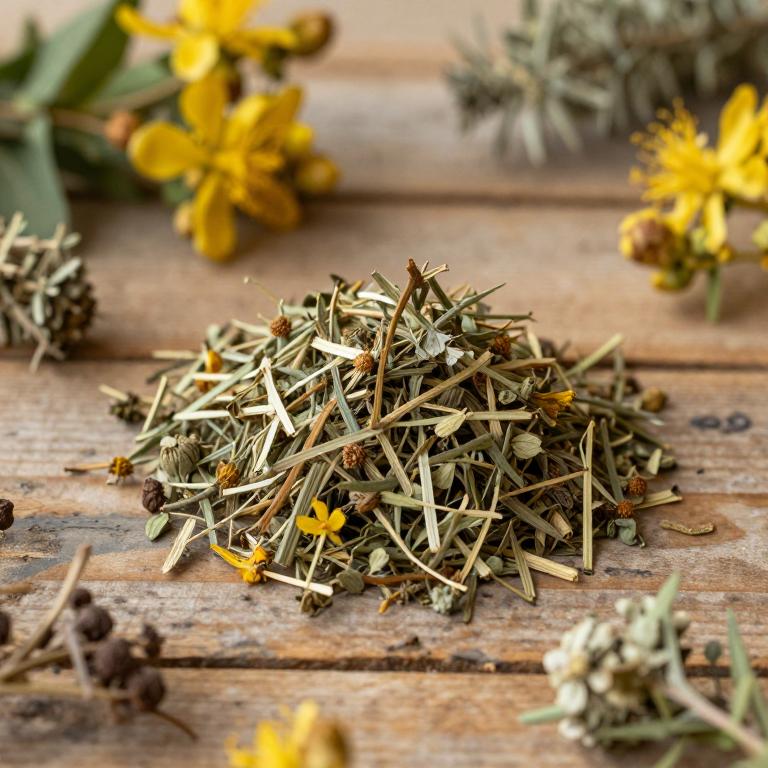
Large-Leaved Currybush, scientifically known as Hypericum roeperianum, is a striking perennial shrub celebrated for its lush foliage and vibrant blossoms. Often utilized in traditional medicine, this plant possesses unique therapeutic properties. Understanding its botanical characteristics and medicinal potential offers valuable insights into the diverse healing power of nature.
Names and Synonyms
Common Names
- Large-Leaved Currybush
- Large-Leaved Hypericum
- Large-Leaves St John's Wort
Scientific Names
Accepted name
Hypericum roeperianumSynonyms
- Hypericum conrauanum
- Hypericum riparium
- Hypericum roeperianum var. schimperi
- Hypericum schimperi
- Hypericum schimperi var. angustisepalum
- Hypericum schimperi var. huillense
- Hypericum quartinianum subsp. roeperianum
Sources: Wikidata, Catalogue of Life
Taxonomical Classification
This plant, Hypericum roeperianum, belongs to the kingdom Plantae within the phylum Streptophyta. It is classified under the class Equisetopsida and subclass Magnoliidae, falling into the order Malpighiales. Finally, it is a member of the family Hypericaceae and is situated within the genus Hypericum.
| Rank | Classification |
|---|---|
| Kingdom | Plantae |
| Phylum | Streptophyta |
| Class | Equisetopsida |
| Subclass | Magnoliidae |
| Order | Malpighiales |
| Family | Hypericaceae |
| Genus | Hypericum |
Sources: The World Checklist of Vascular Plants (WCVP)
Distribution
This plant exhibits a diverse range of habitats across the tropical regions of the African continent. In West Tropical Africa, its presence is documented in both Guinea and Nigeria. Moving into West-Central Tropical Africa, the species can be found extending through Cameroon and into the Democratic Republic of the Congo. Furthermore, its distribution reaches into Northeast Tropical Africa, specifically within the borders of Ethiopia. Together, these locations highlight a broad geographical footprint spanning multiple African subregions.
| Region | Area |
|---|---|
| West Tropical Africa | Guinea |
| West Tropical Africa | Nigeria |
| West-Central Tropical Africa | Cameroon |
| West-Central Tropical Africa | DR Congo |
| Northeast Tropical Africa | Ethiopia |
| Northeast Tropical Africa | Sudan-South Sudan |
| East Tropical Africa | Kenya |
| East Tropical Africa | Tanzania |
| East Tropical Africa | Uganda |
| South Tropical Africa | Angola |
Sources: The World Checklist of Vascular Plants (WCVP)
Botanical Identification
Ecology
The ecology of Hypericum roeperianum is defined by its specific niche within montane environments, where it thrives across a defined altitudinal gradient. This species is primarily found at moderate elevations, occupying a vertical range that begins at 700 m AMSL and extends to a maximum of 915 m AMSL. Within this specific elevational bracket, the plant adapts to the unique microclimates, soil compositions, and moisture regimes characteristic of these mid-altitude habitats. Its distribution is closely tied to these topographic constraints, which dictate the environmental variables necessary for its survival and growth within its native range.
- Elevational range max:
- 915 m AMSL
- Elevational range min:
- 700 m AMSL
Life history
The life history of Hypericum roeperianum is characterized by its status as a perennial species, meaning it persists through multiple growing seasons rather than completing its cycle in a single year. As a perennial, the plant undergoes distinct seasonal phases, establishing a robust root system that allows it to survive dormant periods and regrow annually. This long-term survival strategy enables the plant to invest energy into complex developmental stages, including vegetative growth and repeated reproductive cycles, which can vary in intensity depending on environmental stability and resource availability. Over its lifespan, the plant maintains a continuous presence in its habitat, contributing to the long-term stability of its ecological niche through sustained biomass and periodic flowering events.
- Lifecycle :
- perennial
Morphology
The morphology of Hypericum roeperianum is characterized by a woody, shrub-like growth form that functions as a self-supporting structure rather than a climber. This plant exhibits a significant size range, with a minimum plant height of 1.22 m and a maximum height reaching up to 5 m. In terms of its ecological habit, it is categorized as a terrestrial species, functioning as an independent organism without parasitic tendencies, and it is not an epiphyte. While its habitat preferences can span a gradient from terrestrial to semiaquatic environments, its physical structure remains a robust, woody shrub.
- Aquatic :
- terrestrial
- Climber :
- self-supporting
- Epiphyte :
- terrestrial
- Growth form :
- shrub
- Parasite :
- independent
- Plant height max:
- 5 m
- Plant height min:
- 1.22 m
- Woodiness :
- woody
Reproduction
The reproduction of Hypericum roeperianum is characterized by the production of seeds that exhibit highly consistent physical dimensions. Based on botanical data, the seed mass for this species is uniform, with a mean mass of 5e-05 g. This consistency is reflected in the lack of variance across the recorded measurements, as both the maximum and minimum seed mass values are also documented at 5e-05 g. Such precise and lightweight seed characteristics are essential to the plant's dispersal and germination strategies within its natural habitat.
- Seed mass mean:
- 5e-05 g
Sources: Global Inventory of Floras and Traits (GIFT)
Plant Parts
Hypericum roeperianum has 2 reported plant parts identified across 2 scientific publications and several other databases that are studied for medicinal purposes. The most consistently reported plant part include leaf, stem.
| Plant part | Supporting sources | Consensus |
|---|---|---|
| Leaf | 1 supporting sources | ★☆☆☆☆ |
| Stem | 1 supporting sources | ★☆☆☆☆ |
Leaf
- Fitoterapia
Stem
- Natural product research
Chemicals
Hypericum roeperianum has 15 reported phytochemicals identified across 2 scientific publications and several other databases. The most consistently reported chemicals include 1-Hexadecanol, 1-OCTADECANOL, 2'-Methoxyflavone, 3'-Methoxy-flavone, CAMPESTEROL.
| Chemical | Supporting sources | Consensus |
|---|---|---|
| 1-Hexadecanol | 1 supporting sources | ★☆☆☆☆ |
| 1-OCTADECANOL | 1 supporting sources | ★☆☆☆☆ |
| 2'-Methoxyflavone | 1 supporting sources | ★☆☆☆☆ |
| 3'-Methoxy-flavone | 1 supporting sources | ★☆☆☆☆ |
| CAMPESTEROL | 1 supporting sources | ★☆☆☆☆ |
| Hexadecanoic acid | 1 supporting sources | ★☆☆☆☆ |
| Octadecanoic acid | 1 supporting sources | ★☆☆☆☆ |
| STIGMASTANOL | 1 supporting sources | ★☆☆☆☆ |
| STIGMASTEROL | 1 supporting sources | ★☆☆☆☆ |
| Stigmast-4-en-3-one | 1 supporting sources | ★☆☆☆☆ |
1-Hexadecanol
- Phytochemistry
1-OCTADECANOL
- Phytochemistry
2'-Methoxyflavone
- Phytochemistry
3'-Methoxy-flavone
- Phytochemistry
CAMPESTEROL
- Phytochemistry
Hexadecanoic acid
- Phytochemistry
Octadecanoic acid
- Phytochemistry
STIGMASTANOL
- Phytochemistry
STIGMASTEROL
- Phytochemistry
Stigmast-4-en-3-one
- Phytochemistry
Activities
Hypericum roeperianum has 2 reported activities identified across 2 scientific publications and several other databases. The most consistently reported activities include Antimicrobial, Cytotoxic.
| Activity | Supporting sources | Consensus |
|---|---|---|
| Antimicrobial | 1 supporting sources | ★☆☆☆☆ |
| Cytotoxic | 1 supporting sources | ★☆☆☆☆ |
Antimicrobial
- Fitoterapia
Cytotoxic
- Fitoterapia
Conditions
Hypericum roeperianum has 7 reported investigations on conditions identified across 2 scientific publications and several other databases. The most consistently reported conditions include HIV, HIV-1, anthrax, breast cancer, cancer.
| Condition | Supporting sources | Consensus |
|---|---|---|
| Hiv | 1 supporting sources | ★☆☆☆☆ |
| Hiv-1 | 1 supporting sources | ★☆☆☆☆ |
| Anthrax | 1 supporting sources | ★☆☆☆☆ |
| Breast cancer | 1 supporting sources | ★☆☆☆☆ |
| Cancer | 1 supporting sources | ★☆☆☆☆ |
| Female sterility | 1 supporting sources | ★☆☆☆☆ |
| Fungal infections | 1 supporting sources | ★☆☆☆☆ |
Hiv
- Natural product research
Hiv-1
- Natural product research
Anthrax
- BMC complementary and alternative medicine
Breast cancer
- Journal of ethnopharmacology
Cancer
- Journal of ethnopharmacology
Female sterility
- Journal of ethnopharmacology
Fungal infections
- Journal of ethnopharmacology
Preparations
Hypericum roeperianum has 5 reported preparations identified across 2 scientific publications and several other databases. The most consistently reported preparations include Hypericum riparium leaves extract, bark extract, crude acetone extracts, extracts, stem bark.
| Preparation | Supporting sources | Consensus |
|---|---|---|
| Hypericum riparium leaves extract | 1 supporting sources | ★☆☆☆☆ |
| Bark extract | 1 supporting sources | ★☆☆☆☆ |
| Crude acetone extracts | 1 supporting sources | ★☆☆☆☆ |
| Extracts | 1 supporting sources | ★☆☆☆☆ |
| Stem bark | 1 supporting sources | ★☆☆☆☆ |
Hypericum riparium leaves extract
- Fitoterapia
Bark extract
- Journal of ethnopharmacology
Crude acetone extracts
- BMC complementary and alternative medicine
Extracts
- BMC complementary and alternative medicine
Stem bark
- Natural product research